
Average Settlement for a Car Accident in Connecticut: What Your Case May Actually Be Worth
The average bodily injury claim from a car accident in the United States pays out approximately $28,278. That number comes from the Insurance Information Institute’s most recent industry data. It is one of the least useful figures you will encounter while researching your situation — because it blends minor fender-benders with life-altering catastrophic injuries, every state’s laws, and every possible insurance scenario into a single misleading statistic.
What actually determines the value of a car accident settlement is not a national average. It is the specific combination of your injuries, your expenses, and the insurance that is available to pay. And in car accident cases specifically, that last variable — available insurance — is where most people’s expectations collide with reality.
How Do Insurance Policy Limits Affect Your Settlement?
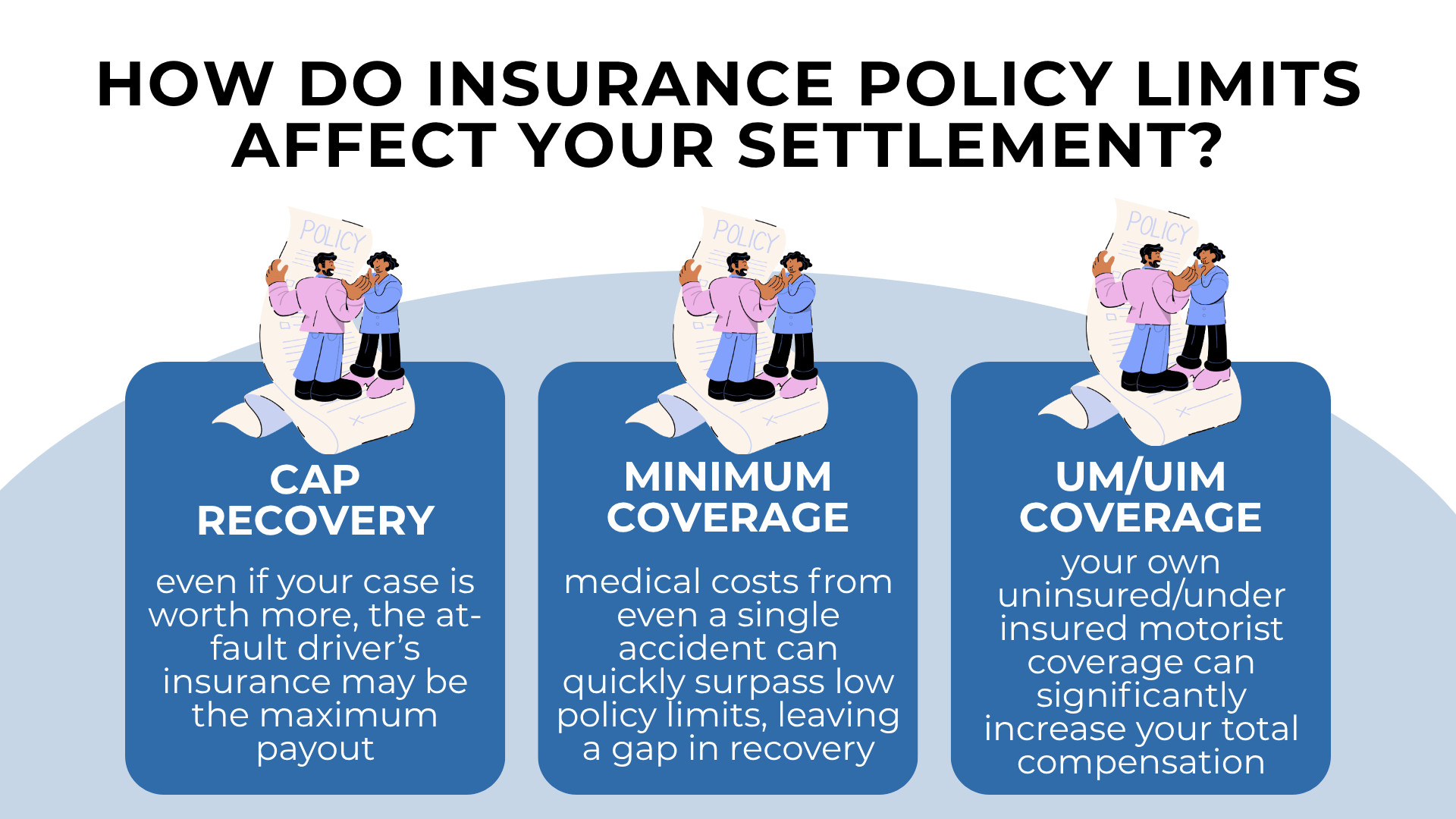
There is an important difference between what a case is worth and what can actually be collected. Insurance policy limits often act as the practical cap on recovery, and in Connecticut, those limits can be surprisingly low.
Connecticut’s mandatory minimum liability insurance is $25,000 per person for bodily injury, $50,000 per accident, and $25,000 for property damage under Conn. Gen. Stat. § 14-112. Many drivers carry only these minimums. To put that in context, 33,975 emergency department visits and 942 hospital admissions resulted from motor vehicle crashes in Connecticut in a single year. A single ER visit followed by imaging, stabilization, and a short admission can easily exceed $25,000 before any surgery, rehabilitation, or follow-up care enters the picture. When the at-fault driver carries minimum coverage, a $25,000 policy limit may be all that is available from their insurer. That remains true even if the injuries justify a claim five or ten times that amount.
This is where uninsured and underinsured motorist coverage becomes critical. Under Conn. Gen. Stat. § 38a-336, every automobile liability insurance policy issued in Connecticut must provide UM/UIM coverage. If the at-fault driver has no insurance or not enough insurance to cover your damages, your own UM/UIM policy fills the gap up to your coverage limits. Connecticut law also requires insurers to offer underinsured motorist conversion coverage under Conn. Gen. Stat. § 38a-336a. Under conversion coverage, the at-fault driver’s liability payment does not reduce your UIM benefits. You can collect from both, which can increase your total recovery. Whether you have standard UIM coverage or conversion coverage, and at what limits, can be the difference between recovering $25,000 and recovering several times that amount from the same accident.
An estimated 11.8% of Connecticut drivers are uninsured, according to Insurance Research Council data. Even among insured drivers, many carry only the state minimum. Understanding the insurance picture surrounding your accident — the at-fault driver’s policy, your own UM/UIM coverage, and whether conversion coverage applies — is often just as important as understanding the injuries themselves.
How Do You Know If You Need a Lawyer for Your Car Accident Claim?
Not every car accident requires an attorney. A minor collision with no injuries and a straightforward insurance payout may resolve on its own without difficulty. But several signals suggest that handling a claim without a lawyer puts real money at risk.
If your injuries required more than a single doctor’s visit — if you are looking at imaging, physical therapy, surgery, or ongoing treatment — the complexity of documenting and valuing your claim increases significantly. If the at-fault driver was underinsured or uninsured, handling the UM/UIM claim process under your own policy involves different rules. It often leads to arbitration under Conn. Gen. Stat. § 38a-336(c). And if the insurance company’s offer does not account for the full cost of your treatment, lost income, and the impact of the injury on your life, that gap between what is offered and what your claim supports is exactly where having a lawyer changes outcomes.
At Etemi Law in Waterbury, Connecticut, case evaluations are free and carry no obligation. Ron Etemi, Lou Etemi, Semir Dervisi, and Peter Brown have collectively spent decades handling motor vehicle accident cases across Connecticut — from negotiation through trial. If you are trying to figure out whether your situation justifies professional help, a conversation costs nothing and gives you a concrete basis for deciding what to do next.
