
Bike Lane Accident Connecticut: Who’s Liable When a Cyclist Is Hit in a Bike Lane?
Estimated reading time: 8 minutes
Key Takeaways
- What counts as a bike lane crash under Connecticut law and why markings matter.
- How liability is decided — negligence, causation, and damages determine who pays.
- Comparative negligence in CT can reduce or bar recovery depending on percentages.
- Evidence is decisive: photos, video, police reports, and witnesses often make or break a claim.
- Immediate steps—call 911, document the scene, and seek medical care—protect health and legal options.
Table of contents
- What Is a “Bike Lane Accident” in Connecticut?
- How Fault Is Decided in Connecticut: Negligence Basics
- Key Factors That Determine Liability
- Comparative Negligence in Connecticut
- What Evidence Proves Fault
- What to Do Immediately After a Crash
- When to Speak With a Connecticut Personal Injury Lawyer
- Frequently Asked Questions
What Is a “Bike Lane Accident” in Connecticut?
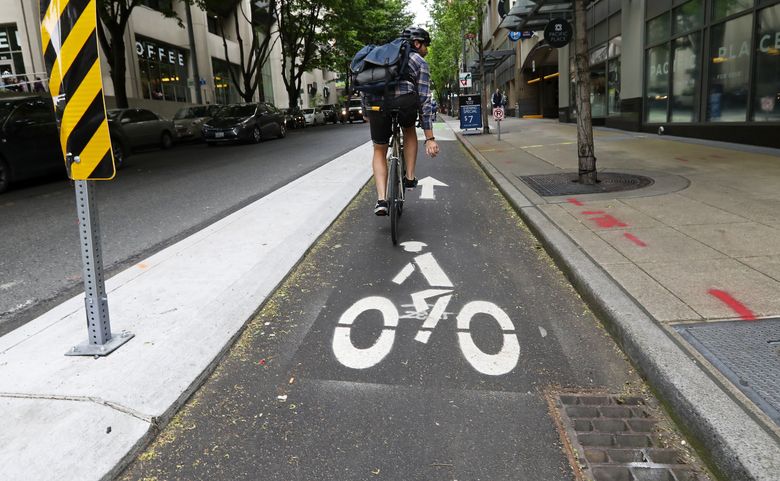
A bike lane is a designated portion of the roadway marked for bicycle travel — painted lines, bicycle symbols, or both.
Some bike lanes run alongside parked cars; others sit between traffic lanes and the curb.
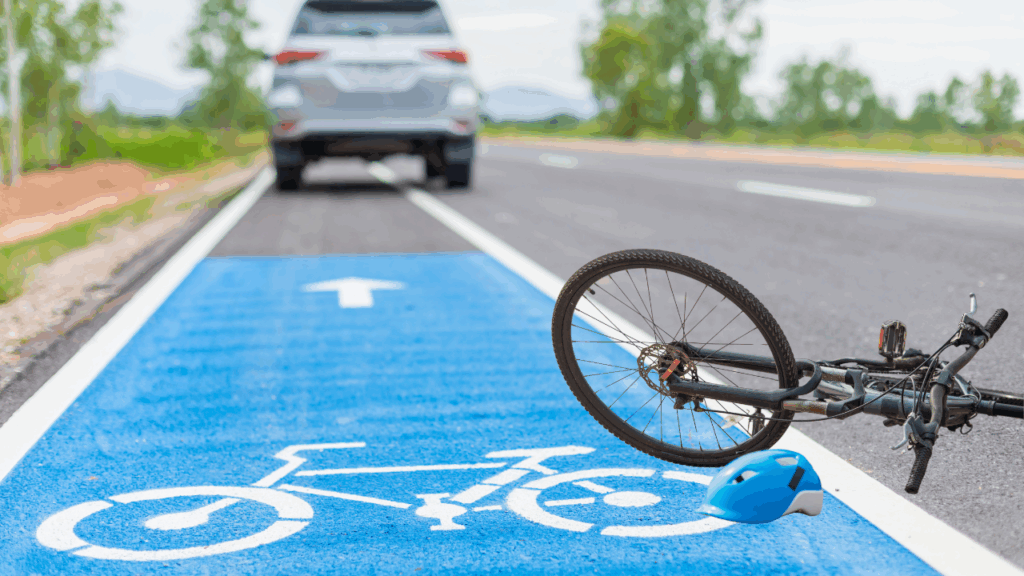
A bike lane accident occurs when a cyclist traveling in, entering, or exiting a marked bike lane is involved in a collision or incident that causes injury or property damage.
That collision may involve a motor vehicle, a pedestrian, an opened car door, or a road hazard.
Why these crashes are unique:
- Narrow space. Bike lanes are often only a few feet wide, limiting maneuvering room.
- Turning conflicts. Vehicles crossing the lane to turn create constant risks.
- The door zone. When a bike lane borders parked cars, riders face sudden door openings.
- Speed differential. Cyclists typically travel much slower than adjacent traffic, increasing impact risk.
- Visibility issues. Drivers often fail to check for cyclists before turning or merging.
Common Bike Lane Crash Scenarios in Connecticut
Understanding typical crash patterns helps explain how fault gets assigned:
- Right-hook: A driver turns right across the bike lane, cutting off a cyclist going straight.
- Left-turn conflict: A vehicle turning left crosses into a bike lane and strikes an oncoming rider.
- Dooring: A parked occupant opens a door into the path of a cyclist.
- Sideswipe: A distracted or drifting driver enters the bike lane and hits a cyclist.
- Merge or block: A driver pulls into the bike lane to stop or wait, forcing the cyclist to swerve.
Fault depends on precise facts: the crash location, markings, signals used, speeds, and what each party could reasonably see.
How Fault Is Decided in Connecticut: Negligence Basics
Connecticut follows a fault-based approach. The party who acted negligently can be held financially responsible for harm caused.
For a cyclist-focused overview of CT fault and bike-crash claims, see this guide to bicycle accident rights in Connecticut.
“Negligence means failing to use reasonable care.”
Negligence in road cases generally requires showing:
- Duty: Road users owe a duty of reasonable care to others.
- Breach: Someone violated that duty (unsafe turn, failure to yield, distracted driving).
- Causation: The breach directly caused the collision.
- Damages: The collision produced real losses—medical bills, lost wages, pain, or property damage.
Insurance adjusters, attorneys, and juries weigh the available proof to determine which party’s conduct was negligent.
Key Factors That Determine Liability in a Connecticut Bike Lane Crash
Right-of-Way and Turning Rules
When a driver turns across a bike lane, they must yield to through traffic — including cyclists lawfully in the lane.
Indicators of driver fault include failing to check mirrors or blind spots, cutting the lane at the last moment, or not signaling.
Rule of thumb: A cyclist traveling straight in a marked bike lane typically has the right-of-way over a vehicle crossing that lane to turn.
Traffic Control Devices
Lights, stop signs, and lane markings matter. Whoever violates these controls is more likely to be at fault.
If a cyclist runs a red light, they may share fault; if a driver runs a stop sign and crosses a bike lane, fault likely lies with the driver.
Visibility and Lookout
Drivers have a duty to maintain a proper lookout for foreseeable users, including cyclists in marked lanes.
Factors include lighting, weather, obstructions, and time of day. A driver’s claim of “I didn’t see them” may fail if a reasonable driver should have.
Speed, Impairment, and Distraction
Speeding or impairment often shifts fault heavily to the driver. Phone use, drowsiness, or intoxication are decisive factors.
Likewise, a cyclist riding dangerously fast in a complex area can bear more fault.
Lane Positioning and Predictability
Cyclists must ride predictably. Sudden swerves out of the bike lane without signaling can increase their share of fault. Staying within the lane and signaling supports a cyclist’s claim.
Dooring and Parked Vehicle Issues
Opening a door into an active bike lane is typically negligent.
For a closely related discussion of dooring liability—especially when rideshare vehicles are involved—see this piece on rideshare and crosswalk liability.
Comparative Negligence in Connecticut: What Happens When Fault Is Shared
Connecticut uses a modified comparative negligence rule with a 51% bar:
– You can recover if you are 50% or less at fault.
– Your recovery is reduced by your percentage of fault.
– If you are 51% or more at fault, you usually cannot recover.
For a deeper dive into Connecticut’s 51% rule and insurance context, see this explanation of CT insurance rules.
Bike Lane Examples of Shared Fault
Example A: Driver turns without checking; cyclist lacked a front light at night — insurer assigns 80% driver / 20% cyclist.
Result: cyclist recovers 80% of damages.
Example B: Cyclist rides the wrong way and is 60% at fault; driver 40% at fault — cyclist barred from recovery.
Why this matters: Even when you made a mistake, you may still have a valid claim depending on fault percentages.
Driver vs. Cyclist Fault: Common Dispute Patterns
Certain dispute patterns recur, especially where intersections, driveways, and parking are common.
When the Driver Is Commonly at Fault
- Right-hook turns that cut off cyclists.
- Pulling over or stopping in the bike lane without checking.
- Dooring incidents where a door opens into the lane.
- Distracted driving that causes encroachment into the bike lane — see how insurers can dispute claims for context.
When the Cyclist May Share or Hold Fault
- Riding against traffic or in the wrong direction.
- Ignoring traffic signals or running red lights.
- Abrupt lane departures without checking.
- Riding at night without proper lights or reflectors.
Arguments arise because of conflicting statements, confusing markings, and the absence of clear video or witnesses.
What Evidence Proves Fault After a Bike Lane Crash
Liability often turns on documentation gathered immediately after the crash. The stronger the evidence, the clearer the story.
- Photos and video: Capture markings, vehicle positions, skid marks, door positions, and signals.
- Medical records: Same-day documentation linking injuries to the crash.
- Bike and gear damage: Damage points help reconstruct collision angles.
- Witnesses: Independent accounts carry weight.
- Police report: The responding officer’s report often becomes key evidence — see CT MV-104 accident report guidance.
- Surveillance and dashcams: Ring cameras, business cameras, and dashcams are frequently decisive — see how traffic camera footage can change an investigation.
- Phone records: Can prove distraction if phone use is suspected.
- Preservation steps: Quickly preserve video and data; preservation letters are sometimes necessary — see preservation guidance.
What not to do at the scene: Don’t argue about fault, don’t admit fault, and don’t leave without exchanging information unless emergency care requires it.
What to Do Immediately After a Bike Lane Accident in Connecticut
Follow these steps to protect your health and preserve any claim. Many mirror standard CT collision protocol — see this emergency checklist for more detail.
1. Get to Safety and Call for Medical Help
If you can move safely, get out of the travel lane and seek medical attention.
For guidance on moving vehicles and reporting, see Connecticut Department of Emergency Services and Public Protection guidance.
2. Call Police and Request an Officer
Even for minor crashes, request an officer to create an official record with diagrams and witness collection.
3. Stop, Render Aid, and Exchange Information
Connecticut law requires stopping and exchanging identifying information for crashes involving injury or property damage.
See Conn. Gen. Stat. § 14-224 for statute text.
Collect name, address, license, registration, and insurance details.
4. Document the Scene
Use your phone to photograph lane markings, vehicle positions, bike damage, skid marks, and the surrounding area.
Get witness names and numbers.
5. Get Medical Evaluation the Same Day
Adrenaline can mask injuries. Same-day records tie injuries to the crash and strengthen claims.
6. Notify Your Insurer—But Understand Your Obligations
Connecticut has no single statutory requirement to notify an insurer, but your policy likely requires prompt notice.
An Office of Legislative Research report discusses notice and related topics: CT OLR report.
When to Speak With a Connecticut Personal Injury Lawyer
Not every crash needs an attorney, but consider legal help when:
- Injuries are serious or require ongoing treatment.
- Fault is disputed and the driver claims you caused the crash.
- You’re dealing with a hit-and-run or uninsured driver — see hit-and-run recovery options.
- You’re under insurer pressure to give a recorded statement or accept a quick settlement.
What a lawyer can do: Investigate, preserve evidence, communicate with insurers, evaluate comparative negligence, and calculate full damages.
What to bring: Police report number, photos, medical records, insurance info, and witness contacts. Many CT personal injury lawyers offer free consultations.
Conclusion: How Fault Is Determined When You’re Hit in a Bike Lane
Fault in a bike lane crash turns on negligence principles and the available evidence.
The party who breached the duty of care is typically responsible, but Connecticut’s comparative negligence rule means shared fault can still allow recovery unless you exceed 50% responsibility.
Document the scene, seek prompt medical care, and consider legal advice if fault or damages are disputed.
This article is for informational purposes only and does not constitute legal advice. Every case is different; consult a qualified attorney about your situation.
About the Author
Ron Etemi is a Connecticut trial lawyer and co-founder of Etemi Law who represents individuals and families in serious personal injury, wrongful death, and catastrophic motor-vehicle cases. With more than 15 years of experience in Connecticut state and federal courts, Ron has litigated hundreds of cases and recovered millions of dollars in settlements and verdicts. A former insurance-defense attorney and appellate law clerk to a Connecticut Supreme Court Chief Justice, Ron brings a trial-first mindset, deep medical-legal analysis, and an insider understanding of insurance tactics to every case.
Frequently Asked Questions
A: Not automatically, but a driver crossing a bike lane to turn generally has a duty to yield to cyclists. Fault depends on the specific facts — evidence like video, witness statements, and lane markings will be crucial.
Q: What should I photograph immediately after a bike lane crash?
A: Photograph bike lane markings, vehicle positions and damage, any opened car door, skid marks, nearby signage or signals, and visible injuries. Capture wide shots and close-ups.
Q: Will I lose my claim if I’m partly to blame?
A: Not necessarily. Under Connecticut’s modified comparative negligence rule, you can recover if you are 50% or less at fault, but your recovery is reduced by your percentage of fault. If you are 51% or more at fault, recovery is generally barred.
Q: Should I speak to the driver’s insurance company right away?
A: You should notify your own insurer per your policy requirements, but avoid giving recorded statements to the other party’s insurer without advice. Consider consulting an attorney if fault or injuries are disputed.