What Counts as Truck Driver Negligence Under Connecticut Law
Truck driver negligence is the legal term for a commercial driver’s failure to use the care the law requires. Because truck drivers operate under a thick body of federal safety regulations that ordinary motorists don’t, the standard they’re held to is stricter and more narrowly defined than the “careful driver” standard applied to someone driving a passenger car. What follows covers what negligence legally means in a trucking case, the specific behaviors that commonly qualify, why proving it can work differently from proving fault in an ordinary car accident, whether the trucking company can be held responsible alongside the driver, what evidence the case turns on, and how much time Connecticut law gives you to act.
What does “truck driver negligence” actually mean?
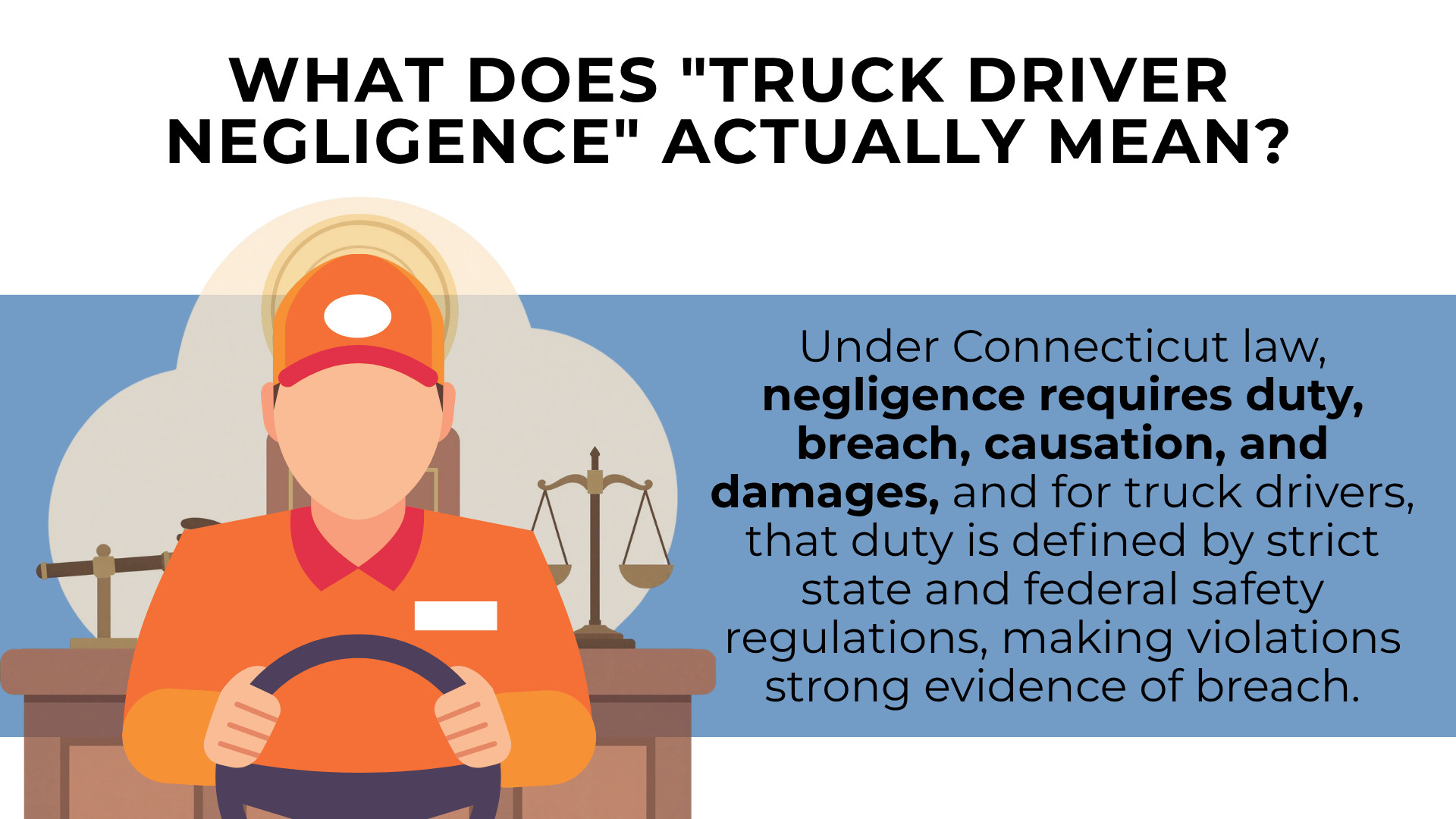
Under Connecticut law, a negligence claim has four parts: the driver owed you a duty of care, the driver breached that duty, the breach caused your injuries, and you suffered actual damages. Duty is a question of law decided by the court, and the ultimate test is whether harm was foreseeable if reasonable care wasn’t exercised.
Connecticut doesn’t impose a heightened common-law duty on commercial freight carriers the way it does on carriers of passengers — a freight trucker isn’t automatically held to a “highest degree of care” standard. But that doesn’t mean the standard is the same one that applies to a neighbor running a stop sign. Reasonable care for a commercial truck driver is shaped by an extensive set of statutory and regulatory obligations — speed laws, reckless driving statutes, and most importantly the Federal Motor Carrier Safety Regulations (FMCSR). Connecticut has adopted the FMCSR by statute and applied it to both interstate and intrastate commercial motor vehicles under Conn. Gen. Stat. § 14-163c. Those rules govern how many hours a driver can be behind the wheel, when they must stop to rest, what condition the truck must be in before a trip begins, and whether the driver is even legally fit to drive at all. When a commercial driver breaks one of those rules and it causes harm, the breach element of a negligence claim gets much easier to prove.
The reason the law treats truck drivers this way is physical. A fully loaded tractor-trailer can weigh roughly 20 to 30 times what a passenger car weighs and needs 20 to 40 percent more distance to stop. When a truck driver makes a mistake, the people in the other vehicle usually bear the consequences. In two-vehicle crashes between a large truck and a passenger vehicle in 2023, 97 percent of the occupants killed were in the passenger vehicle.
What do truck drivers actually do that counts as negligence?
When federal researchers studied the causes of large truck crashes, they found that in crashes where the truck was assigned the critical reason, 87.2 percent involved driver-related factors — decision errors, recognition errors, falling asleep, and performance errors. Vehicle defects and environmental conditions accounted for the rest. The patterns that show up in truck negligence cases cluster into a recognizable set.
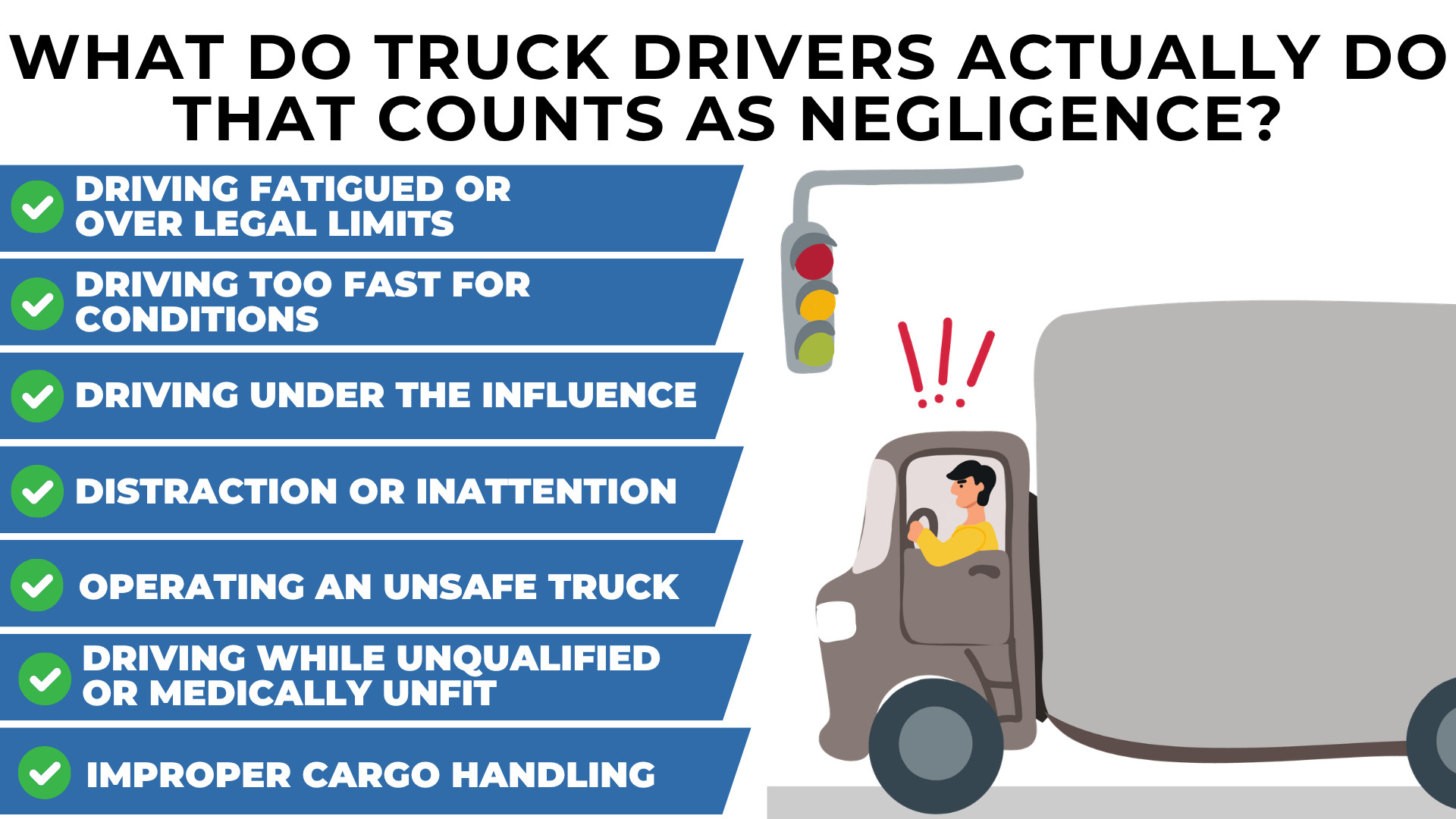
Driving fatigued or past hours-of-service limits. Federal rules under 49 CFR § 395.3 prohibit a driver from driving more than 11 hours after 10 consecutive hours off duty. They also prohibit driving after the 14th consecutive hour on duty, or driving past 60 or 70 hours in a rolling 7- or 8-day window. Drivers also can’t continue past 8 hours of driving time without at least a 30-minute break. 49 CFR § 392.3 separately prohibits operating a commercial motor vehicle while impaired by fatigue, illness, “or any other cause” that makes it unsafe to drive. Fatigue was coded as a factor in roughly 13 percent of the drivers studied in the federal crash causation study. Hours-of-service violations made up 32.1 percent of all driver violations found during the 2024 North American inspection blitz.
Driving too fast for conditions. Conn. Gen. Stat. § 14-218a prohibits operating a vehicle faster than is reasonable given the conditions. Separately, § 14-222 treats speeds over 85 mph as a per se violation of the reckless driving statute. Speed was the second most common driver-related factor in the federal causation study, coded against roughly 22.9 percent of the trucks. A truck traveling at the posted limit can still be negligently fast — in rain, in heavy traffic, on a curve, or at the end of a long shift.
Impairment by alcohol or drugs. Commercial drivers face a stricter standard than ordinary motorists. Where a regular driver is presumed impaired at a 0.08 blood alcohol concentration, the legal limit for commercial drivers is 0.04. Only about 4 percent of large-truck drivers in fatal crashes in 2023 had a BAC of 0.08 or higher — a lower rate than any other vehicle category. But the lower threshold means impairment cases can be established with less alcohol than in a passenger-vehicle case. Drug impairment remains an ongoing issue addressed by the testing rules in 49 CFR Part 382.
Distraction and inattention. Decision errors and recognition errors — the driver failing to see what was in front of them, misjudging what another vehicle was doing, or paying attention to something other than the road — made up more than two-thirds of the driver-related factors in the federal crash study. Phone use, GPS interaction, and routine inattention are all breaches of the duty of reasonable care.
Driving a truck that wasn’t safe to drive. A driver who gets behind the wheel with brakes that don’t work, tires that are bald, or a trailer that isn’t properly coupled has breached duties under both federal pre-trip inspection requirements and § 392.3’s prohibition on operating an unsafe vehicle. Brake defects were the single most common vehicle-related factor in the federal causation study, showing up in almost 30 percent of the trucks involved in crashes.
Driving while unqualified or unfit. 49 CFR Part 391 sets the federal driver qualification requirements — medical fitness, licensing, experience, and a sufficiently clean record. A driver whose medical certificate has lapsed, who shouldn’t have been behind the wheel given a known health condition, or who lacks the endorsements required for the cargo being hauled is operating outside the standard the law requires.
Load-related negligence. Improperly secured cargo, overweight loads, or loads that shift in transit can turn a routine lane change into a rollover. Federal cargo securement rules are part of the FMCSR framework Connecticut has adopted.
Why is proving truck driver negligence different from proving fault in a car accident?
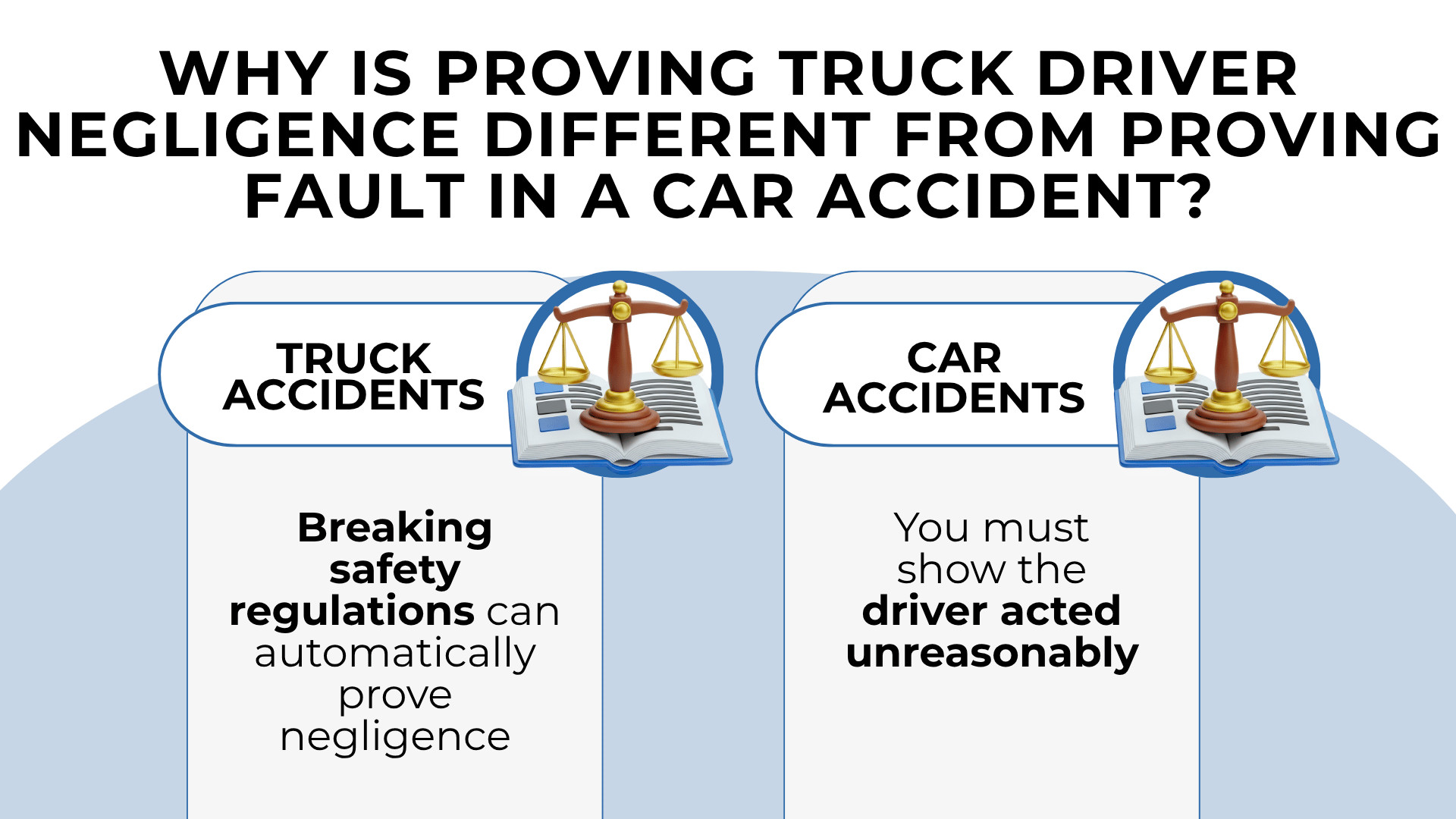
In an ordinary car accident, proving the other driver was at fault usually means persuading a jury that a reasonable person wouldn’t have done what that driver did. Truck cases have an additional path that ordinary car cases usually don’t.
Because Conn. Gen. Stat. § 14-163c adopts the Federal Motor Carrier Safety Regulations as Connecticut state law, violating one of those regulations can trigger Connecticut’s negligence per se doctrine. Under the Connecticut Supreme Court’s decision in Gore v. People’s Savings Bank, two conditions matter. The plaintiff must fall within the class of persons the regulation was meant to protect, and must have suffered the type of harm the regulation was meant to prevent. When both conditions are met, the jury doesn’t have to decide whether the defendant acted like an ordinarily prudent person. The jury only has to decide whether the rule was broken. If it was, the defendant was negligent as a matter of law. And under Wendland v. Ridgefield Construction Services, even where negligence per se doesn’t apply, federal safety regulations are admissible as evidence of the applicable standard of care.
What that means in practice: if the ELD data shows the driver was in the 13th consecutive hour on duty when they rear-ended you, or the post-crash drug screen comes back positive, or the pre-trip inspection paperwork shows brakes were flagged and not repaired, you don’t have to argue about whether the driver was being careful. The rule was broken. The breach is established. You still have to prove that the violation caused your injuries, but one of the hardest elements of a negligence case is largely cleared.
The scale on which these violations occur matters here too. The national vehicle out-of-service rate in 2023 was 22.6 percent — meaning more than one in five commercial vehicles inspected had safety defects serious enough that inspectors wouldn’t let them keep operating. Regulatory violations in the trucking industry are not rare.
Is the trucking company also responsible, or just the driver?
In many serious truck cases, the trucking company is a defendant alongside the driver. Two separate legal theories can put it there.
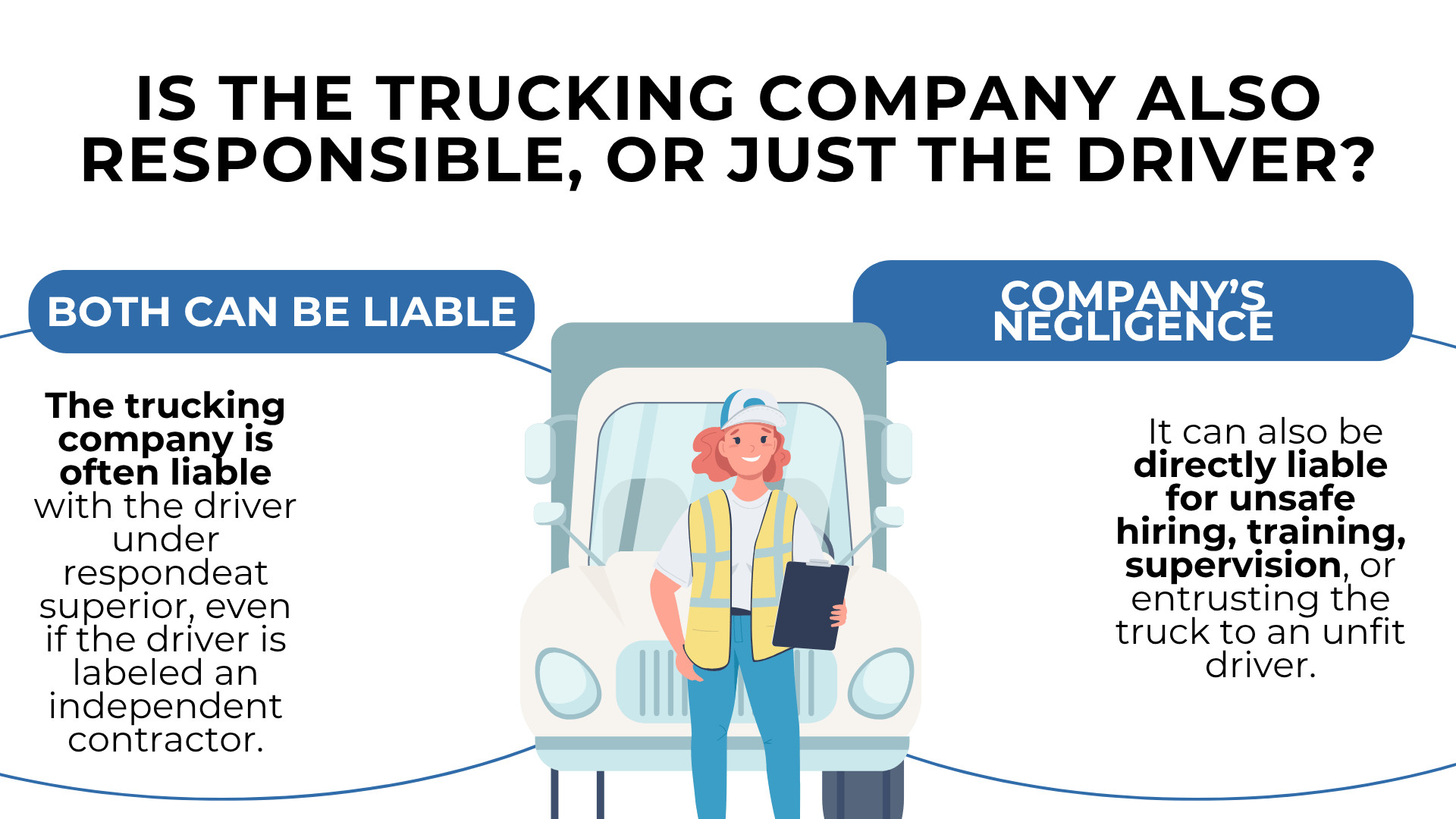
The first is respondeat superior: Connecticut recognizes the common-law rule that employers are vicariously liable for the negligent acts of their employees committed within the course and scope of employment, as the Connecticut Supreme Court confirmed in Jagger v. Mohawk Mountain Ski Area. Conn. Gen. Stat. § 52-183 goes further in the motor vehicle context. It creates a rebuttable presumption that the operator of an owner’s vehicle is the owner’s agent acting in the course of employment. That means the burden of rebutting that presumption falls on the defendant, not on you. Many trucking companies classify their drivers as independent contractors, but the label in a contract isn’t what controls. Courts examine the actual relationship. The federal definition of “employee” at 49 CFR § 390.5 specifically includes drivers operating under a motor carrier’s authority even when they’re classified as independent contractors while operating a commercial motor vehicle.
The second theory is the company’s own direct negligence. Connecticut recognizes that trucking companies can be sued for negligently hiring, training, supervising, retaining, or entrusting a truck to an unfit driver. Shore v. Stonington established negligent hiring as a cause of action grounded in the employer’s own failure to select a fit or competent employee. Greeley v. Cunningham recognized the separate doctrine of negligent entrustment — that the owner of a vehicle is liable when they know or should know the person they entrust it to is so incompetent to operate it that injury is reasonably foreseeable. Seguro v. Cummiskey confirmed that negligent hiring, supervision, and retention claims exist independently of respondeat superior, meaning they can be pursued alongside a respondeat superior claim. The central element for these theories is foreseeability — whether a reasonable employer, knowing what this employer knew or should have known, would have anticipated the harm.
Why this matters: a driver’s personal insurance is almost never sufficient for a catastrophic truck crash. The company’s policy typically is. For interstate carriers hauling ordinary freight in trucks over 10,001 pounds, federal law requires a minimum of $750,000 in liability coverage. For certain hazardous materials, required coverage reaches $5 million under 49 CFR § 387.9. Identifying every potentially liable party early — driver, motor carrier, and where applicable other parties — is one of the most important things that happens in the first weeks of a truck case.
How do you actually prove a truck driver was negligent?
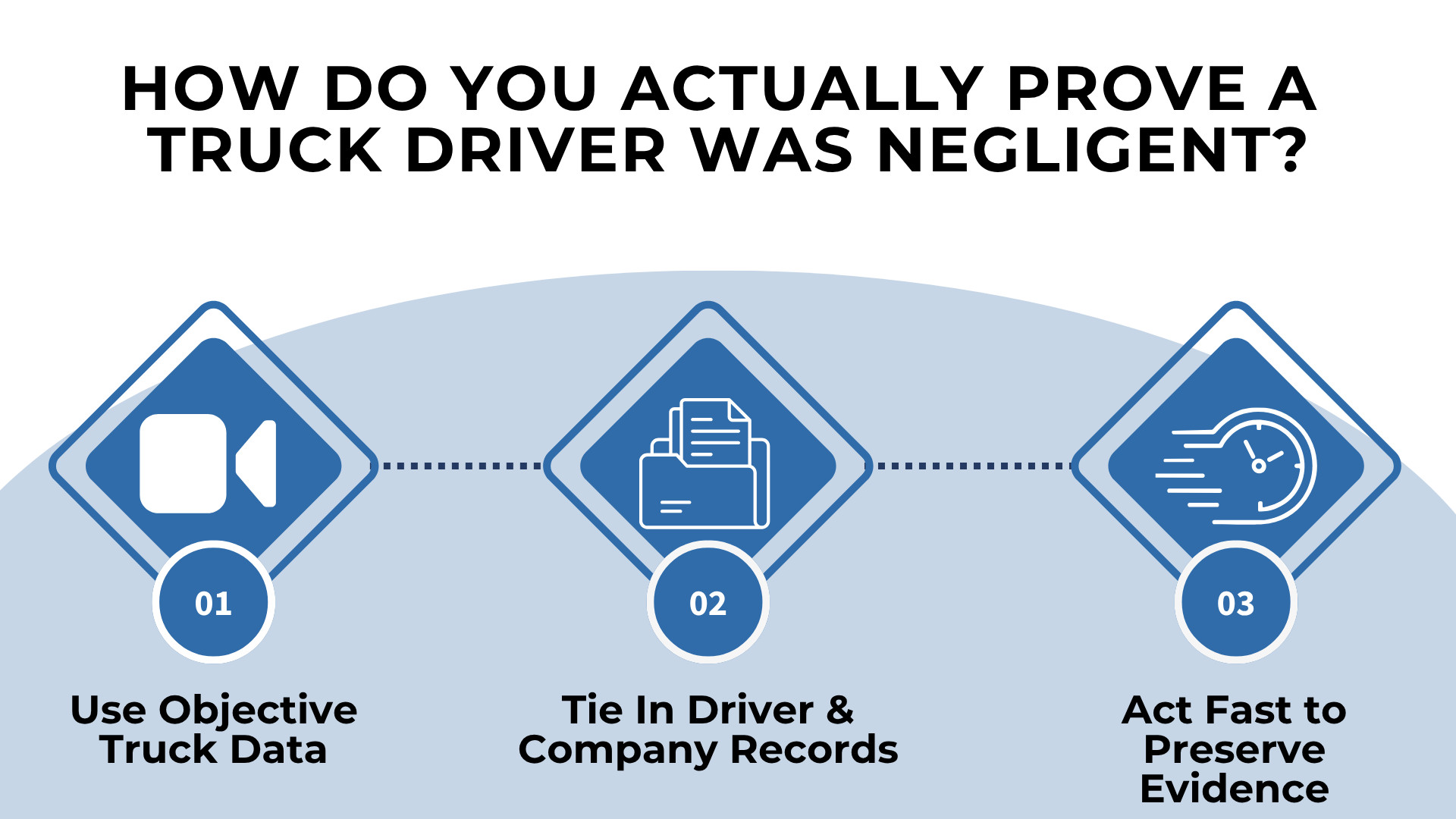
Truck cases are evidence cases, and the most important evidence lives on and around the truck itself. The categories that come up repeatedly include electronic logging device (ELD) data, which records the driver’s hours of service and is central to establishing fatigue and HOS violations. They include the truck’s event data recorder, which captures vehicle data in the moments before a crash. They include dashcam footage, if the truck is equipped, along with GPS and telematics data, and dispatch communications. They include the driver’s qualification file, which documents licensing, training, medical certification, and prior history. And they include post-crash drug and alcohol test results under 49 CFR Part 382, maintenance records and pre-trip inspection reports, and the truck’s inspection history.
The problem is that a lot of this evidence doesn’t last long on its own. Federal rules under 49 CFR § 395.8 require carriers to retain ELD records of duty status for only six months. Dashcam footage is often overwritten on a loop. Dispatch messages can be deleted. This is why Connecticut’s evidence preservation rules matter so much in truck cases.
Under Connecticut law, there is a common-law duty to preserve evidence when litigation is pending or reasonably anticipated. Under Beers v. Bayliner Marine Corp., the trier of fact may draw a permissive adverse inference from intentional spoliation. That is, the jury may be permitted to infer that the destroyed evidence would have been unfavorable to the destroying party, provided the Beers factors are met. Connecticut goes further than most states: in Rizzuto v. Davidson Ladders, Inc., the Connecticut Supreme Court recognized an independent tort of intentional first-party spoliation. Federal regulations at 49 CFR § 395.30(f) separately prohibit the alteration or erasure of original ELD data.
What triggers the preservation duty in practice is typically a formal preservation letter from a lawyer, sent to the motor carrier and its insurer, identifying the specific categories of data and physical evidence that must be held. The earlier that letter goes out, the more evidence is likely to survive.
How long do you have to act in Connecticut?
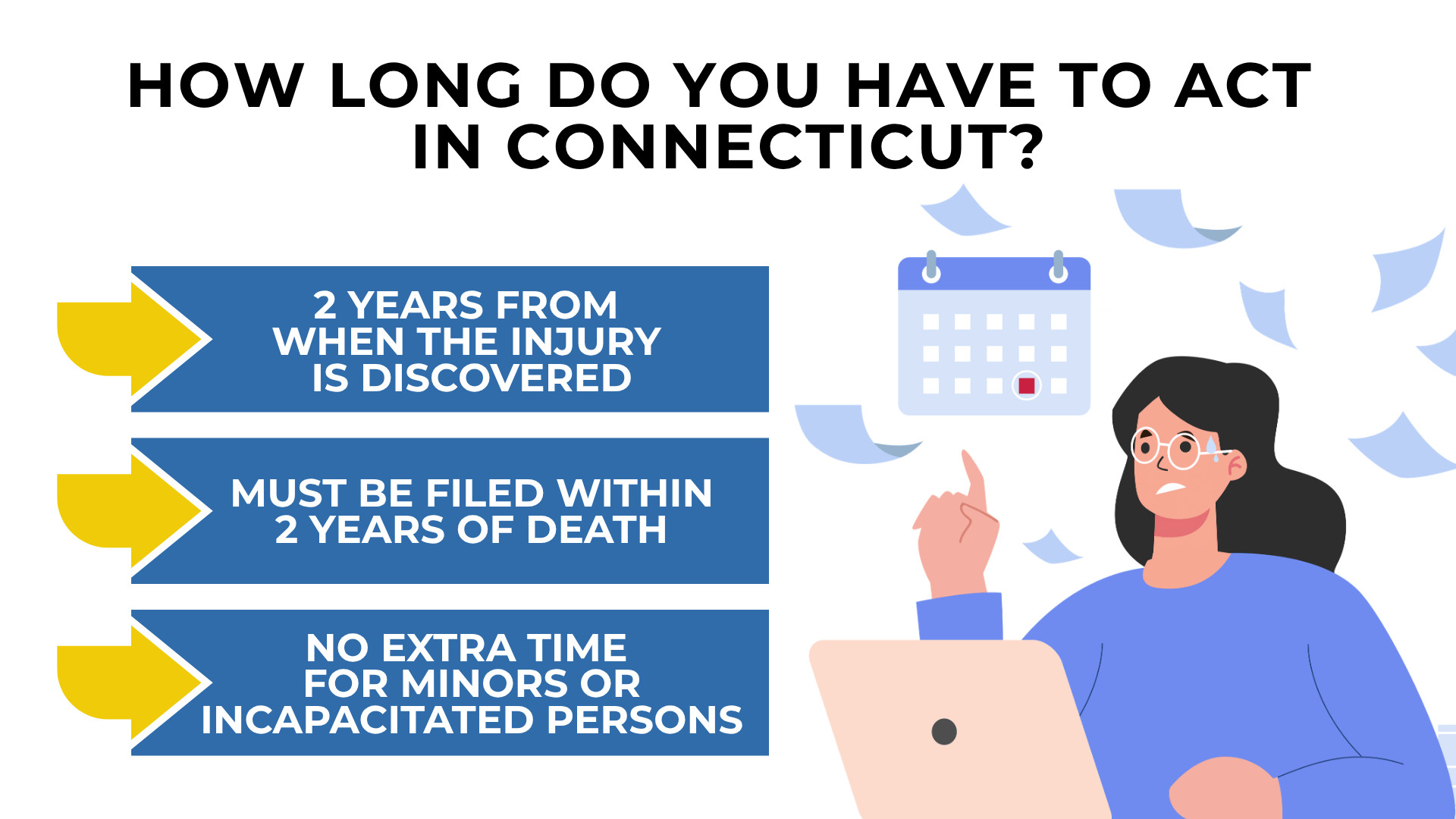
Connecticut’s statute of limitations for a motor vehicle negligence claim is two years from the date the injury was sustained, discovered, or with reasonable care should have been discovered. That two-year period comes with a three-year absolute repose period from the date of the act or omission, under Conn. Gen. Stat. § 52-584. Wrongful death claims must be brought within two years of the death and no more than five years from the act or omission, under Conn. Gen. Stat. § 52-555.
There is one feature of Connecticut law that injured people are often stunned to learn: Connecticut is the only state that does not toll the negligence statute of limitations for minors or incapacitated persons. A parent or guardian has to bring the claim within the ordinary deadline even if the injured person is a child. A family that assumes more time is available because the injured person is young can find themselves out of time before medical treatment has even finished.
The two-year deadline is the legal deadline. The practical deadline is usually shorter. Six months after the crash, the ELD records that federal rules require the carrier to keep are no longer required to be kept. Dashcam loops may have long since overwritten. Witness memories fade. The strongest truck cases are often the ones where someone started preserving evidence in the first days.
What to do if a truck driver’s negligence has injured you or someone you love
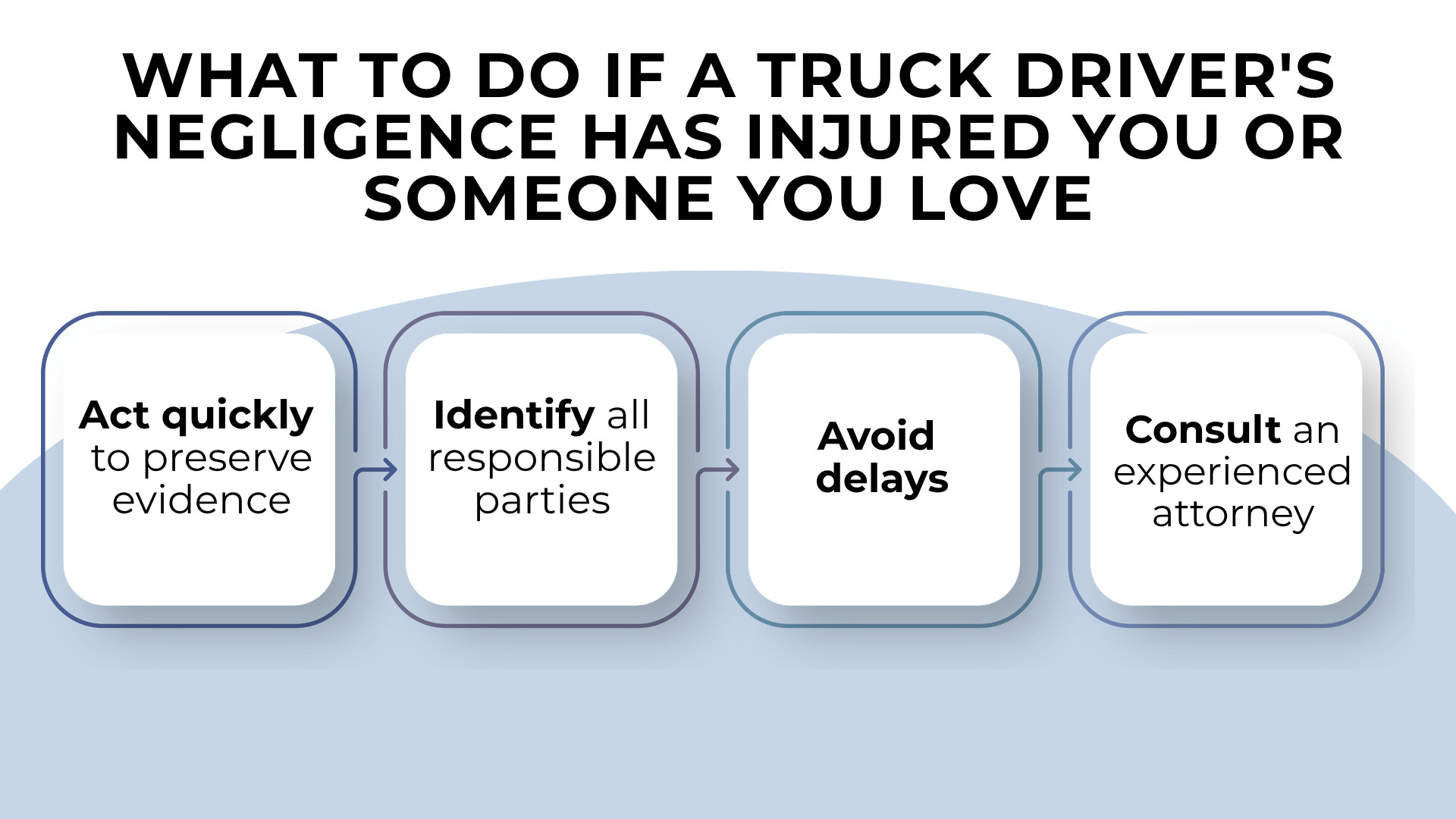
If the reason you’re reading this is a crash that’s already happened, the most useful thing that can happen in the next several days is getting the evidence locked down. That means an attorney sending preservation letters to the trucking company and its insurer, identifying the truck, the driver, the trip, and the specific records that must not be altered or destroyed. Those records include the ELD, event data recorder, dashcam, dispatch, qualification file, drug and alcohol test results, and maintenance records.
Etemi Law is a personal injury firm based in Waterbury, Connecticut, with a practice area that includes motor vehicle accidents and commercial trucking accidents. Ron Etemi, Lou Etemi, Semir Dervisi, and Peter Brown handle these cases. If a truck driver’s negligence caused serious injury to you or to someone in your family, contact Etemi Law to have the facts reviewed and the evidence preserved before the clock runs on either one.