
How Much Is a Herniated Disc Car Accident Settlement Worth in Connecticut?

Herniated disc settlements from car accidents don’t have a single average because the range is too wide for one number to be useful. A herniated disc treated with physical therapy and injections can settle for tens of thousands of dollars. A herniated disc that requires spinal fusion surgery can settle for several hundred thousand — or more. The difference comes down to a specific set of medical and legal variables. Understanding those variables is the only way to gauge what a particular case might actually be worth.
This page breaks down what drives herniated disc settlement values, what role surgery plays in the calculation, and why the medical specifics of the diagnosis matter more than any national average.
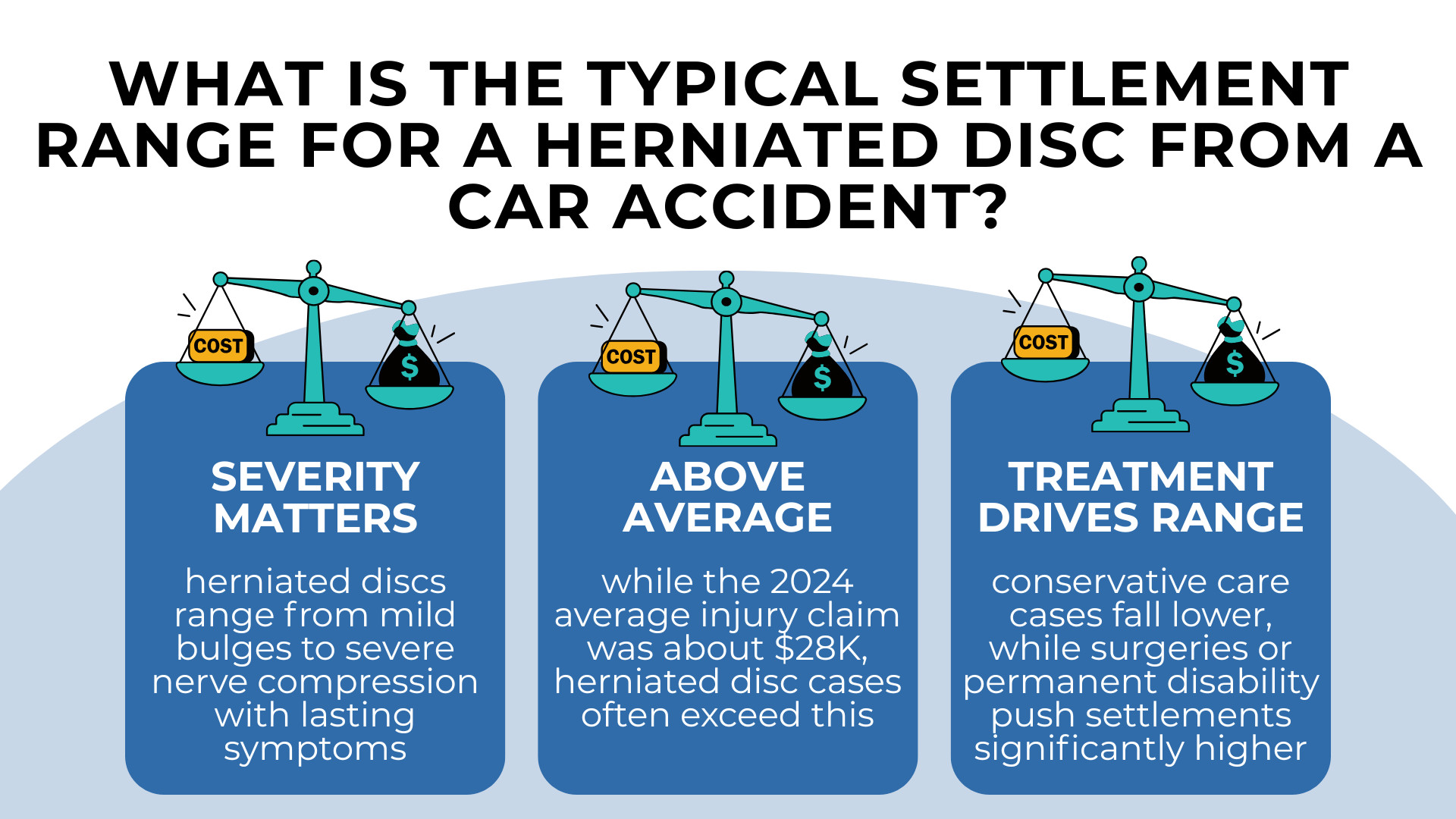
What Is the Typical Settlement Range for a Herniated Disc From a Car Accident?
The first thing to understand is that “herniated disc” covers a wide spectrum of injuries. A small disc bulge causing intermittent back pain is a different case than a large extrusion compressing a nerve root and causing radiating leg pain, numbness, or weakness. Settlement value tracks that spectrum closely.
As a baseline reference, workers’ compensation data shows the average lost-time claim from a motor vehicle crash was $91,433 — nearly double the $47,316 average across all workplace injury causes. Herniated disc cases routinely exceed those benchmarks because they involve objective diagnostic findings on MRI, longer treatment timelines, and a higher likelihood of chronic symptoms or surgical intervention.
In general terms, herniated disc settlements tend to fall into tiers based on how the injury is treated and how it resolves. A single-level herniation that responds to conservative care — physical therapy, medication, and perhaps a round of epidural steroid injections — typically settles in a lower range than one that doesn’t improve without surgery. A multi-level herniation, or one involving cervical disc replacement or lumbar fusion, pushes the value much higher because the medical costs, recovery period, and long-term consequences are all greater. Cases involving permanent neurological deficits or documented disability occupy the top of the range.
No honest attorney or website can give a precise dollar figure without knowing the specific diagnosis, the treatment history, the available insurance coverage, and the facts of how the accident happened. But the variables that determine where a case falls in that range are knowable — and that’s what matters.
What Factors Make a Herniated Disc Settlement Go Up or Down?
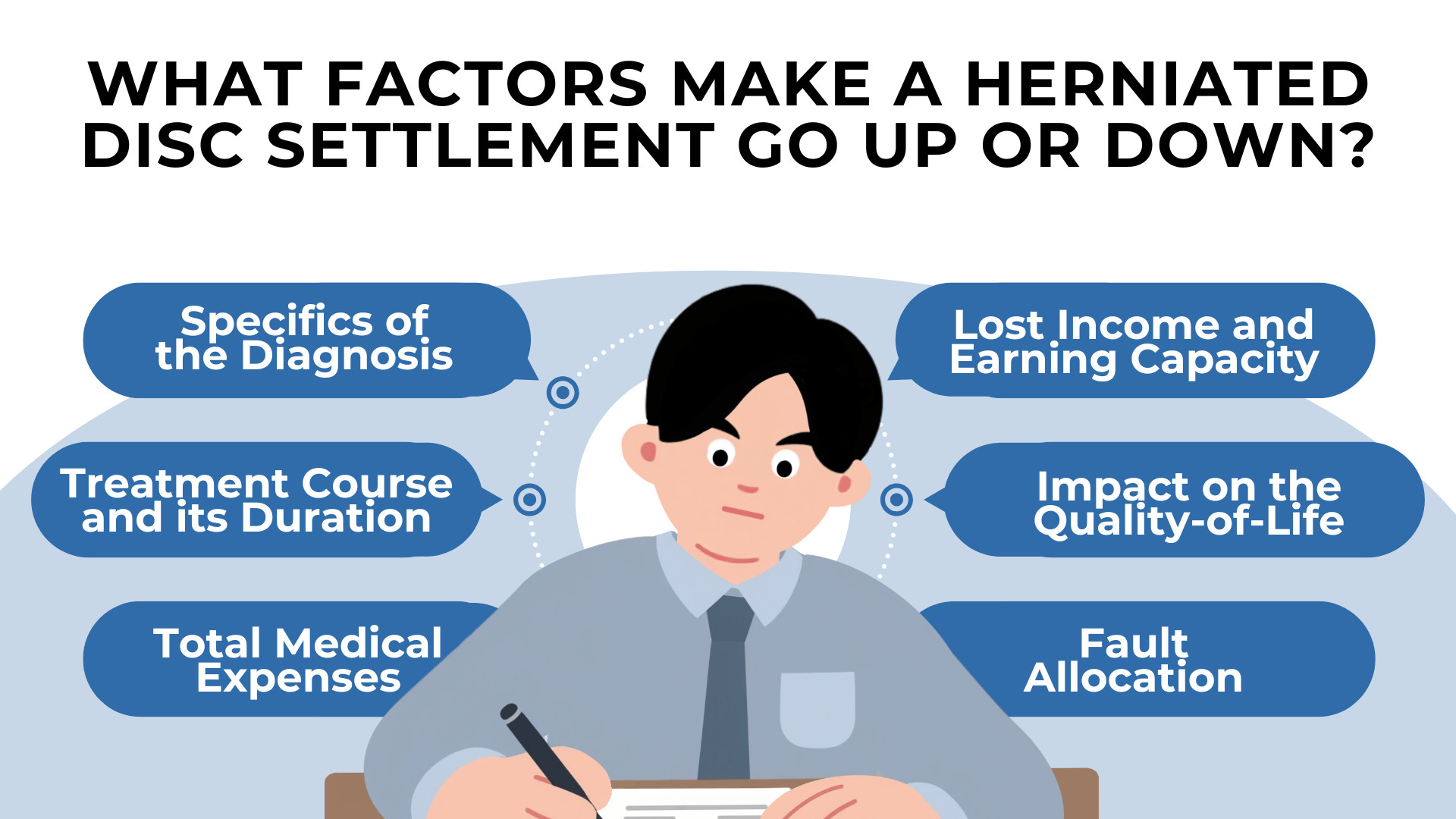
Settlement value isn’t arbitrary. Insurance adjusters and attorneys evaluate herniated disc claims based on a set of factors that interact with each other. Here are the ones that carry the most weight.
The specifics of the diagnosis. An MRI-confirmed herniated disc with documented nerve impingement or radiculopathy is a stronger case than one based solely on clinical symptoms. Whether the herniation is cervical (neck) or lumbar (lower back), whether it affects one level or multiple levels, and whether there’s spinal cord compression all affect value. The more objective and detailed the diagnostic evidence, the harder it is for an insurer to minimize the injury.
The treatment course and its duration. A case involving six weeks of physical therapy tells a different story than one involving twelve months of escalating treatment — injections, nerve blocks, surgical consultation, and ultimately an operation. Longer, more intensive treatment usually means a higher settlement value. It reflects a more serious injury and generates higher medical costs that drive the damages calculation.
Total medical expenses. Medical bills are one of the starting points for valuing a personal injury claim. NHTSA’s most recent comprehensive crash-cost study estimated $30.9 billion in medical expenses nationally from motor vehicle crashes, with lost productivity adding another $106.3 billion. That reflects the reality that car accident injuries — especially spinal injuries — generate substantial healthcare costs. The total cost of care matters not just as a reimbursable expense but as a reference point for calculating pain and suffering.
Lost income and earning capacity. If a herniated disc prevents you from working during recovery, those lost wages are a direct economic damage. If the injury imposes permanent lifting restrictions or limitations that affect your ability to do your job long-term, lost future earning capacity can be the single largest component of the claim.
Pain and suffering and quality-of-life impact. There is no statutory cap on non-economic damages in Connecticut personal injury cases. For herniated disc claims specifically, this means a jury can assign full value to the daily reality of living with the injury — disrupted sleep, inability to exercise, difficulty picking up your children, chronic discomfort at work. Under Conn. Gen. Stat. § 52-572h, the full measure of physical pain, mental suffering, and loss of enjoyment of life is recoverable without an artificial ceiling.
Fault allocation. Under Connecticut’s modified comparative negligence rule (Conn. Gen. Stat. § 52-572h), your recovery is reduced by your percentage of fault — and eliminated entirely if your share exceeds 50%. In herniated disc cases, this matters because even a strong medical case can lose significant value if the liability picture is contested.
Does It Matter Whether You Had Surgery?
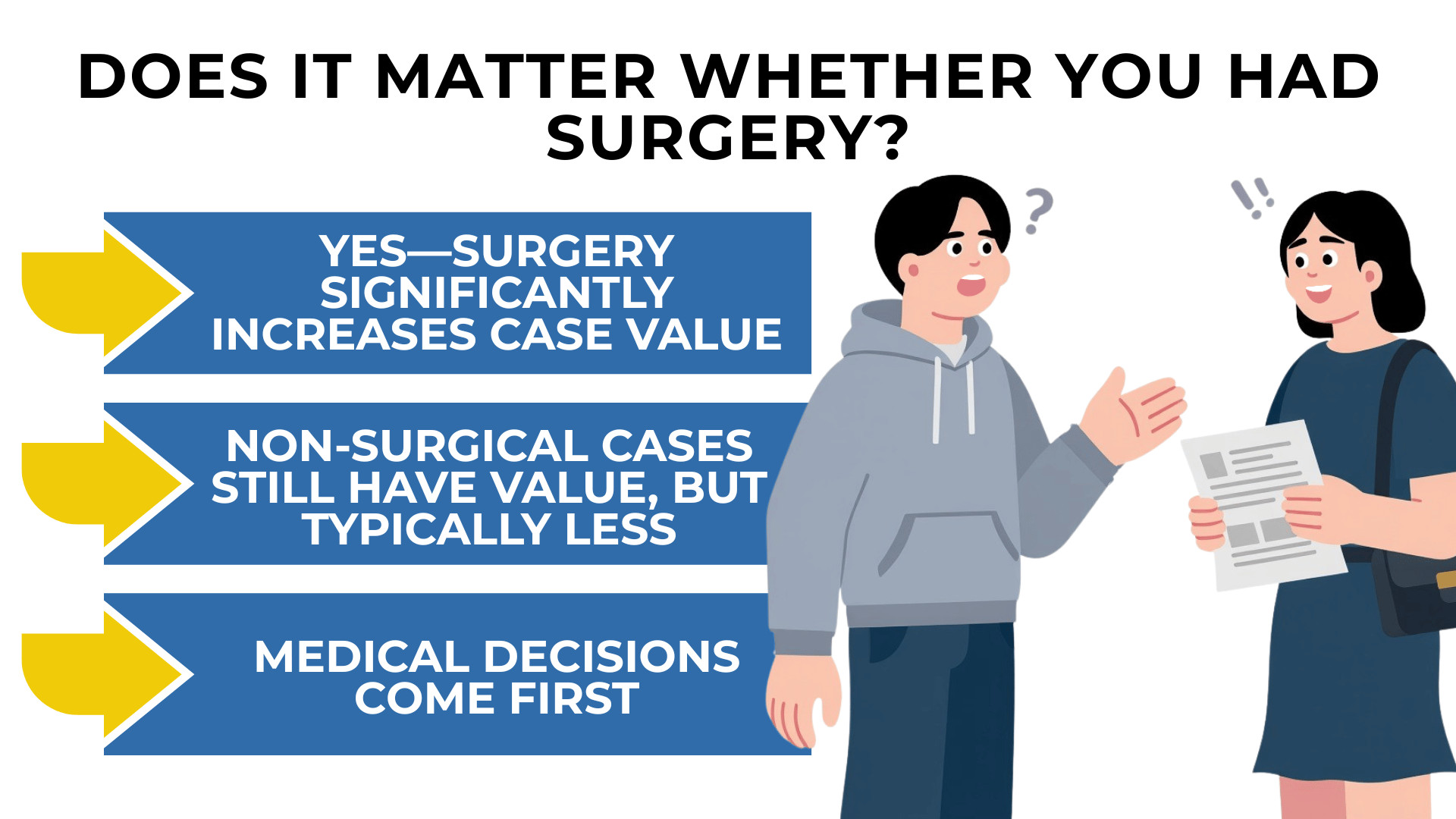
It matters enormously. Surgery is the single biggest variable that separates lower-value herniated disc settlements from higher-value ones.
The reason is straightforward. A herniated disc that requires surgical intervention — whether that’s a microdiscectomy, a laminectomy, or a cervical or lumbar fusion — carries serious consequences. It means higher medical bills, a longer recovery period, more time out of work, greater pain during recovery, and in many cases a permanent change in spinal function. Fusion surgery in particular often results in documented restrictions: no heavy lifting, limited range of motion, and an increased likelihood of adjacent-segment degeneration over time. All of that means higher damages.
Conservative treatment doesn’t mean a case has no value — far from it. Epidural injections, extended physical therapy, and ongoing pain management reflect real suffering and real expense. But the gap between a conservatively treated herniation and a surgically treated one is often the difference between a five-figure settlement and a six-figure one. In serious surgical cases, the value can climb well beyond that.
The important thing is that you shouldn’t pursue or avoid surgery based on what it might do to a legal claim. Medical decisions should be made with a doctor based on what the injury requires. But it’s worth understanding that the treatment path will be one of the most significant factors any insurer or jury considers when evaluating the case.
How Does Hiring an Attorney Change What Your Case Is Worth?
Insurance companies evaluate herniated disc claims differently depending on whether the injured person is represented. This isn’t speculation — it comes down to how claims are processed. An unrepresented claimant is more likely to accept a low offer, less likely to fully document damages, and far less likely to file a lawsuit if the offer is inadequate. Insurers know this and price their offers accordingly.
An attorney who handles herniated disc cases understands how to connect the diagnostic findings — the MRI results, the nerve conduction studies, the surgical records — to a damages figure that reflects the actual severity of the injury. They know how to distinguish a case involving a single-level bulge from one involving multi-level herniations with radiculopathy. They also know how to present that distinction in a way that changes what an insurer is willing to pay.
At Etemi Law in Waterbury, Connecticut, lead litigator Ron Etemi has tried over 100 cases to verdict, and attorney Peter Brown has secured 175 jury verdicts over a career practicing since 1990. That trial experience matters because the value of a settlement is shaped by what would happen if the case went to trial — and insurers adjust their offers based on whether the attorney on the other side actually tries cases.
If you’re dealing with a herniated disc from a car accident and trying to figure out what your case is worth, a consultation is the fastest way to get an answer grounded in the specific facts of your situation.