Truck Accident Compensation in Connecticut: What You Can Recover and From Whom
Compensation after a truck accident typically covers your medical bills (past and future), lost income and lost earning capacity, pain and suffering, and — in cases involving reckless conduct — double or treble damages under Connecticut law. Connecticut places no cap set by law on either economic or non-economic damages in personal injury cases, and because commercial trucks are required to carry far more insurance than ordinary vehicles, the recoverable amount in a truck case is often many times higher than in a typical car accident.
The rest of this article walks through how truck accident compensation actually works in Connecticut. It covers why these cases pay out differently than car accident cases and who can be held responsible beyond just the driver. It explains how much insurance is usually available and what the trucking company’s adjuster is really doing when they call. It also covers what evidence you need to preserve (and how fast it can disappear), what can reduce what you receive, and how long you have to file a claim.
Why is a truck accident claim worth more than a regular car accident claim?
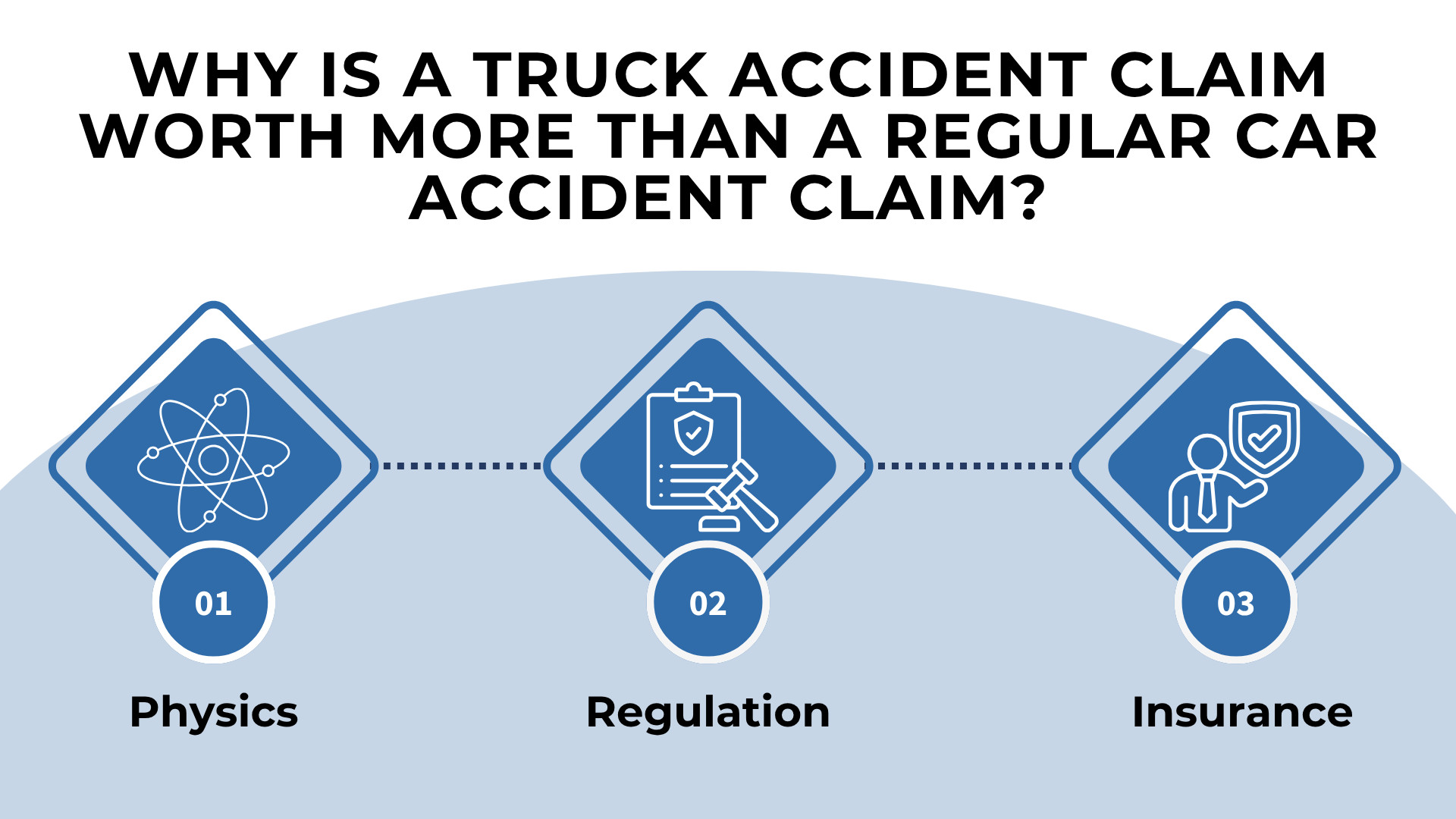
Three basic differences drive the math.
The first is physics. A fully loaded tractor-trailer weighs roughly 20 to 30 times what a typical passenger car weighs and needs 20 to 40 percent more distance to stop. That weight disparity is reflected in the fatality data: of the 5,472 people killed in large truck crashes nationally in 2023, 70% were occupants of other vehicles. Injuries in truck cases tend to be catastrophic — traumatic brain injuries, spinal cord damage, fractures requiring multiple surgeries — and catastrophic injuries carry catastrophic damage values. First-year healthcare and living expenses for a survivor with high-level tetraplegia average over $1.4 million, and lifetime costs for a 25-year-old with that injury approach $6.4 million. A claim has to be large enough to actually cover a lifetime of care.
The second is regulation. Commercial trucks are governed not just by Connecticut traffic law but by the Federal Motor Carrier Safety Regulations, which Connecticut has adopted into state law under Conn. Gen. Stat. § 14-163c. These federal rules govern how long a driver can be behind the wheel, how brakes must be maintained, how drivers must be screened and tested, and how driving hours must be logged electronically. Violations of these rules can establish negligence as a matter of law. That means the jury doesn’t have to debate whether the trucking company acted unreasonably if it broke a specific federal safety rule that caused the crash.
The third is insurance. Connecticut’s minimum auto liability requirement is $25,000 per person. But federally regulated interstate trucking companies are required to carry a minimum of $750,000 in liability coverage, rising to $5 million for the most dangerous hazardous materials loads under 49 CFR § 387.9. That gap between $25,000 and $750,000+ is often where the real difference in outcomes is decided.
What types of compensation can I actually recover?
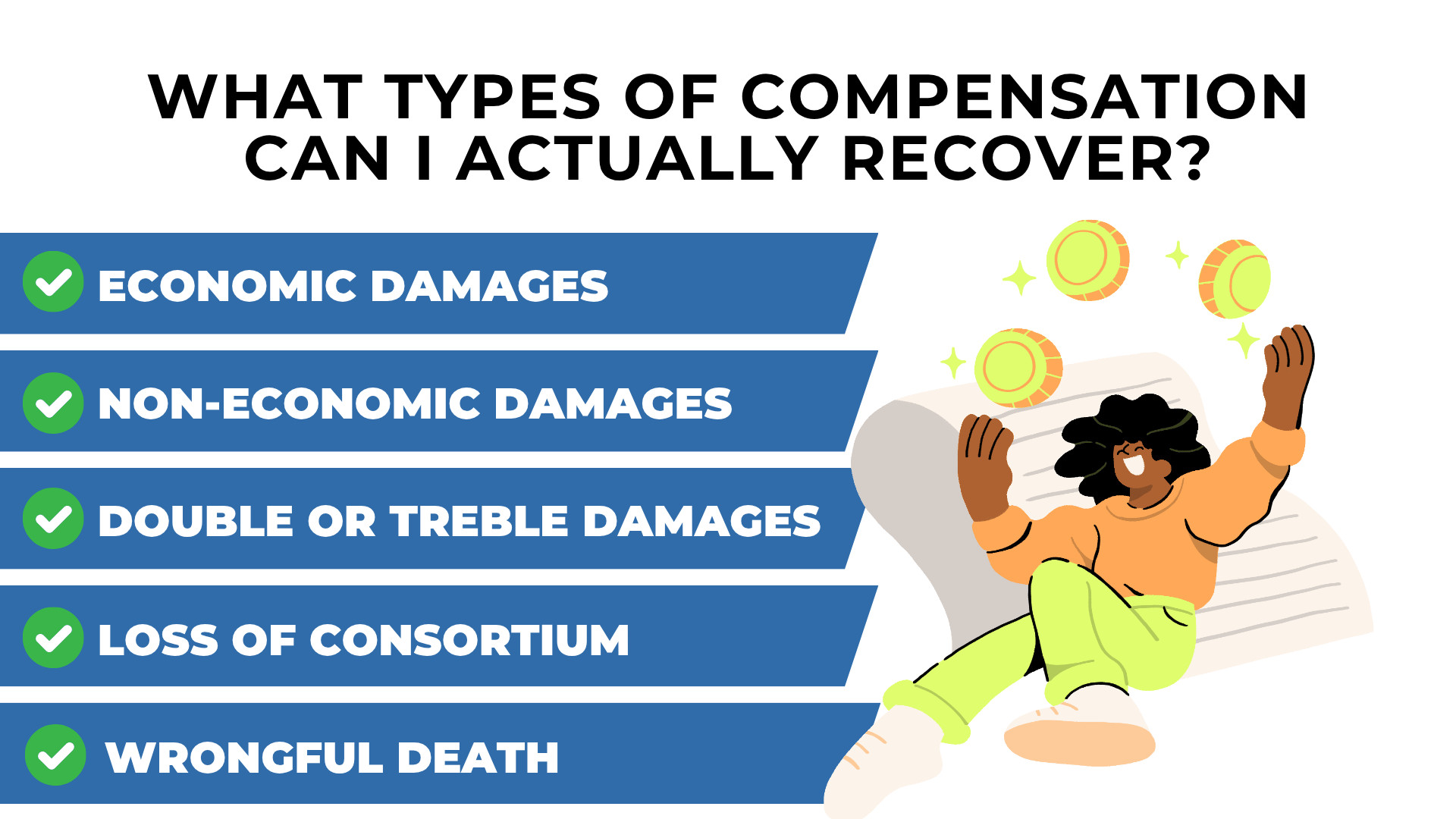
Connecticut law divides damages into two main categories, and you can recover both.
Economic damages are the measurable financial losses from the crash. This includes all medical care — emergency treatment, hospitalization, surgeries, physical therapy, medications, assistive devices — plus future medical care you’ll need, rehabilitative services, and custodial care if your injuries require it. It also includes lost earnings from time you couldn’t work and, if your injuries permanently limit what you can do professionally, lost earning capacity going forward. Under Conn. Gen. Stat. § 52-572h(a), these are fully recoverable and uncapped.
Non-economic damages cover the losses that don’t come with a receipt: physical pain and suffering, mental and emotional suffering, and the general loss of enjoyment and quality of life that serious injury brings. Connecticut imposes no cap on non-economic damages in personal injury cases.
Double or treble damages may be available under Conn. Gen. Stat. § 14-295 if the truck driver deliberately or with reckless disregard violated certain listed traffic statutes. Those include reckless driving and operating over 85 mph. The violation must have been a substantial factor in causing your injury. These enhanced damages must be specifically claimed in the lawsuit. But in serious cases involving logbook falsification, impairment, or extreme speed, they can dramatically increase the value of a claim.
Loss of consortium is a separate claim available to spouses and minor children of a seriously injured person under Conn. Gen. Stat. §§ 52-555a through 52-555c. It compensates for the loss of companionship, affection, and support that serious injury to a family member causes.
Wrongful death compensation is available to the estate of a person killed in a truck crash under Conn. Gen. Stat. § 52-555, covering medical, hospital, nursing, and funeral expenses plus “just damages” for the loss of life itself.
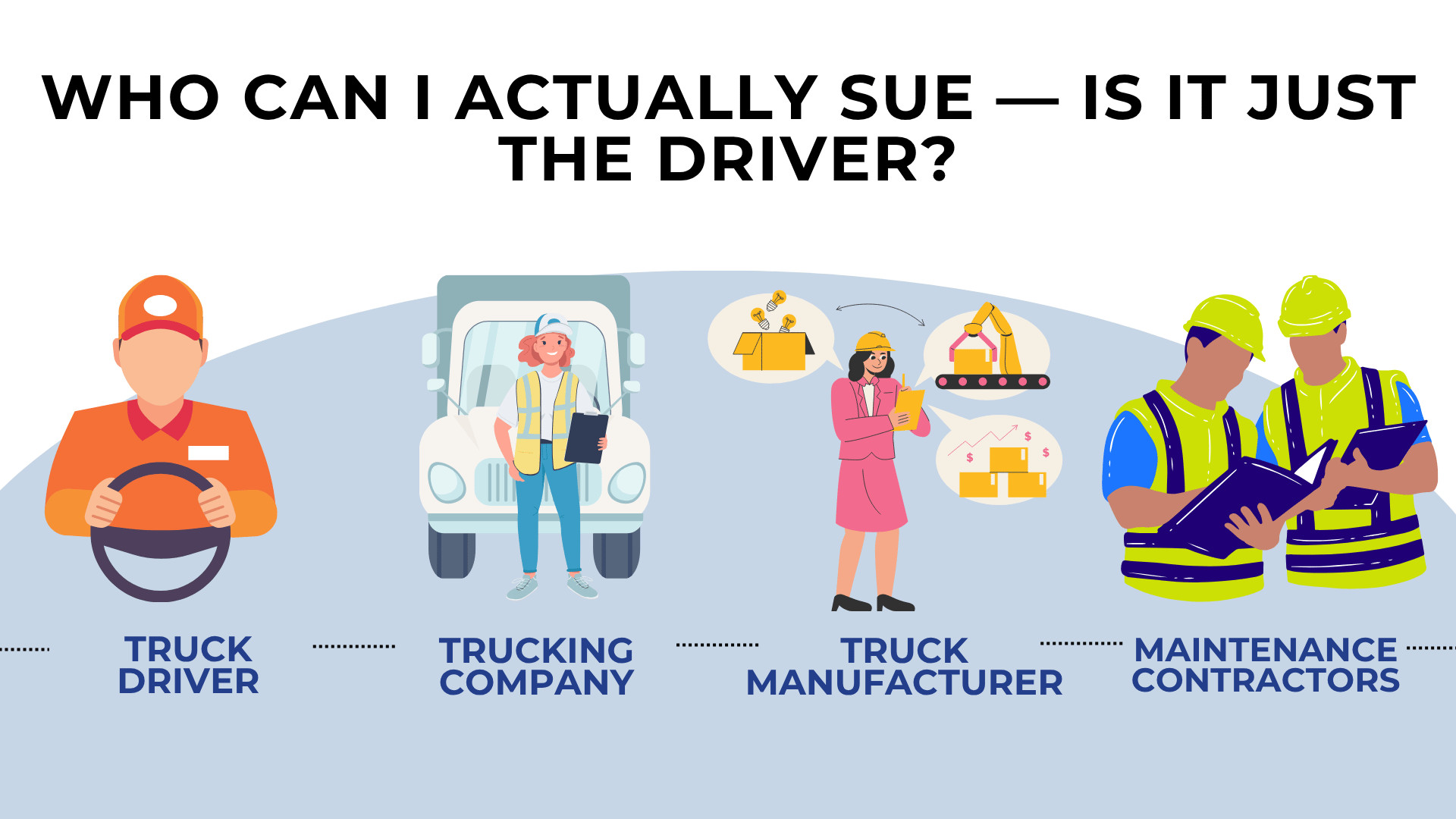
Who can I actually sue — is it just the driver?
No. This is one of the most important things to understand about truck cases and one of the main reasons they pay out more than car cases.
The driver is the most obvious defendant, but often the least financially significant — most commercial drivers don’t personally carry the kind of assets or coverage a serious case requires.
The trucking company is almost always a defendant. Under respondeat superior, the carrier is vicariously liable for driver negligence in the course and scope of employment — and Conn. Gen. Stat. § 52-183 presumes the driver was acting as the company’s agent. Connecticut also recognizes separate direct claims against the carrier for negligent hiring, supervision, retention, and entrustment. Both theories can proceed simultaneously, which means the company’s own decisions about who to hire and how to supervise are independently at issue.
The truck manufacturer or parts manufacturer may be liable if equipment failure caused or contributed to the crash. The Connecticut Product Liability Act (Conn. Gen. Stat. §§ 52-572m through 52-572q) provides the exclusive remedy against product sellers, including manufacturers of brakes, tires, and coupling devices. Equipment failure is far from rare: defective brakes account for about a quarter of all vehicle violations in annual CVSA inspections.
Maintenance contractors and cargo loaders can also be liable in specific cases — a repair shop that signed off on defective brakes, or a loading company whose improperly secured cargo shifted and caused a rollover.
Identifying every responsible party isn’t a bookkeeping exercise. It’s how a claim gets fully funded. More defendants usually mean more available insurance policies, and more available insurance usually means a larger recovery is actually collectible.
How much insurance coverage is actually available in a truck case?
This is where expectations often need to be reset — usually upward.
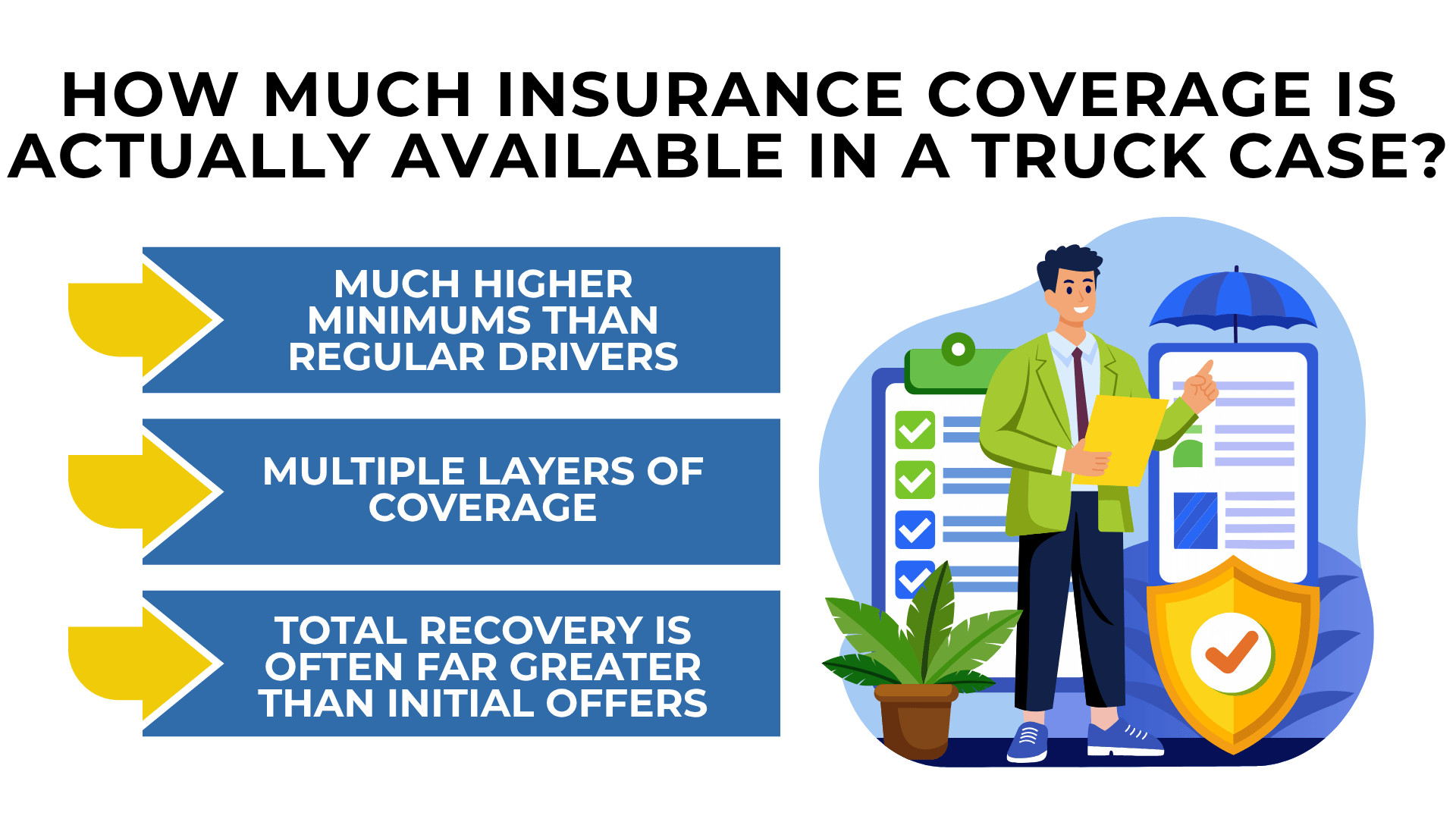
A regular Connecticut driver is only required to carry $25,000 per person in bodily injury liability coverage under Conn. Gen. Stat. § 14-112. For a truck case, that’s almost never the ceiling.
Under 49 CFR § 387.9, federally regulated interstate motor carriers hauling general non-hazardous freight must carry a minimum of $750,000 in liability coverage. Carriers hauling certain hazardous waste, materials, substances, or oil must carry $1,000,000. Carriers hauling the most dangerous hazmat categories must carry $5,000,000. Many larger trucking companies carry well above the minimum through primary policies plus layered excess coverage. In addition, the federal MCS-90 endorsement (49 CFR § 387.15) requires the insurer to pay public liability claims against federally regulated interstate carriers even where the policy would otherwise exclude the claim.
When you add everything up, the picture shifts. That includes the driver’s coverage, the trucking company’s primary policy, possible excess layers, any applicable product liability coverage on the manufacturer, and your own uninsured/underinsured motorist coverage under Conn. Gen. Stat. § 38a-336 (which Connecticut requires on every auto policy). The total pool available to compensate a seriously injured person is usually very different from the number the first adjuster quotes.
What’s the trucking company’s insurance adjuster really doing when they call me?
They’re doing their job — which is not the same as yours.
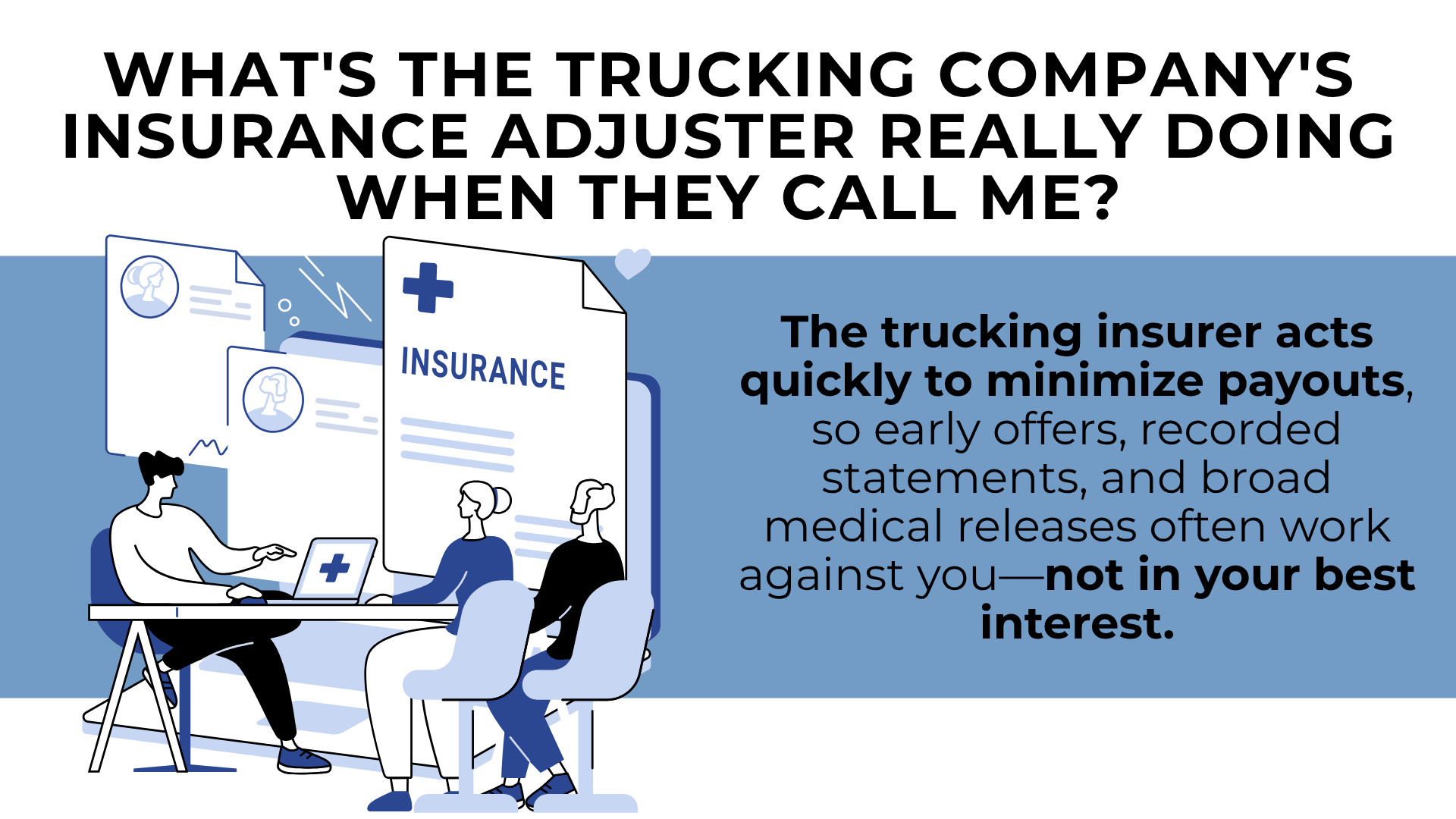
A trucking company’s insurer is typically on the scene of a serious crash almost immediately, sometimes within hours. Their representatives are trained, experienced, and measured professionally on how quickly and cheaply they close claims. That’s not a conspiracy; it’s the economics of the industry. But it means a few things are predictable.
Early offers are almost always low offers. The first number is based on the adjuster’s rapid internal estimate before you know the full extent of your injuries, before you know whether you’ll need future surgery, before a wage loss analysis has been done, and before anyone has developed evidence of the trucking company’s regulatory violations. Accepting early almost always means accepting less.
Recorded statements are risky. A request for a recorded statement is a request for ammunition. Off-the-cuff answers about “how you’re feeling” on day three — before you’ve even seen a specialist — can be quoted back months later to argue your injuries aren’t as serious as your medical records later show. You are not legally required to give one to the other party’s insurer.
Broad medical authorizations can be used against you. A blanket release granting access to your entire medical history gives the defense decades of records to mine for prior complaints that can be framed as pre-existing conditions unrelated to the crash.
The adjuster isn’t evil. They’re not the enemy. They’re simply not on your side, and understanding that distinction before you talk to them is often worth more than any single piece of advice in this article.
What evidence determines what my claim is worth — and why does it disappear so fast?
Truck cases are won and lost on evidence that exists only inside the trucking company’s control — and much of it has a short shelf life.
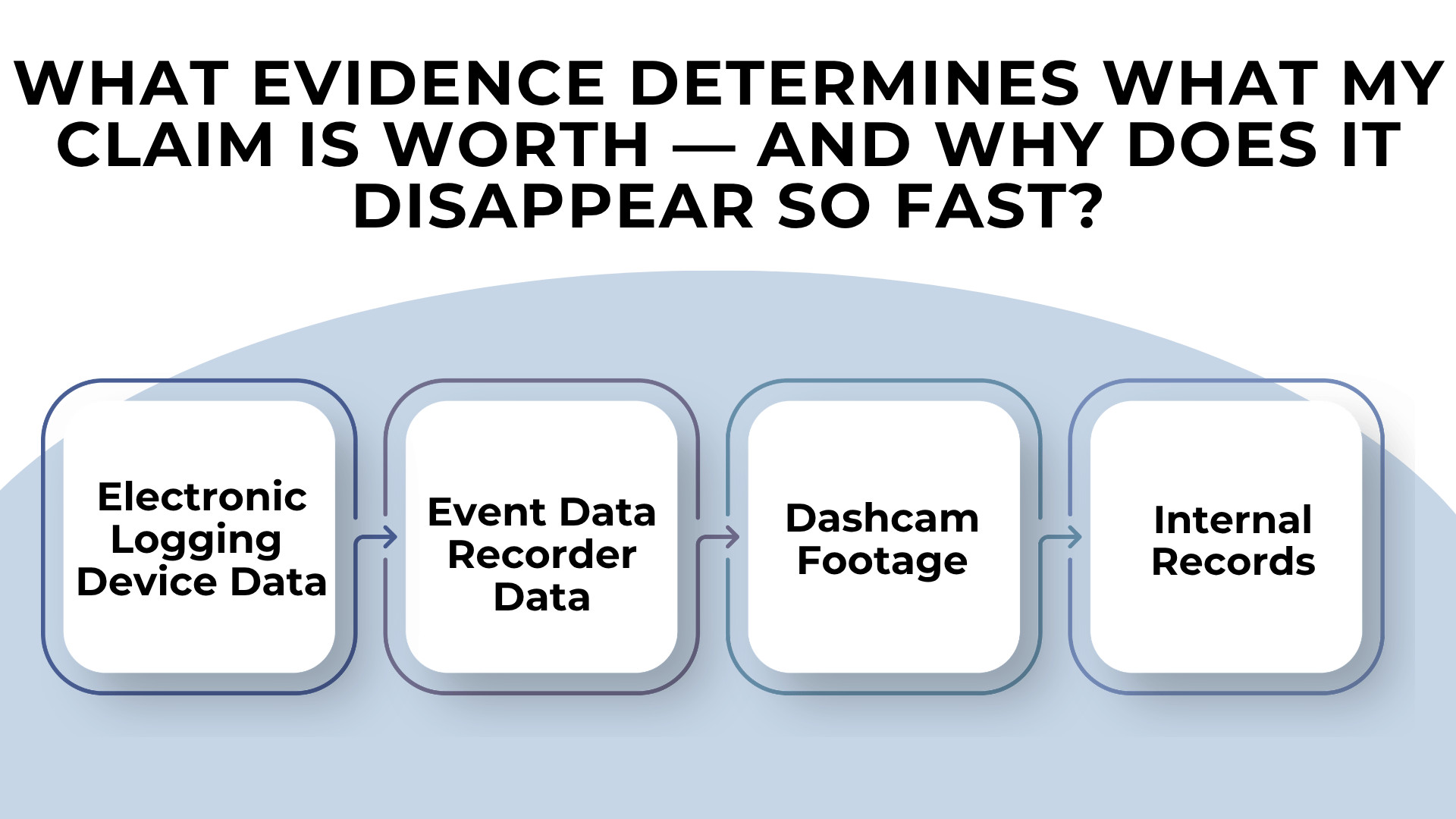
Electronic Logging Device (ELD) data shows exactly how long the driver had been on duty, how long they’d been driving, and whether they were following federal hours-of-service rules under 49 CFR § 395.3. That rule limits drivers to 11 hours of driving within a 14-hour on-duty window, following 10 consecutive hours off. Federal regulations only require carriers to retain ELD records of duty status for six months under 49 CFR § 395.8(k).
Event Data Recorder (“black box”) data from the truck itself can capture speed, braking, throttle position, and steering inputs in the seconds before impact. This data can be overwritten or lost if the vehicle is put back into service or repaired.
Dashcam and in-cab camera footage, if the truck was equipped, is often on a rolling loop that overwrites itself within days or weeks.
Dispatch records, GPS data, text messages between dispatcher and driver, driver qualification files, maintenance logs, brake inspection records, and post-crash drug and alcohol test results are all held by the trucking company and its contractors.
Connecticut does impose a common-law duty to preserve evidence once litigation is reasonably anticipated. And 49 CFR § 395.30(f) prohibits altering or erasing original ELD data. But “reasonably anticipated” generally means once the trucking company has been notified that a claim is coming. Until someone sends a formal preservation letter, the clock on routine retention keeps running.
This is the single biggest reason most truck accident attorneys push to get involved early — not to rush a claim, but to freeze the evidence.
What can affect how much I actually receive?
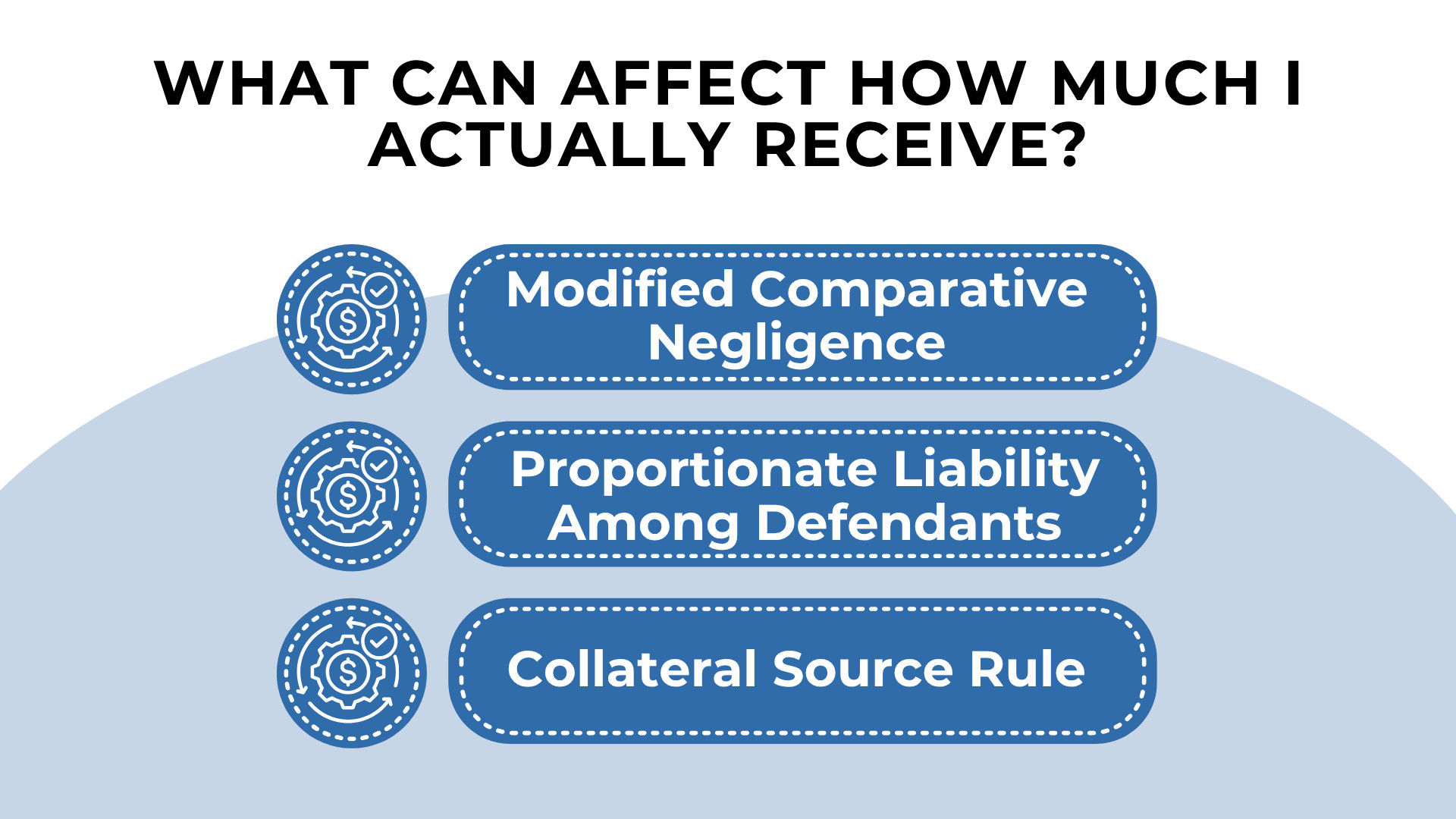
Three rules, in particular, shape the final number.
Modified comparative negligence. Under Conn. Gen. Stat. § 52-572h, if you are found more than 50 percent at fault for the crash, you recover nothing. If you are 50 percent or less at fault, you can recover, but your damages are reduced by your percentage of fault. A $500,000 claim where you are found 20 percent at fault becomes a $400,000 recovery. This is why how fault is framed, investigated, and argued matters enormously — especially when the defense is trying to shift blame onto the injured person.
Proportionate liability among defendants. Connecticut abolished joint and several liability in negligence cases. Each defendant pays only their proportionate share of fault under Conn. Gen. Stat. § 52-572h(c)–(d). In practice, this is another reason identifying and pursuing every responsible party matters. If one defendant is out of money or underinsured, their share isn’t automatically picked up by the others unless specific reallocation rules under § 52-572h(g) apply. One important exception: apportionment does not apply to reckless conduct under § 52-572h(o), which can meaningfully change the math when the driver’s behavior crosses from negligent to reckless.
The collateral source rule. Under Conn. Gen. Stat. § 52-225a, economic damages can be reduced after the verdict by payments you’ve already received from collateral sources like health insurance — but only if there’s no right of subrogation. Where your health insurer has a subrogation right (and most do), no reduction applies. Non-economic damages are never subject to collateral source reduction.
None of these rules makes the process arbitrary. They make it structured — which is why the value of a case is built through investigation and documentation, not guessed.
How long do I have to file a truck accident claim in Connecticut?
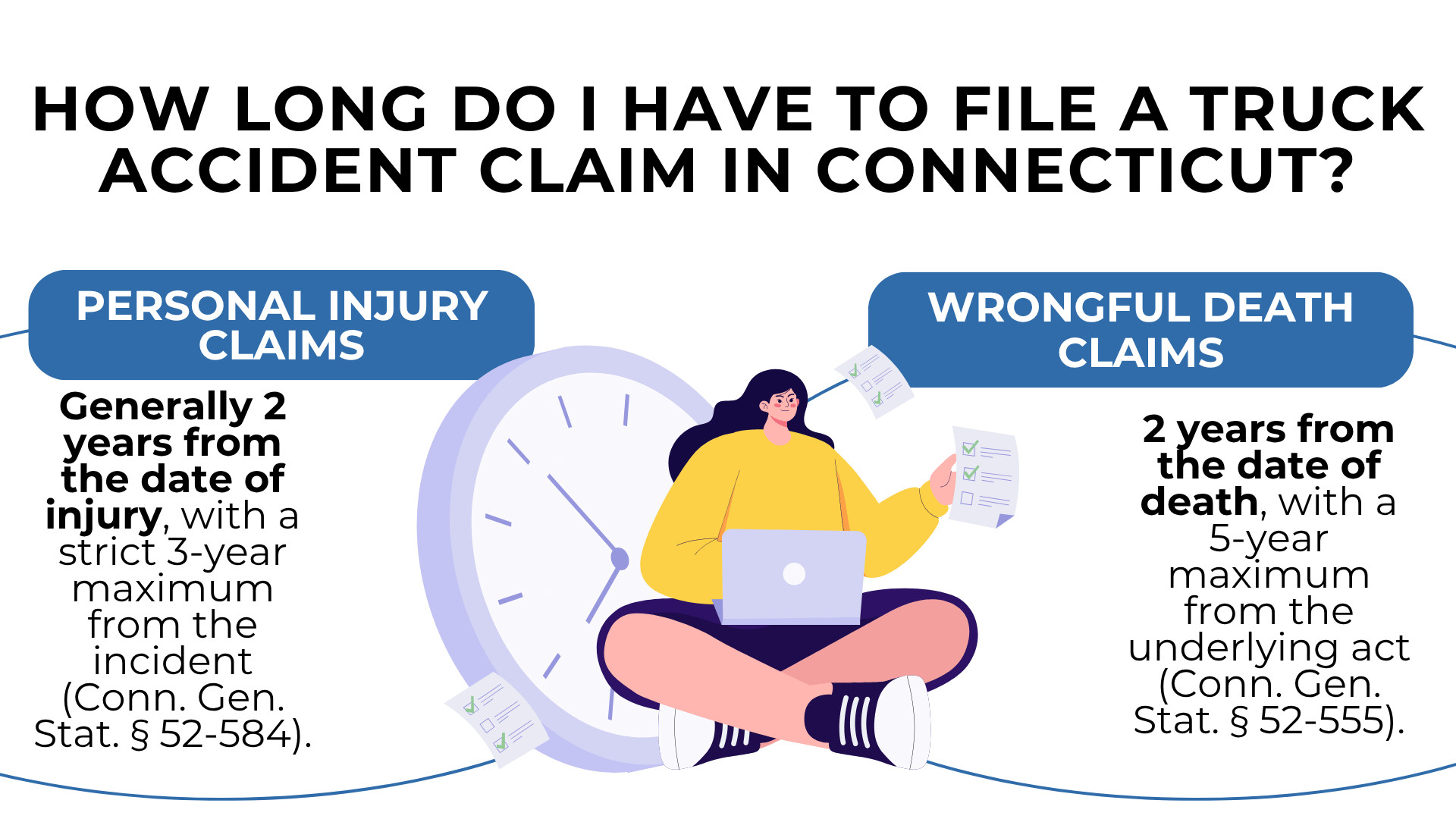
For most truck accident injury claims, Connecticut gives you two years from the date of injury under Conn. Gen. Stat. § 52-584, with an absolute outer limit of three years from the act or omission. For wrongful death, Conn. Gen. Stat. § 52-555 requires the action to be brought within two years from the date of death, and no more than five years from the date of the underlying act or omission.
One rule deserves particular attention: Connecticut is the only state that does not toll the negligence statute of limitations for minors. If a child is injured, parents must bring the claim within the standard two-year window.
Deadlines in Connecticut trucking cases are shorter and less forgiving than many people assume. Waiting to see how your recovery goes before talking to an attorney can narrow your options even when you think you still have time.
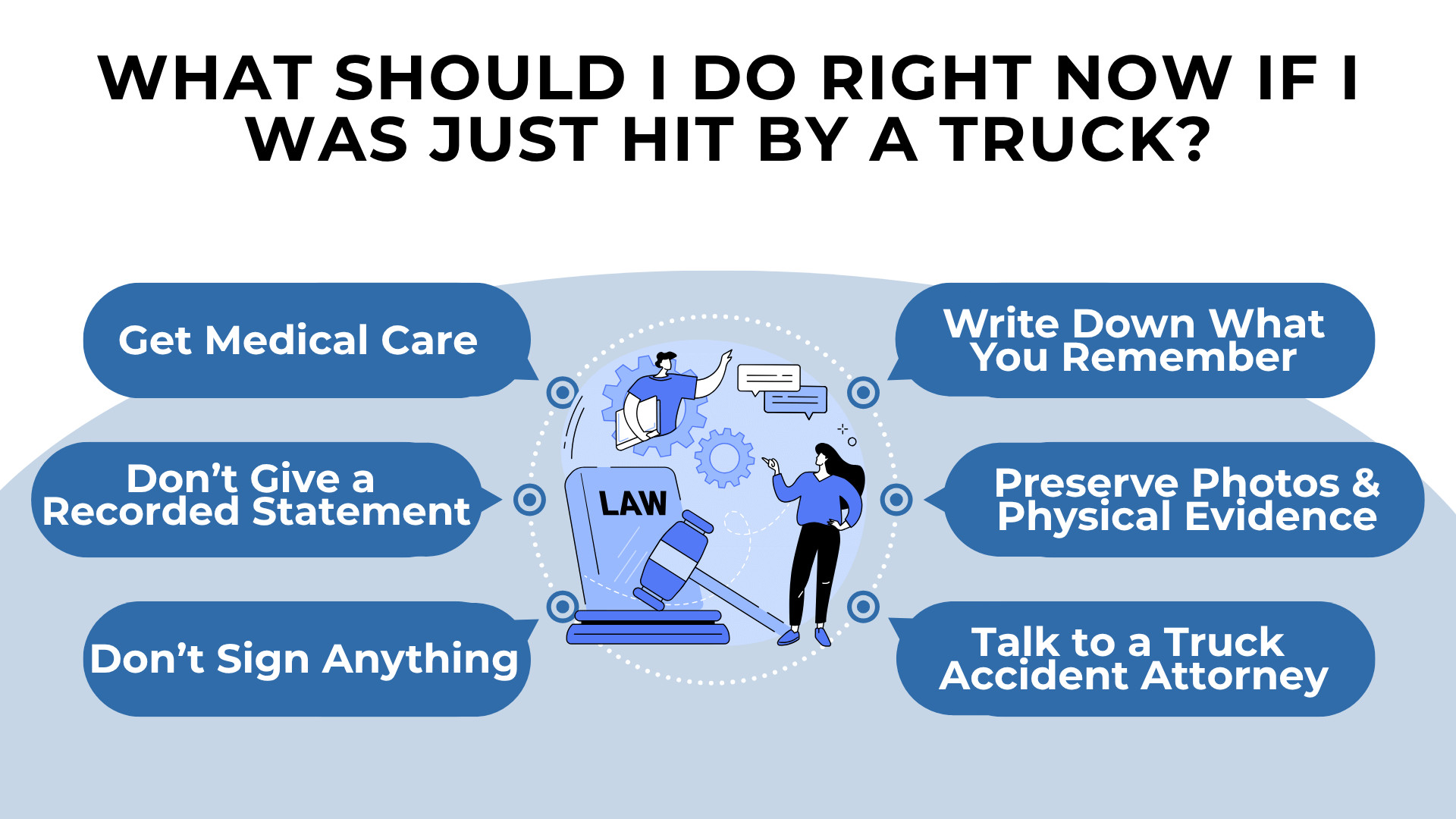
What should I do right now if I was just hit by a truck?
A short list, in rough order of importance:
Get medical care and keep going. Gaps in treatment are the single most common way serious injuries get reframed as minor ones. Follow through on every appointment, referral, and recommendation.
Don’t give a recorded statement to the trucking company’s insurer. You can politely decline. Anything you say can be used against you later.
Don’t sign anything from the other side. Broad medical authorizations, property damage releases with liability-waiver language buried inside, quick settlement checks — all of these can cut off your rights before you know what the case is worth.
Write down what you remember while it’s fresh. The sequence of events, what the truck was doing, what you saw, who stopped, what was said at the scene. Memory fades quickly after trauma.
Preserve photos and physical evidence. Photos of the scene, the vehicles, your injuries, your car before it’s repaired or totaled.
Talk to a truck accident attorney before the evidence window closes. A preservation letter sent early is the difference between having the data that wins the case and arguing about data that no longer exists.
Everything about this is overwhelming, and no article can replace a conversation about your specific circumstances. If you or a family member was injured in a truck crash in Connecticut, the attorneys at Etemi Law in Waterbury handle commercial trucking cases and can talk through what you’re actually dealing with and what your options look like.