
What Is the Average Settlement for a Car Accident Back and Neck Injury in Connecticut?

There is no single reliable average settlement for a car accident back or neck injury. But there are national benchmarks that help frame what these claims are worth, and Connecticut-specific legal rules that determine how high yours can go.
Workers’ compensation data offers a sharper benchmark than national bodily injury averages: the average lost-time claim from a motor vehicle crash was $91,433 — nearly double the $47,316 average for all workplace injury causes. The National Safety Council estimates each nonfatal disabling injury carries an economic cost of $174,000 before quality-of-life factors are considered. Those figures reflect very different injuries combined into single numbers. A resolved whiplash case and a cervical fusion surgery both count toward the same “average,” which is why that number is almost useless for predicting what any individual case is worth.
What matters more than a national average is what Connecticut law allows you to recover. Under Conn. Gen. Stat. § 52-572h(a), compensatory damages include both economic losses (medical care, rehabilitative services, custodial care, lost earnings, and lost earning capacity) and noneconomic losses (physical pain and suffering and mental and emotional suffering). Connecticut imposes no statutory cap on either category. The ceiling on a back or neck injury settlement is set by the medical evidence and the impact on your life, not by a legislative formula.
What Types of Back and Neck Injuries Pay Out the Most After a Car Accident?
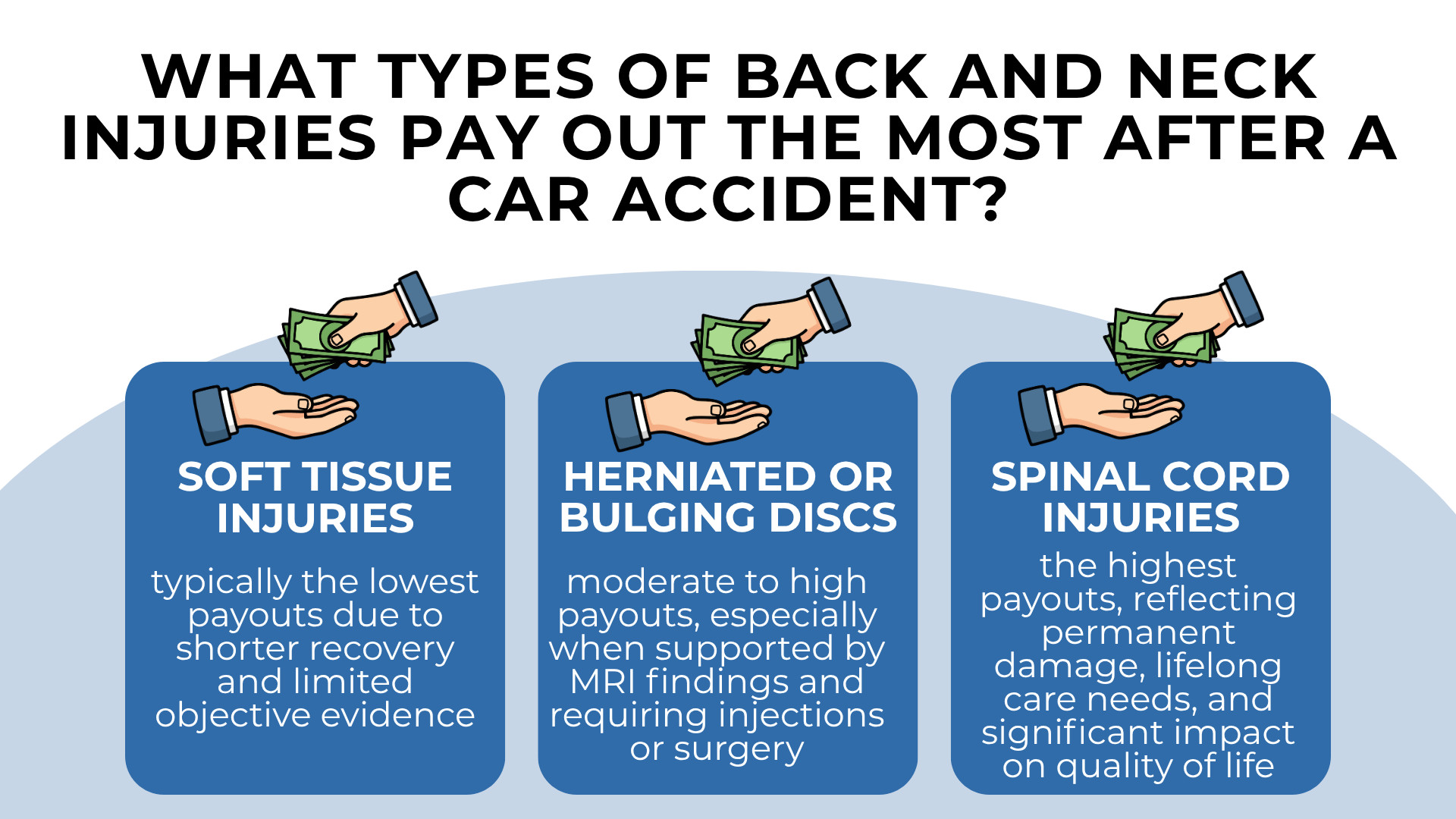
The single biggest variable in settlement value is the type and severity of the injury itself. Back and neck injuries from car accidents generally fall along a spectrum. Where your injury lands on that spectrum largely determines what range of compensation is realistic.
Soft tissue injuries and whiplash — strains, sprains, and muscle tears in the cervical or lumbar spine — tend to produce the lowest settlement values. These injuries are real and often painful, but they typically resolve with conservative treatment over weeks or months. Because they don’t always show up on imaging, insurers frequently push back harder on their value.
Herniated and bulging discs fall in the middle range. When a disc in the cervical or lumbar spine herniates and compresses a nerve root, the injury usually shows clearly on MRI and causes radiating pain. It may require epidural injections or physical therapy extending over many months. If surgery becomes necessary — a discectomy, laminectomy, or spinal fusion — the settlement value increases significantly because the medical costs, recovery time, and long-term impact of the condition all increase.
Spinal cord injuries represent the highest tier. Motor vehicle crashes are the leading cause of traumatic spinal cord injury in the United States, accounting for 37.3% of all new cases, according to the National Spinal Cord Injury Statistical Center. Life expectancies for people with traumatic spinal cord injuries remain well below general population life expectancies and have not improved since the early 1980s after the first year post-injury. These are lifelong injuries with significant ongoing care costs, and settlements reflect that reality.
The point is not to self-diagnose. It’s to understand that if you’re searching for an “average,” you’re looking at a number that blends whiplash cases resolving in six weeks with spinal cord injuries requiring decades of care. Those are not the same claim, and no average captures both.
Why Shouldn’t You Settle Before You Know What Your Claim Is Actually Worth?
Everything above points to the same conclusion: the number that brought you to this page — “average settlement for car accident back and neck injury” — doesn’t exist in any form that’s useful for your case. National benchmarks combine soft tissue whiplash and catastrophic spinal cord injuries into the same number — which is why no published average can predict what a specific case is worth. The type of back or neck injury, its severity, and the medical evidence documenting it are what actually determine where a case falls on the spectrum. Connecticut’s no-cap damages framework means the upper end is defined by the facts, not by a statute.
What isn’t knowable from a Google search is what a specific case is worth. That requires a case-specific evaluation — a review of the medical records, the accident facts, the available insurance coverage, and the strength of the liability position.
Etemi Law, based in Waterbury, Connecticut, handles motor vehicle accident injury claims with an approach built around trial readiness. Ron Etemi, lead litigator and co-founder, has tried over 100 cases to verdict and received the Top Verdict Award. Peter Brown has 175 jury verdicts and spent his first 15 years in practice trying cases as a defense lawyer — meaning he understands how the other side builds its case. That kind of trial experience is what gives a settlement demand credibility, because insurers price their offers based on what they think will happen if the case doesn’t settle.
If you’re trying to figure out what a back or neck injury from a car accident is worth, the most direct path from where you are now to an actual answer is a conversation with an attorney who can evaluate the facts of your case.