Car Accident Lawyer Connecticut: What to Know Before You Hire

If you’re searching for a car accident lawyer in Connecticut, you’re looking for someone who can help you get compensation after a crash — and who you can trust to handle the legal process while you deal with everything else. Connecticut’s fault-based system means the driver who caused your accident is legally responsible for your damages. But collecting what you’re owed requires proving negligence, navigating insurance tactics, and meeting strict deadlines that most people don’t know exist until it’s too late.
This page covers how fault works in Connecticut, what your case could be worth, what happens if the other driver is uninsured, how long you have to file, what the process looks like start to finish, and what it costs to hire a lawyer. It also explains why Etemi Law, based in Waterbury, handles these cases the way we do.
Do I actually need a lawyer after a car accident in Connecticut?
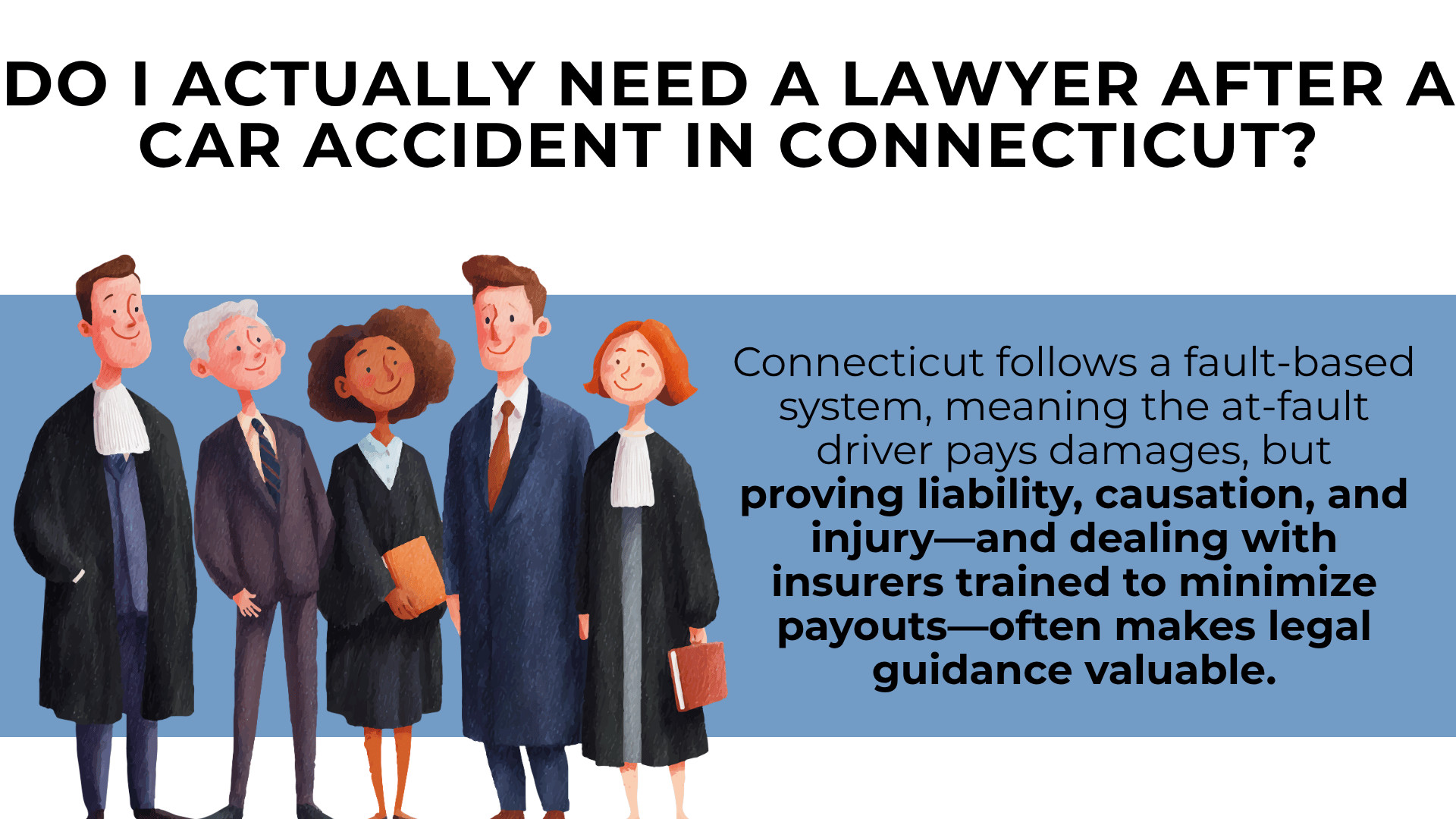
Connecticut is not a no-fault state. It uses a traditional tort-based liability system, which means the person who caused the accident is responsible for compensating you. That sounds straightforward, but in practice it means the outcome of your case depends entirely on proof — proof of what the other driver did, proof that it caused your injuries, and proof of what those injuries have cost you and will continue to cost you.
Under Connecticut law, a motor vehicle negligence claim requires four elements: duty, breach of that duty, causation, and actual injury. The existence of a duty is a question of law decided by the court; whether that duty was violated is decided by the jury. Every driver on a Connecticut road owes both a statutory duty to comply with Title 14 of the Connecticut General Statutes and a common-law duty to drive as a reasonably prudent person under the same or similar circumstances.
Insurance companies know these elements inside out, and their adjusters are trained to minimize what they pay. They may contact you early, ask for a recorded statement, or offer a settlement before you understand the full extent of your injuries. A lawyer levels the playing field — and just as importantly, keeps you from missing the procedural deadlines that can eliminate your claim entirely.
How does Connecticut decide who’s at fault — and what if I’m partly to blame?
This is one of the most common concerns people have, and it’s worth addressing directly: being partially at fault for your accident does not automatically disqualify you from recovering compensation in Connecticut.
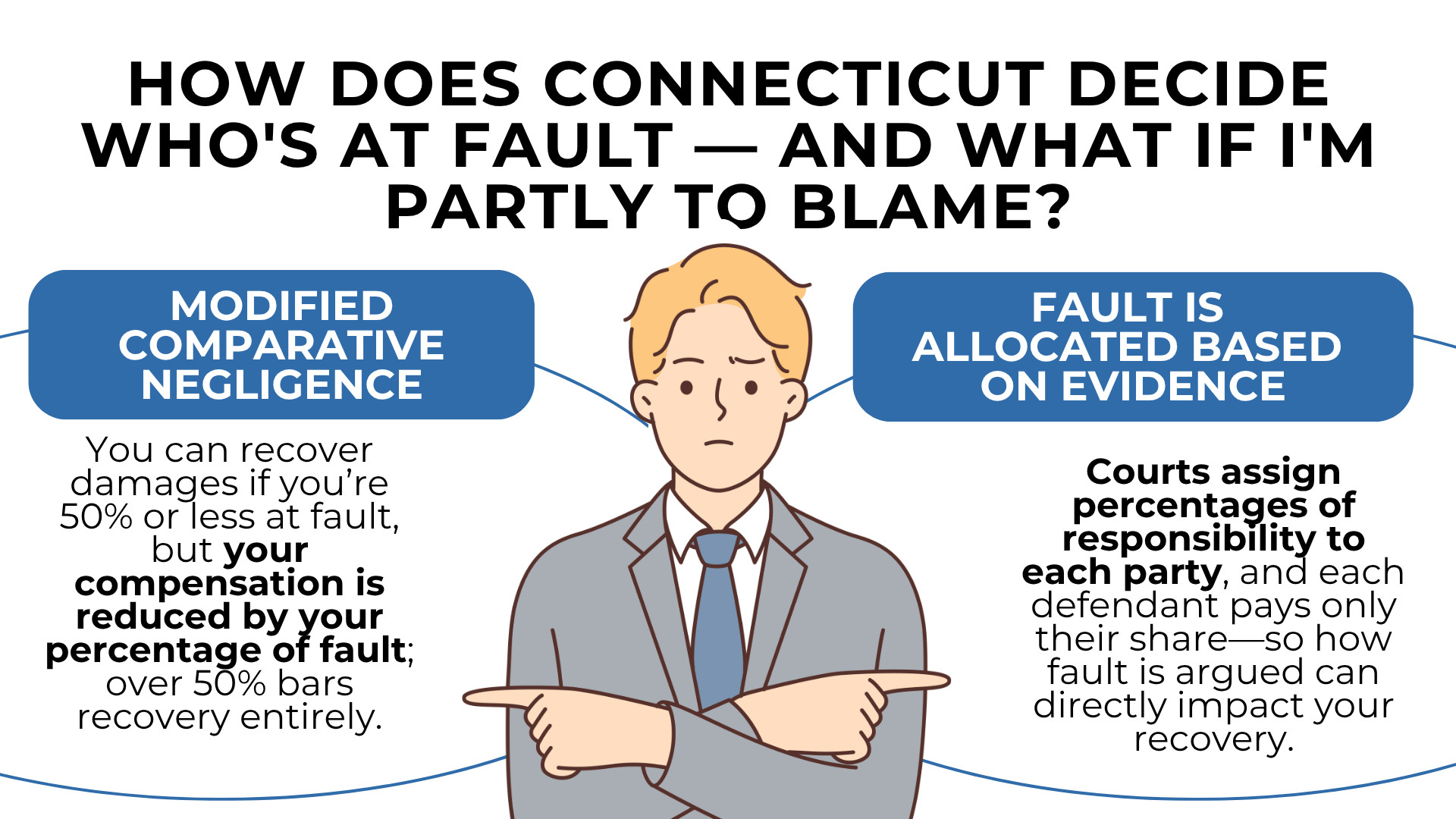
Connecticut follows a modified comparative negligence system under Conn. Gen. Stat. § 52-572h. Here’s how it works. If your share of fault is 50% or less, you can still recover damages — they’ll just be reduced by your percentage of negligence. If you’re found to be 30% at fault and your damages total $100,000, you’d recover $70,000. But if your fault exceeds 50% — meaning you’re 51% or more responsible — recovery is completely barred.
Connecticut has also abolished the old doctrines of assumption of risk and last clear chance under § 52-572h(l), so the defense can’t use those arguments against you. And the state uses proportionate (several) liability rather than joint and several liability, meaning each defendant pays only their share of the damages.
What matters here is how fault is presented and argued. The percentage assigned to you is not a fixed fact — it’s the result of evidence, testimony, and legal argument. That’s where representation makes a measurable difference.
What can I actually recover in a Connecticut car accident case?
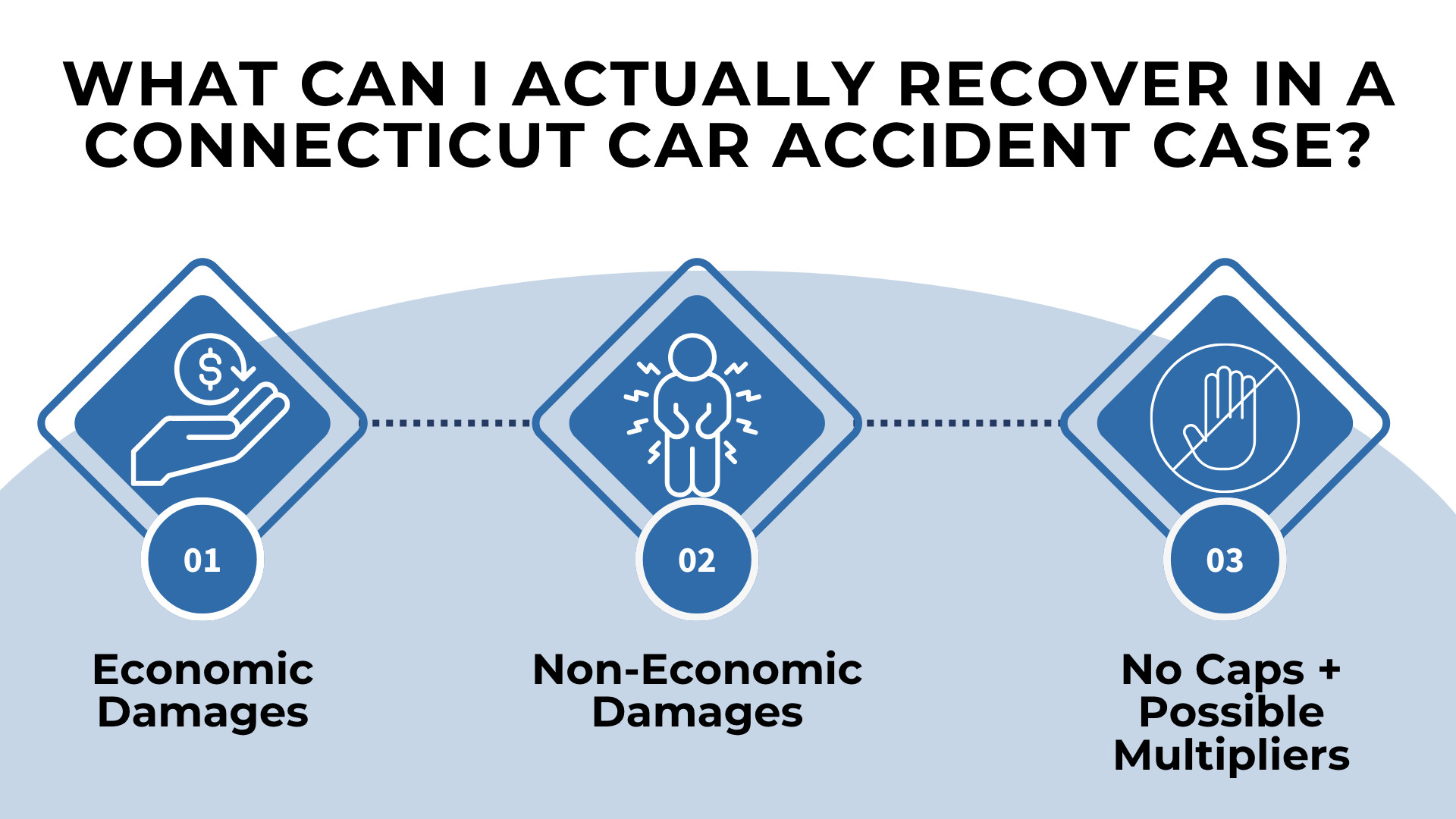
Connecticut divides compensatory damages into two categories. Economic damages cover your measurable financial losses: medical expenses, rehabilitation costs, lost wages, and lost earning capacity. Non-economic damages cover everything that doesn’t come with a receipt: physical pain and suffering, mental and emotional suffering, and loss of enjoyment of life. These categories are defined under Conn. Gen. Stat. § 52-572h(a).
The critical fact most people don’t know is that Connecticut imposes no statutory cap on compensatory damages in personal injury cases — neither economic nor non-economic. Unlike many states that limit pain and suffering awards, Connecticut allows juries to award everything the evidence supports.
The numbers involved in car accident injuries are significant. Connecticut hospitals billed nearly $1.7 billion for crash-related treatment in 2023. Motor vehicle crashes are also the leading cause of traumatic spinal cord injury nationally, accounting for 37.3% of all new cases. Traumatic brain injuries from vehicle crashes account for roughly 20.4% of all TBI-related hospitalizations. These aren’t injuries that resolve in weeks — they reshape lives and livelihoods, and your compensation should reflect that.
There’s also a provision that can greatly increase your recovery in certain cases. Under Conn. Gen. Stat. § 14-295, the court may award double or triple compensatory damages if the driver who caused your accident was operating with deliberate or reckless disregard. This includes violations of statutes covering reckless driving (§ 14-222) or DUI (§ 14-227a). This multiplier applies on top of your full compensatory award. It sits outside the usual common-law punitive damages rules, which in Connecticut are otherwise limited to legal costs.
Connecticut recorded 113 alcohol-impaired-driving fatalities in 2023, representing 37% of the state’s total traffic deaths — well above the national average of 30%. The state also had the highest percentage of speeding drivers who were alcohol-impaired (53%) of any state in 2023. If your crash involved impairment or recklessness, the § 14-295 multiplier may apply. Comparative negligence is not a defense to reckless conduct under § 52-572h(o).
What if the other driver doesn’t have enough insurance — or no insurance at all?
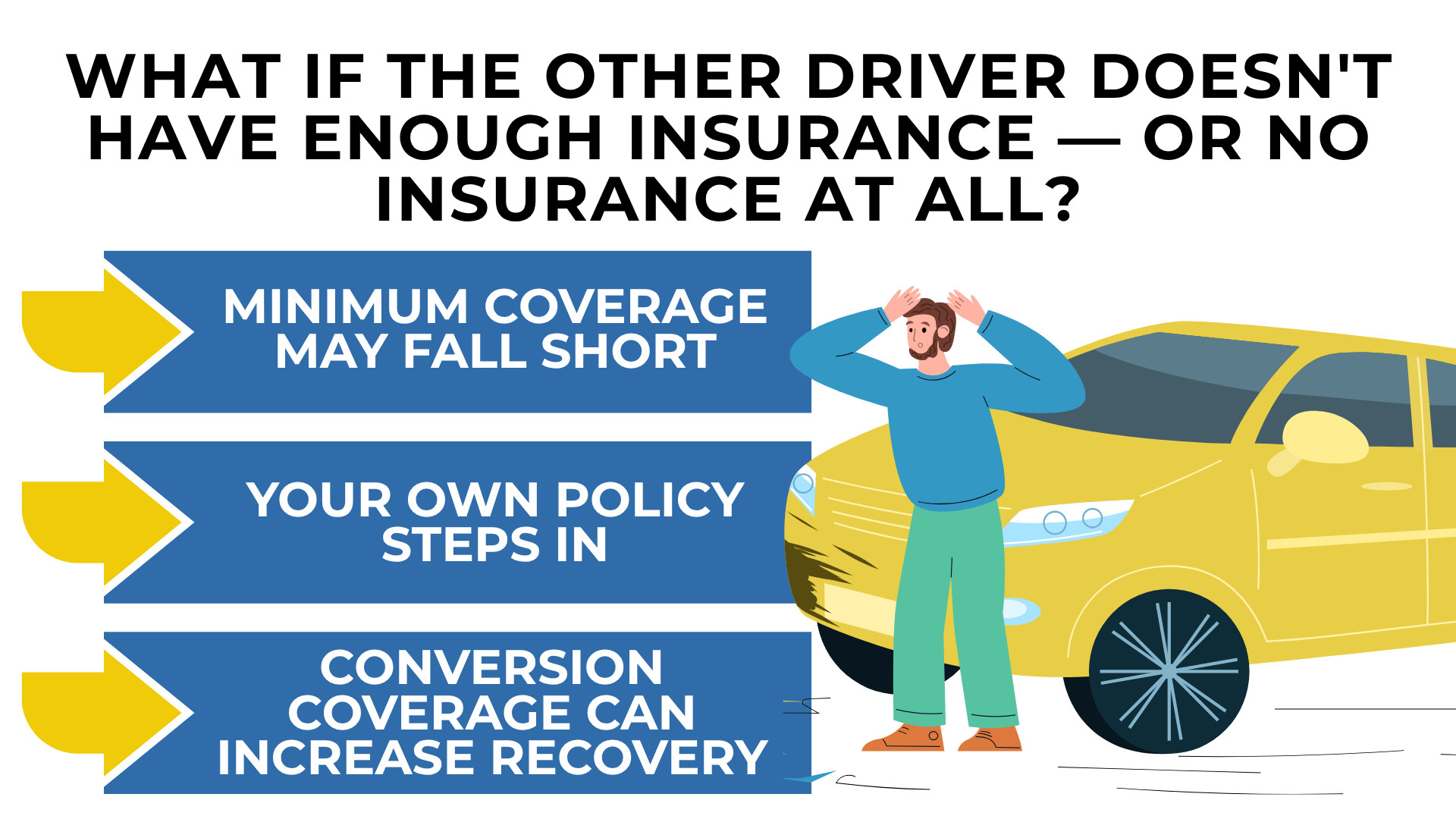
This is a scenario most people don’t think about until they’re in it. Connecticut law requires all registered vehicle owners to carry minimum liability coverage of $25,000 per person for bodily injury or death, $50,000 per accident for bodily injury or death to more than one person, and $25,000 for property damage under Conn. Gen. Stat. § 14-112. But those minimums often don’t come close to covering serious injuries.
An estimated 11.8% of Connecticut drivers are uninsured, and even those who carry insurance may carry only the bare minimum. When the at-fault driver’s coverage isn’t enough, your own policy becomes critical.
Under Conn. Gen. Stat. § 38a-336, every automobile liability insurance policy issued in Connecticut must include uninsured and underinsured motorist (UM/UIM) coverage. This coverage protects you when the person who hit you either has no insurance or doesn’t have enough to cover your damages. Connecticut law also requires insurers to offer underinsured motorist conversion coverage under § 38a-336a. Under conversion coverage, the at-fault driver’s liability payments do not reduce your conversion benefits. That means you can collect from both.
Understanding your own policy’s UM/UIM limits and whether you carry conversion coverage is one of the first things a lawyer will assess after a crash. It can completely change what recovery is available to you.
How long do I have to file, and what happens if I wait too long?
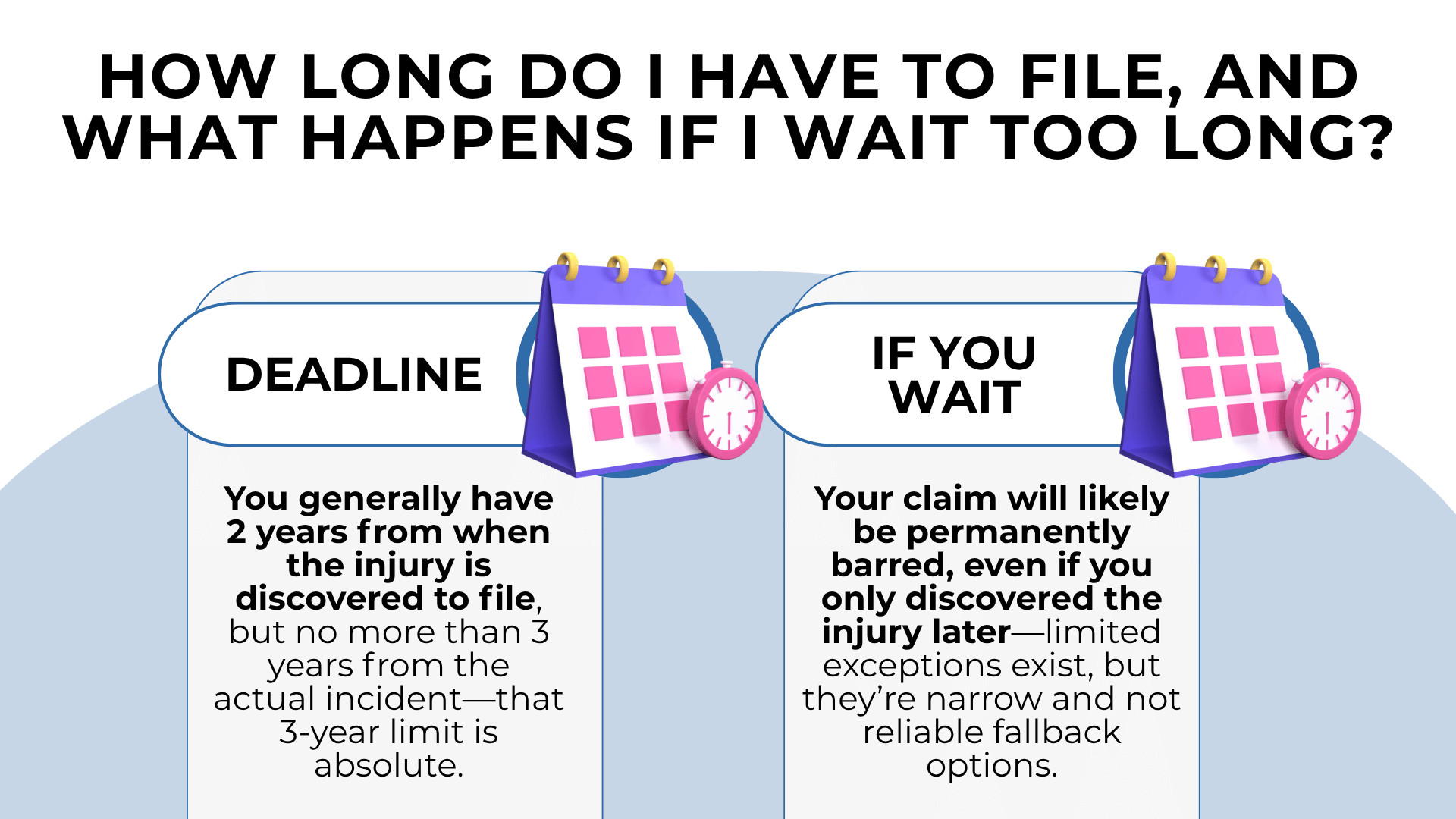
Connecticut’s statute of limitations for a personal injury claim based on negligence is two years from the date the injury is first sustained or discovered, or in the exercise of reasonable care should have been discovered, under Conn. Gen. Stat. § 52-584. There is also an absolute three-year statute of repose measured from the date of the act or omission that caused the injury.
The word “absolute” matters. The Connecticut Supreme Court has held that the three-year repose period cannot be extended even when the discovery rule would otherwise apply. In Tarnowsky v. Socci, 271 Conn. 284 (2004), the Court held that the two-year limitation does not begin until the plaintiff knows or reasonably should know the identity of the person responsible. But the three-year repose is a hard ceiling.
There are saving statutes. Conn. Gen. Stat. § 52-593a allows a claim to survive if the lawsuit papers are delivered to the court within the limitation period and served within 30 days. Separately, § 52-592 provides a one-year window to refile if a timely-filed action fails on its merits, results in a nonsuit, or a judgment for the plaintiff is reversed. But these are safety nets for narrow situations, not substitutes for acting within the primary window.
Connecticut recorded approximately 104,260 total reported crashes in 2024. Every one of those crashes started a clock. If you’re reading this after an accident, yours is already running.
How does the process work from the first call to resolution?
The uncertainty of not knowing what comes next is one of the hardest parts of dealing with a car accident case. Here’s what the process generally looks like.
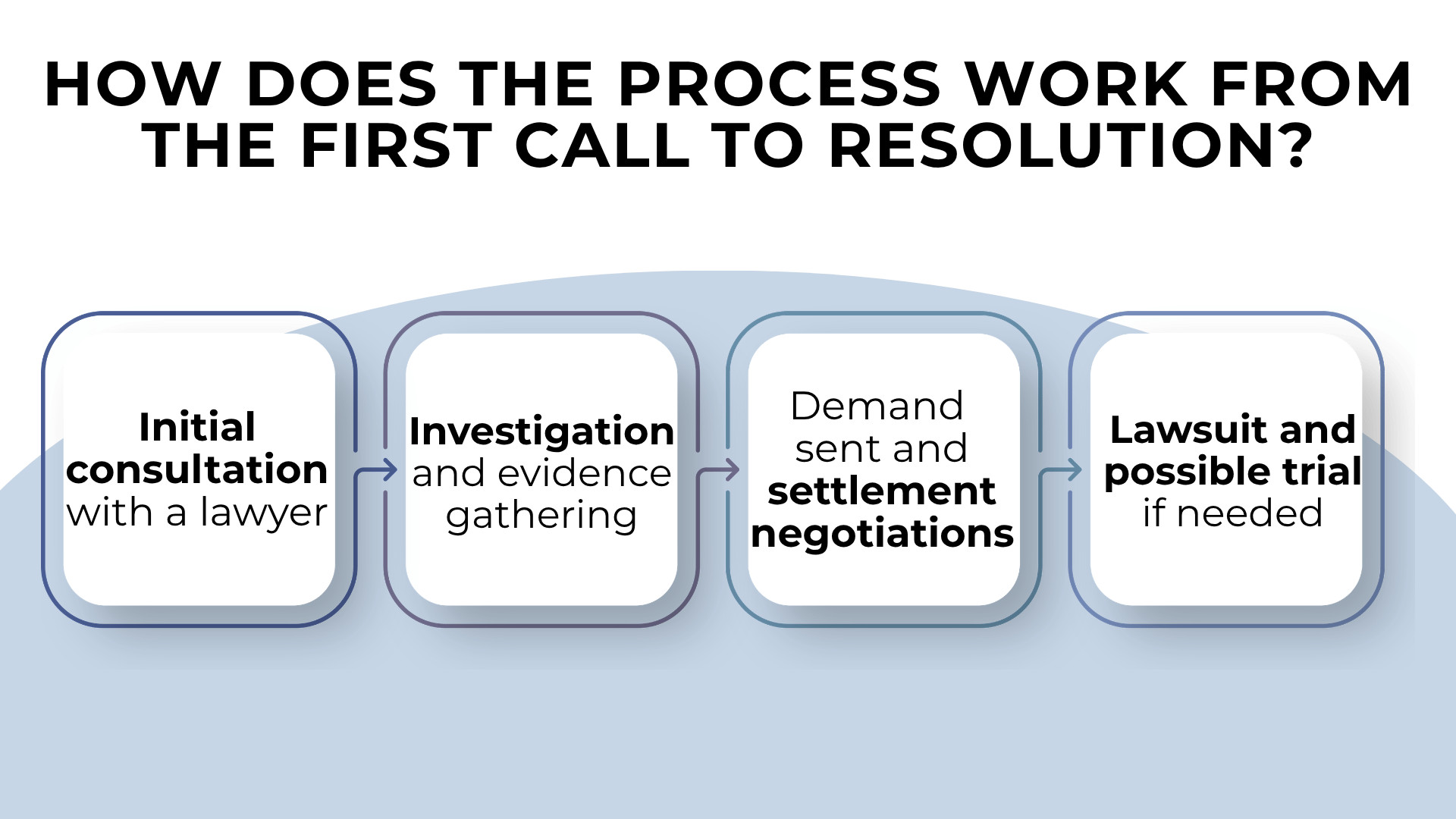
It starts with an initial consultation, where a lawyer reviews the facts of your crash, your injuries, your insurance coverage, and the strength of the evidence. At Etemi Law, this consultation is free and carries no obligation.
From there, the firm investigates — gathering police reports, medical records, witness statements, and any available physical or digital evidence. Connecticut’s presumption under Conn. Gen. Stat. § 52-114 — that you were exercising reasonable care at the time of the accident — works in your favor at this stage, placing the burden on the defendant to prove otherwise.
Once your damages are clear and you’ve reached maximum medical improvement — or your treating physicians can project future needs — your lawyer presents a demand to the at-fault driver’s insurance carrier. Most cases are resolved through negotiation at this stage.
If the insurer won’t offer a fair settlement, the next step is filing a lawsuit. This opens the discovery phase — depositions, document requests, expert disclosures — and moves the case toward trial. Not every case goes to trial, but your lawyer’s willingness and ability to try the case is what gives settlement negotiations their weight.
The timeline varies. Straightforward cases may resolve in months. Complex injuries, disputed liability, or cases involving multiple parties can take longer. Each phase builds on the last. Early decisions — preserving evidence, documenting treatment, meeting deadlines — shape everything that follows.
What does it cost to hire a car accident lawyer in Connecticut?
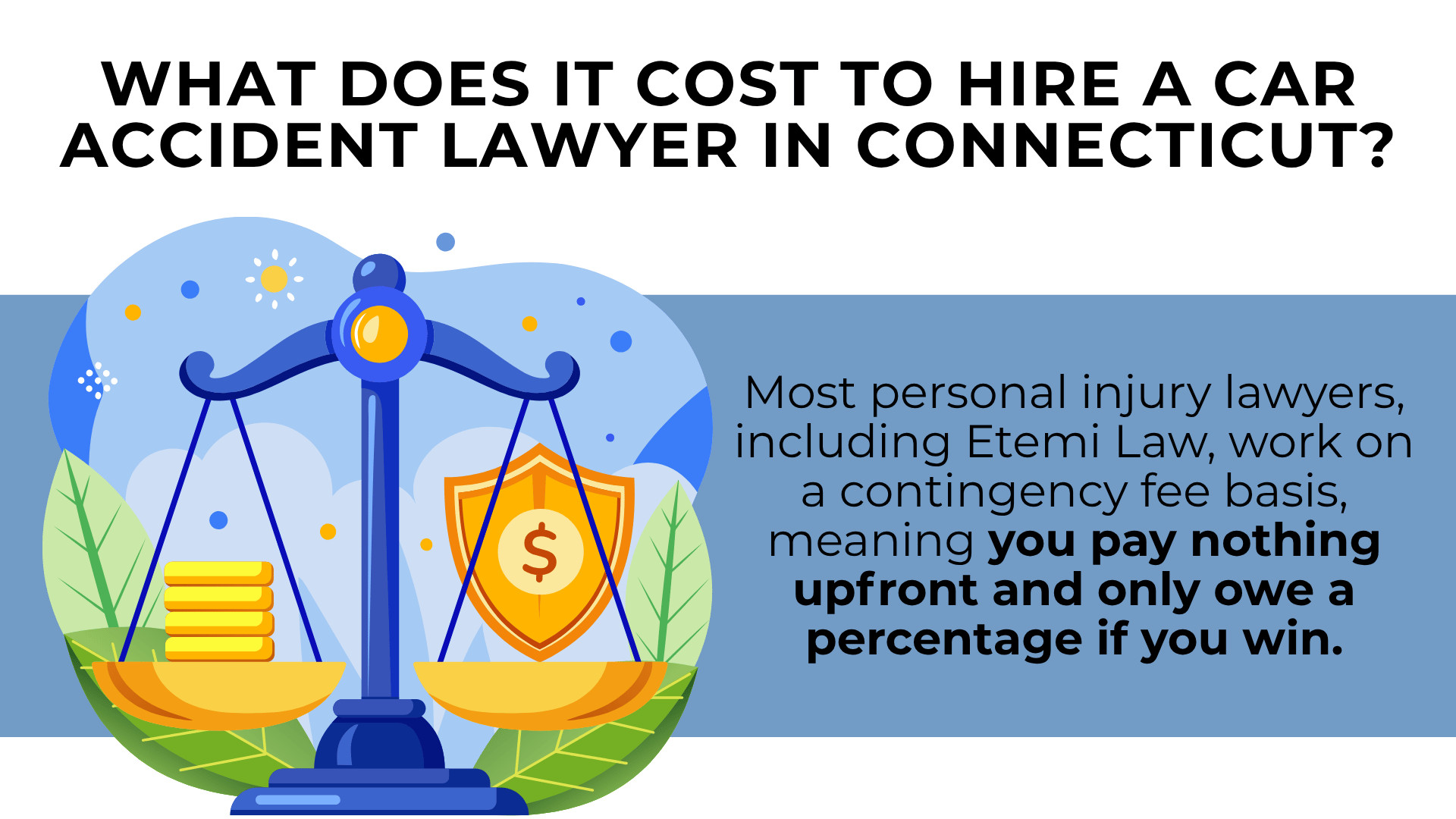
Most personal injury lawyers, including Etemi Law, work on a contingency fee basis. That means you pay nothing upfront. No retainer, no hourly billing. The firm’s fee is a percentage of the recovery, collected only if the case results in a settlement or verdict in your favor. If there’s no recovery, you owe nothing for attorney’s fees.
This model exists because access to legal representation shouldn’t depend on whether you can afford to pay a lawyer while you’re already dealing with medical bills and lost income. It also aligns your lawyer’s incentive directly with yours: the better the outcome, the better it is for both of you.
Why choose Etemi Law for your Connecticut car accident case?
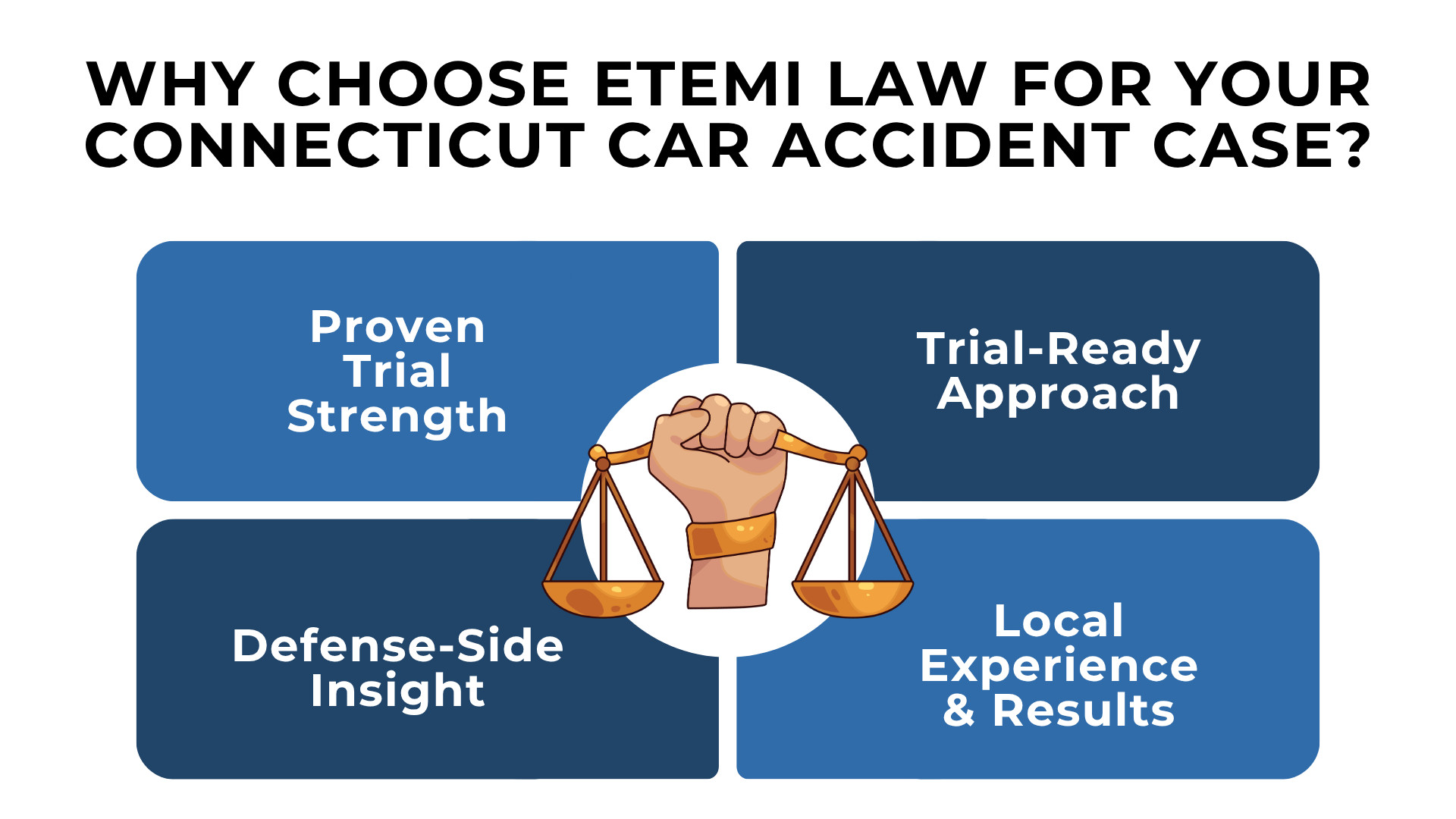
Etemi Law is a personal injury firm based in Waterbury, Connecticut — one of the municipalities with the highest crash volumes in the state. The firm handles motor vehicle accident and commercial trucking accident cases across Connecticut, and its attorneys have the courtroom record to back up their negotiations.
Ron Etemi, co-founder and lead litigator, is a graduate of the University of Connecticut School of Law with honors, with over 15 years of experience and more than 100 cases tried to verdict. He received the Top Verdict Award and is known for his trial readiness, strategic case development, and ability to confront insurance companies and corporate defendants without hesitation.
Peter Brown has been practicing since 1990 and has 175 jury verdicts to his name. His first 15 years were spent as a civil defense trial lawyer — one of the most respected in the state of Connecticut — giving him extensive firsthand experience with how the defense side prepares and argues cases.
Lou Etemi, co-founder and University of Connecticut School of Law graduate, has helped hundreds of clients through strategic negotiation and relentless advocacy. Semir Dervisi, also a UConn Law graduate, brings a detail-oriented approach to case strategy with extensive experience in depositions, arbitration, and trial preparation.
This team doesn’t hand your case to a paralegal and hope the insurer makes a reasonable offer. They prepare every case as if it’s going to trial — because that preparation is what produces results whether the case settles or not.
Talk to a Connecticut car accident lawyer today
If you’ve been injured in a car accident in Connecticut, the statute of limitations is already running. A consultation with Etemi Law is free, confidential, and comes with no obligation. You’ll speak with an attorney who can assess your case, explain your options, and tell you honestly whether you need representation.
Call Etemi Law in Waterbury or contact the firm through etemilaw.com to schedule your free consultation.