Truck Accident Settlement in Connecticut: What Determines Your Case Value and How to Protect It
This article explains how truck accident settlements work in Connecticut — what makes these cases legally and financially different from ordinary car accidents, what factors drive settlement value, who can be held liable, what evidence matters most, and how quickly that evidence can disappear. If you’re evaluating a potential truck accident claim, the legal rules explained here will help you understand what your case may be worth and what steps protect it.
Truck accident claims operate under a different set of rules than standard motor vehicle cases. Connecticut has adopted the Federal Motor Carrier Safety Regulations as state law under Conn. Gen. Stat. § 14-163c. That means trucking companies and their drivers are held to regulatory standards that don’t apply to ordinary motorists. Violating those regulations can establish negligence as a matter of law — not just evidence of carelessness, but a legal conclusion that the defendant was negligent. The insurance minimums are higher, the number of potentially liable parties is larger, and the injuries tend to be more severe. Understanding these rules is the difference between accepting a settlement that reflects your actual losses and accepting one that doesn’t.
What Makes Truck Accident Cases Different From Car Accident Claims
The most immediate difference is physical. A fully loaded tractor-trailer can weigh 20–30 times the weight of a typical passenger car and requires 20–40% more stopping distance. That mass disparity produces catastrophic outcomes. Nationally, 5,472 people were killed in large truck crashes in 2023 — an 8% decrease from 2022, but still 38% higher than 2009. In Connecticut specifically, 37 people were killed in large truck crashes in 2023, with 26 of those deaths being occupants of other vehicles. Large trucks made up just 5% of all registered vehicles nationally but were involved in 9% of all vehicles in fatal crashes.
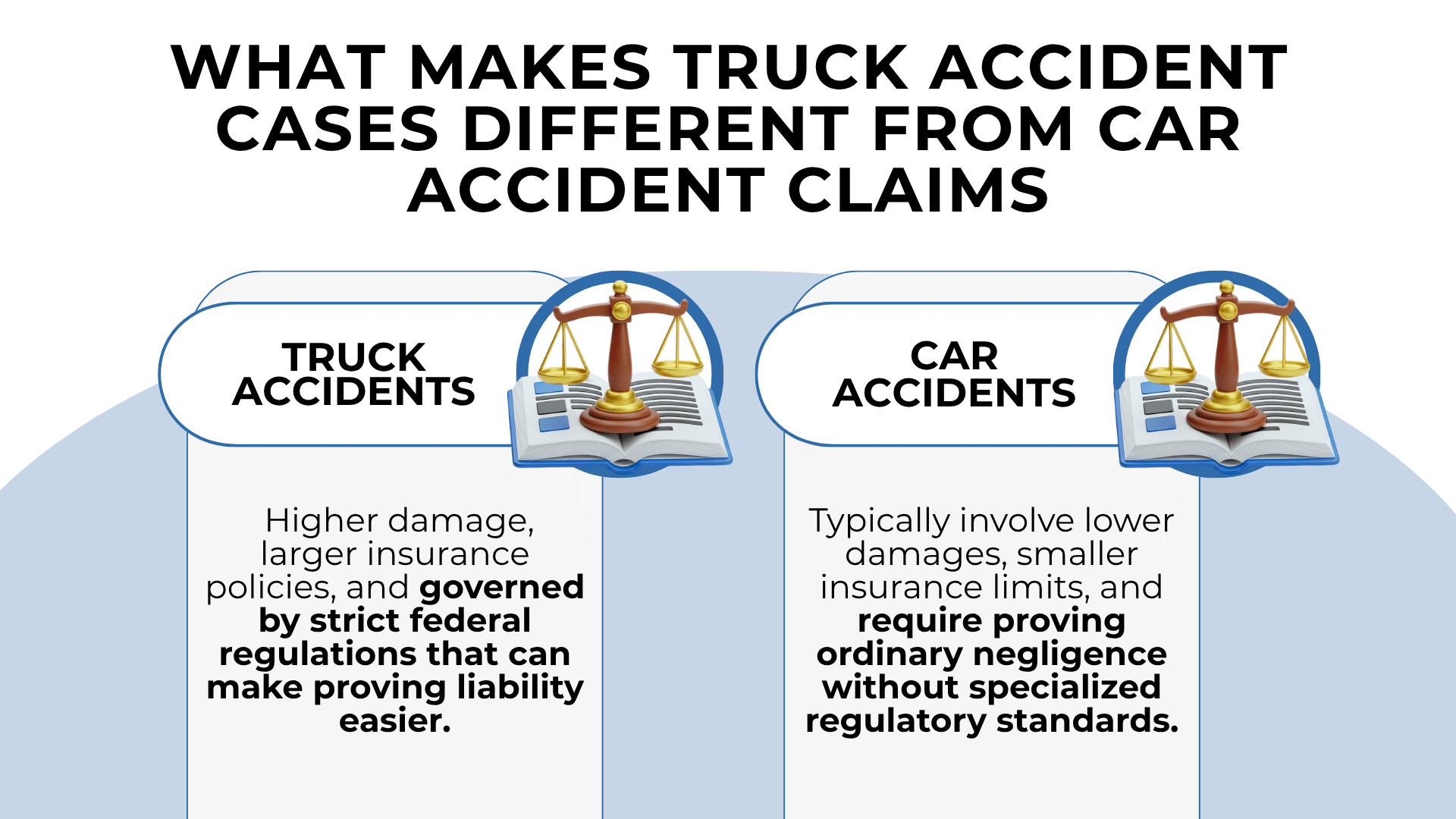
But the legal differences matter just as much as the physical ones. Federal law requires interstate carriers hauling general freight to carry a minimum of $750,000 in liability insurance. That number rises to $1,000,000 or $5,000,000 for carriers transporting hazardous materials. Compare that to Connecticut’s standard minimum of $25,000 per person under Conn. Gen. Stat. § 14-112. The available insurance coverage in a truck accident case is often many times larger than in a car accident. That directly affects what a settlement can look like.
Connecticut’s adoption of 49 CFR Parts 382–397 through Conn. Gen. Stat. § 14-163c is what creates the most significant legal advantage for plaintiffs. These federal regulations govern hours of service, vehicle maintenance, driver qualifications, drug and alcohol testing, and more. Under Connecticut law, once those regulations are adopted, violating them can trigger the state’s negligence per se doctrine. Under the negligence per se doctrine, a violation of these adopted regulations can constitute negligence as a matter of law — the jury decides only whether the regulation was broken. Gore v. People’s Savings Bank, 235 Conn. 360 (1995).
What Factors Determine a Truck Accident Settlement Value
Settlement value in a truck accident case is driven by several categories of loss. Connecticut’s damages rules are more favorable to plaintiffs than many states. Connecticut imposes no statutory cap on either economic or non-economic damages in personal injury or wrongful death cases under Conn. Gen. Stat. § 52-572h.
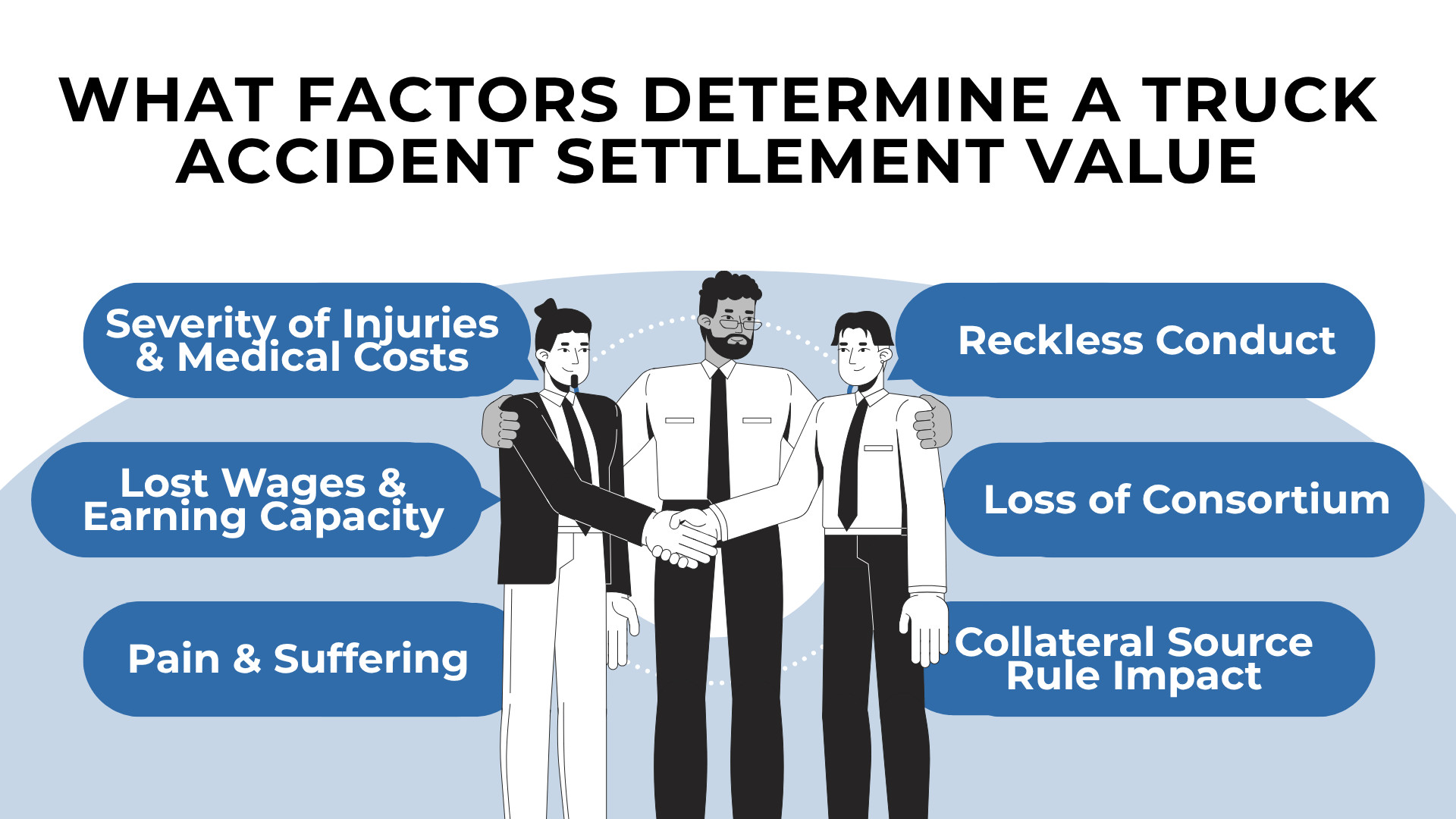
Severity of injuries and medical costs. This is typically the single largest driver of settlement value. Truck accidents produce far more severe injuries because of the forces involved. Motor vehicle crashes are the leading cause of traumatic spinal cord injuries, accounting for 38% of all new cases, and first-year healthcare costs for high tetraplegia average $1,446,827 with lifetime costs approaching $6.4 million for a 25-year-old. Motor vehicle crashes also account for roughly 17% of all TBI-related deaths, with an estimated 5.3 million Americans living with permanent TBI-related disability. These are the kinds of injuries that produce the largest settlements because the economic losses are enormous and provable.
Lost wages and earning capacity. Connecticut recognizes economic damages including loss of earnings and loss of earning capacity under Conn. Gen. Stat. § 52-572h(a). For someone who can no longer work — or can no longer work at the same capacity — the lifetime earnings calculation becomes a major settlement component.
Pain and suffering. Connecticut’s non-economic damages category covers physical pain and suffering as well as mental and emotional suffering, again with no statutory cap. These damages are harder to quantify but often represent a large portion of settlement value in cases involving permanent disability, disfigurement, or chronic pain.
Double or treble damages for reckless conduct. If the truck driver deliberately or with reckless disregard violated certain specifically listed traffic statutes, Connecticut law authorizes double or treble damages under Conn. Gen. Stat. § 14-295. This must be specifically pleaded in the complaint. Per se violations of Conn. Gen. Stat. § 14-222 (reckless driving, including speeds exceeding 85 mph) can support this claim. When § 14-295 applies, it can multiply the total recovery.
Loss of consortium. Connecticut recognizes loss of spousal consortium claims. The Connecticut Supreme Court first recognized this cause of action in Hopson v. St. Mary’s Hospital, 176 Conn. 485 (1979). The court defined consortium as the constellation of companionship, dependence, reliance, affection, sharing, and aid arising from the civil contract of marriage. The Connecticut Supreme Court also recognized a minor child’s derivative claim for loss of parental consortium in Campos v. Coleman, 319 Conn. 36 (2015). That claim is limited to the period between the parent’s injury and the child reaching the age of majority. These derivative claims are separate components of settlement value, but they depend on the injured person’s underlying claim. If that claim fails or settles, the consortium claim is barred.
The collateral source rule. Under Conn. Gen. Stat. § 52-225a, a defendant can seek post-verdict reduction of economic damages by the amount of collateral source payments (health insurance, disability benefits) the plaintiff received, minus the premiums paid to obtain those benefits. However, the Connecticut Supreme Court held in Marciano v. Jimenez, 324 Conn. 79 (2016), that if a health insurer has any subrogation right, no collateral source reduction applies at all. This is a significant detail that affects net recovery.
Who Can Be Held Liable in a Truck Accident Case?
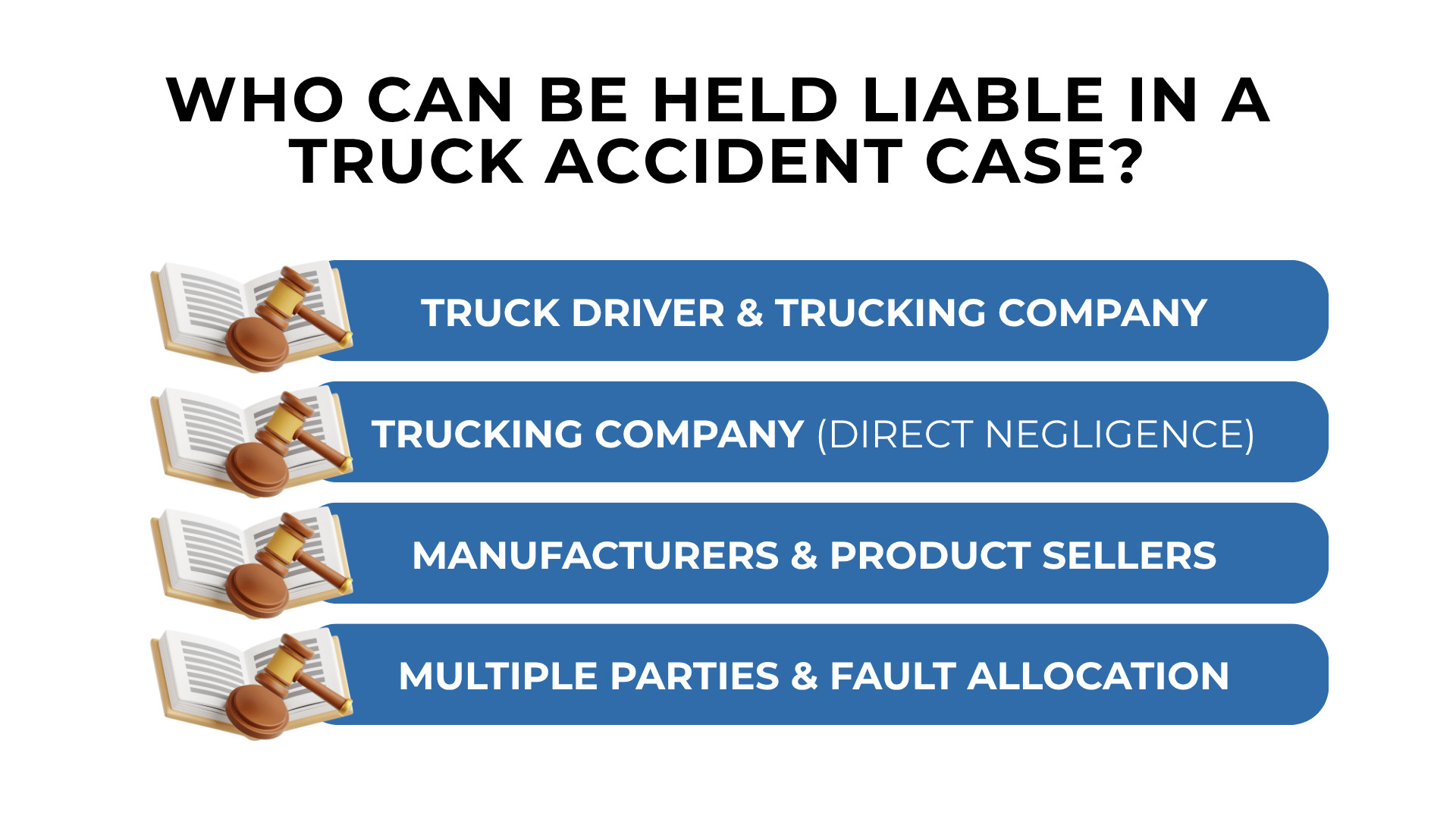
One of the most consequential differences between truck and car accident cases is the number of potentially liable parties. Each one may carry its own insurance policy, which expands the pool of available compensation.
The trucking company (respondeat superior). Connecticut follows the common-law doctrine of respondeat superior: employers are vicariously liable for the negligent acts of their employees committed within the course and scope of employment. The Connecticut Supreme Court confirmed in Jagger v. Mohawk Mountain Ski Area, Inc., 269 Conn. 672 (2004), that this liability applies when the employee acted with apparent authority in furtherance of the employer’s business. Additionally, Conn. Gen. Stat. § 52-183 creates a rebuttable presumption that the operator of an owner’s motor vehicle is the owner’s agent and servant operating in the course of employment. The defendant bears the burden of rebutting that presumption.
The independent contractor defense — where a trucking company claims the driver wasn’t an employee — is harder to sustain than many carriers expect. Connecticut applies the ABC Test under Conn. Gen. Stat. § 31-222(a)(1)(B), which presumes employment status unless the employer proves all three prongs: freedom from direction and control, services outside the employer’s usual course of business, and an independently established trade or business. And under 49 CFR § 390.5, the federal definition of “employee” includes drivers operating under a commercial motor carrier’s authority even when classified as independent contractors, while in the course of operating a commercial motor vehicle. That broader definition can create wider liability exposure for carriers.
The trucking company’s own negligence. Independent of respondeat superior, Connecticut recognizes direct negligence claims against trucking companies for negligent hiring, supervision, retention, and entrustment. These were confirmed as independent causes of action in Seguro v. Cummiskey, 82 Conn. App. 186 (2004). The central element is foreseeability: did the employer know or should it have known that the driver posed a risk? Federal regulations under 49 CFR Part 391 (driver qualifications) and 49 CFR Part 382 (drug and alcohol testing) inform what constitutes reasonable hiring and supervision practices. A trucking company that skipped background checks, ignored a driver’s violation history, or failed to conduct required drug testing faces direct liability for its own negligence.
For negligent entrustment specifically, Connecticut requires proof that the person in control of the vehicle entrusted it to someone they knew or should have known posed a risk, and that injury resulted from such risk. The Connecticut Supreme Court first recognized this theory in Greeley v. Cunningham, 116 Conn. 515 (1933). It’s worth noting, however, that Shea v. Brown, 146 Conn. 631 (1959), held that a suspended license alone isn’t sufficient as a matter of law to establish incompetence.
Equipment and parts manufacturers. When a truck accident is caused or worsened by a mechanical failure — brakes, tires, coupling devices — the Connecticut Product Liability Act (Conn. Gen. Stat. §§ 52-572m through 52-572q) provides the exclusive remedy against product sellers. No privity is required. The CPLA covers manufacturers, distributors, and retailers. Connecticut applies a modified consumer expectation test (also called the risk-utility test) for design defect claims, as established in Potter v. Chicago Pneumatic Tool Co., 241 Conn. 199 (1997). And even when direct evidence of a defect is unavailable, the Connecticut Supreme Court adopted the “malfunction theory” in Metropolitan Property & Casualty Ins. Co. v. Deere & Co., 302 Conn. 123 (2011). Under that theory, a jury may infer a product defect from circumstantial evidence if three things are true: the incident ordinarily does not occur absent a defect, the defect most likely existed when the product left the manufacturer’s control, and the defect was not the result of other reasonably possible causes not attributable to the manufacturer.
The relevance of equipment failure is not theoretical. In the federal Large Truck Crash Causation Study, brake problems were coded as an associated factor in 29.4% of crashed large trucks. During the 2024 CVSA International Roadcheck, brake defects accounted for 25% of all vehicle violations. These aren’t edge cases — they’re systemic industry problems. The CPLA also allows punitive damages up to twice compensatory damages under Conn. Gen. Stat. § 52-240b for reckless disregard of product safety.
Comparative negligence and apportionment. Connecticut follows a modified comparative negligence system under Conn. Gen. Stat. § 52-572h. If the plaintiff is 50% or more at fault, recovery is completely barred. If the plaintiff’s fault is under 50%, damages are reduced proportionally. Each defendant is liable only for their proportionate share — Connecticut abolished joint and several liability in negligence cases. However, a critical exception exists under Conn. Gen. Stat. § 52-572h(o): apportionment does not apply when liability rests on any basis other than negligence, including strict product liability or reckless misconduct. If a truck driver is found to have acted recklessly, comparative negligence defenses and apportionment fall away entirely.
What Evidence Matters Most in Your Truck Accident Case?
Truck accident cases are won or lost on evidence that is unique to the commercial trucking industry — and much of it has a short shelf life.
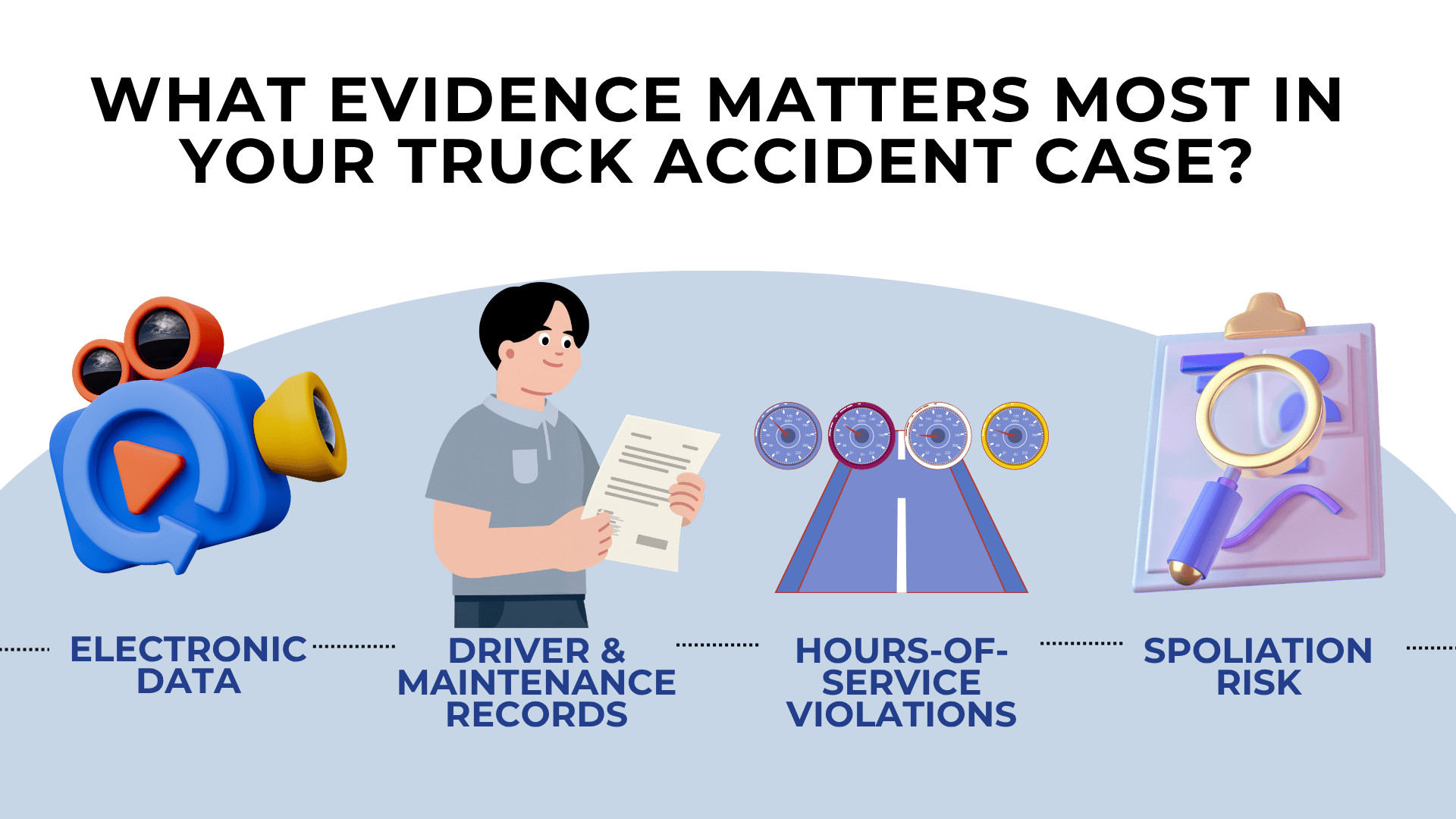
Electronic logging devices and black box data. Federal regulations require motor carriers to retain ELD records of duty status for six months under 49 CFR § 395.8(k)/§ 395.22(j). Event data recorders capture speed, braking, and other vehicle dynamics. Both are critical for proving hours-of-service violations, fatigue, and driver behavior. But six months is not long. The common-law duty to preserve evidence once litigation is reasonably anticipated overrides routine retention periods. The problem is that carriers may not treat preservation as a priority until they’re compelled to.
Driver qualification and inspection records. The driver’s personnel file — including hiring records, training documentation, past violations, drug and alcohol testing history — is essential for negligent hiring and supervision claims. Vehicle inspection and maintenance records establish whether the carrier met its obligations under 49 CFR Parts 391, 392, and 396. The fact that more than one in five commercial vehicles inspected nationally in 2023 had safety violations serious enough to be placed out of service tells you how common maintenance failures are.
Hours-of-service violations. Federal law limits truck drivers to 11 hours of driving within a 14-consecutive-hour window following 10 hours off duty, with a mandatory 30-minute break after 8 hours of driving under 49 CFR § 395.3. Separately, 49 CFR § 392.3 prohibits driving while impaired by fatigue, illness, or any other cause. During the 2024 International Roadcheck, hours-of-service violations accounted for 32.1% of all driver violations. When HOS violations are documented, they can be used to establish negligence per se under Connecticut’s adopted federal regulations.
The spoliation risk. Connecticut imposes a common-law duty to preserve evidence when litigation is reasonably anticipated. Intentional destruction can trigger a permissive adverse inference under Beers v. Bayliner Marine Corp., 236 Conn. 769 (1996), and Connecticut is one of the few states that recognizes an independent tort of intentional spoliation under Rizzuto v. Davidson Ladders, Inc., 280 Conn. 225 (2006). Federal regulations also prohibit altering or erasing original ELD data under 49 CFR § 395.30(f).
The practical implication is this: a preservation letter needs to go out to the trucking company, its insurer, and any maintenance providers as early as possible. Once ELD data, dashcam footage, GPS records, and dispatch communications are overwritten or deleted — whether intentionally or through routine data management — they’re gone.
Common Mistakes That Reduce Your Settlement
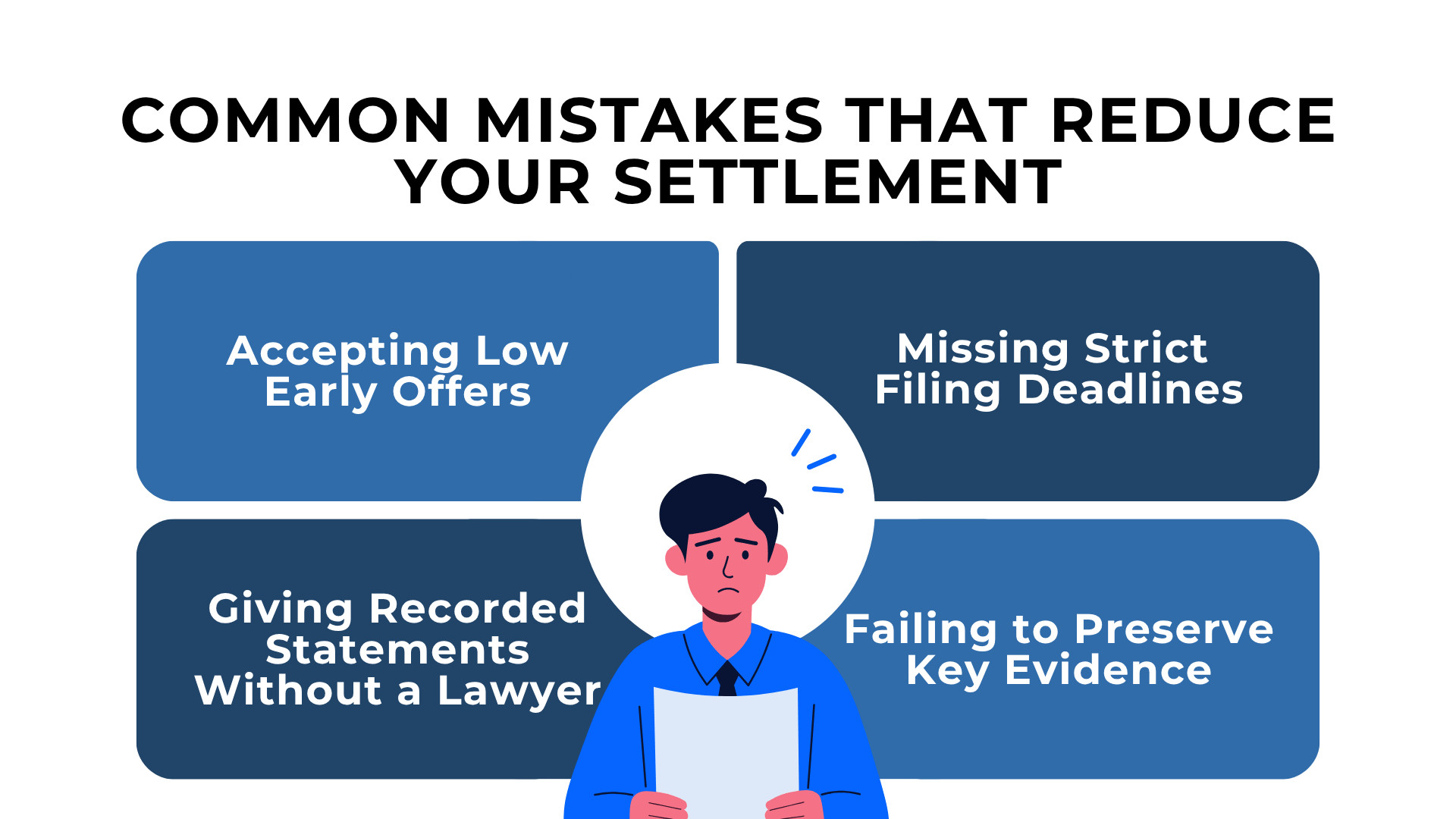
Accepting an early insurance offer before understanding your full losses. Trucking company insurers know the value of these claims. An early offer made before the full extent of injuries is known — particularly with TBI or spinal cord injuries where symptoms evolve over weeks or months — is almost always designed to close the claim cheaply. The FMCSA’s comprehensive cost estimate for a single fatal large truck crash is $14,578,771 in 2022 dollars. Even non-fatal injury truck crashes carry an estimated average comprehensive cost of $383,168. An offer that doesn’t account for future medical costs, lost earning capacity, and non-economic damages is not a serious offer.
Giving recorded statements without legal guidance. What you say to the trucking company’s insurer or investigators can be used to support a comparative negligence defense. Under Connecticut’s modified comparative negligence system, if the defendant can push your share of fault to 50% or more, your recovery is completely barred.
Missing the statute of limitations. Motor vehicle negligence claims in Connecticut are governed by Conn. Gen. Stat. § 52-584. That statute imposes a two-year statute of limitations from the date the injury is first sustained or discovered, subject to an absolute three-year statute of repose from the date of the act or omission. As the Connecticut Supreme Court held in Tarnowsky v. Socci, 271 Conn. 284 (2004), the three-year repose is absolute and cannot be extended even if the injury has not yet been discovered. Wrongful death actions under Conn. Gen. Stat. § 52-555 must be brought within two years from the date of death and no more than five years from the date of the act or omission.
One critical detail: Connecticut is the only state that does not toll the negligence statute of limitations for minors under § 52-584. Parents must act within the standard two-year period.
For product liability claims against equipment manufacturers, the limitations period is three years under Conn. Gen. Stat. § 52-577a. But a ten-year statute of repose applies from the date the product seller last parted with possession or control — particularly relevant for older truck components like brakes or coupling devices.
Failing to preserve evidence early. As discussed above, critical trucking evidence has short retention windows. Waiting even a few months to investigate can mean the ELD data, inspection records, and dashcam footage that would have proved your case no longer exist.
How Does a Truck Accident Lawyer Change the Outcome?
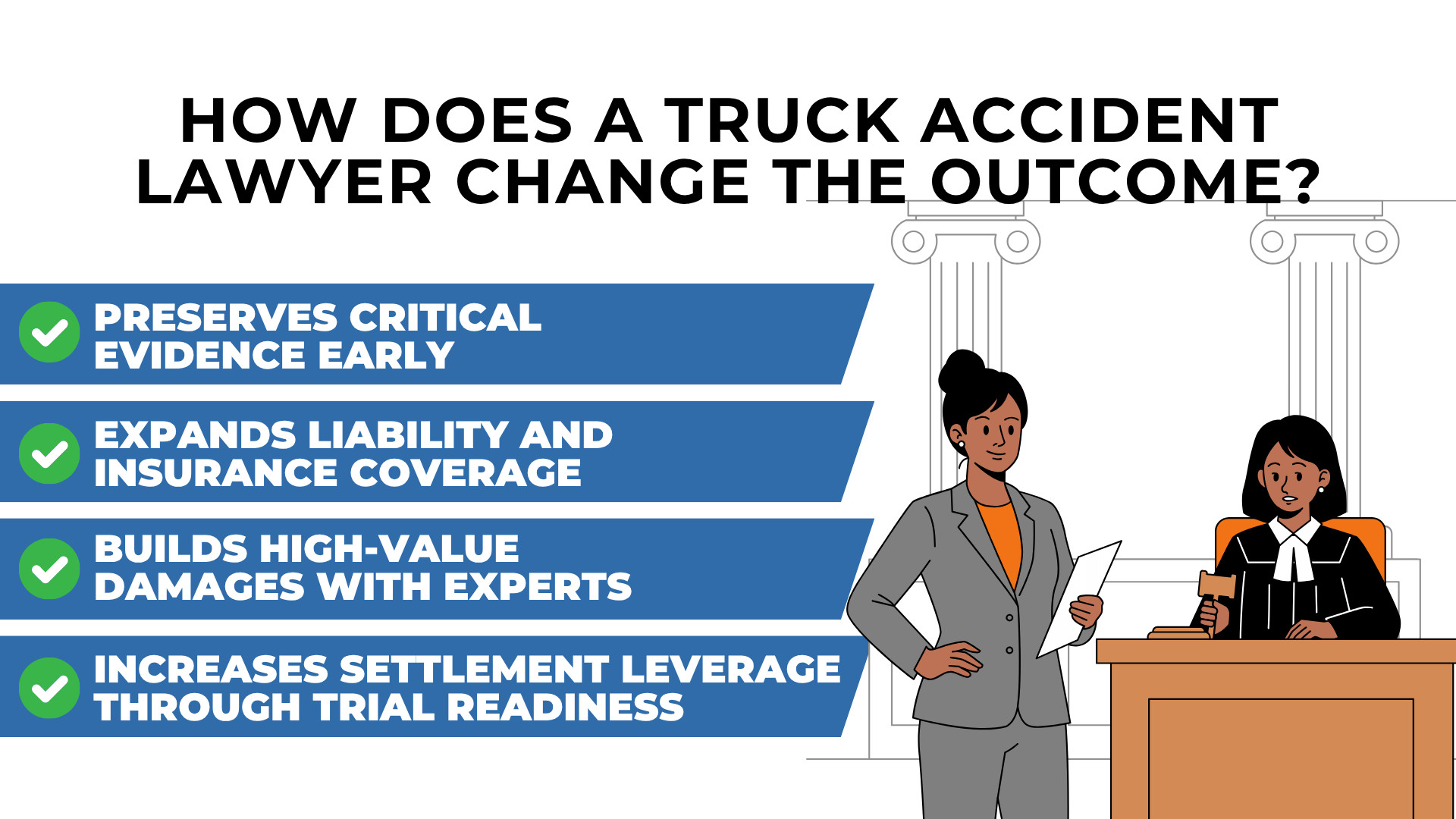
The complexity of truck accident litigation — federal regulations adopted as state law, multiple liability theories running simultaneously, spoliation risks, product liability under the CPLA, the relationship between negligence per se and comparative fault — is what separates these cases from standard motor vehicle claims. An attorney handling a truck accident settlement needs to know how to do several things that directly affect the number.
First, send preservation letters immediately to prevent evidence destruction and preserve the basis for spoliation claims under Beers and Rizzuto if evidence is lost. Second, identify all liable parties and insurance policies — the driver, the trucking company under respondeat superior, the company under direct negligence theories, equipment manufacturers under the CPLA, and maintenance providers under common-law negligence. Third, retain accident reconstruction experts, medical specialists, and economists who can quantify lifetime damages in cases involving catastrophic injuries. Fourth, recognize when the facts support a § 14-295 claim for double or treble damages based on reckless conduct, and plead it properly. That claim must be specifically alleged in the complaint.
At Etemi Law in Waterbury, Connecticut, the attorneys handling these cases bring trial experience that directly affects settlement leverage. Ron Etemi has tried over 100 cases to verdict and received the Top Verdict Award. Peter Brown has 175 jury verdicts and spent his first 15 years trying cases as a defense lawyer — he was one of the most respected civil defense trial lawyers in the state of Connecticut, which means he knows how the other side thinks and prepares. Insurance companies and corporate defendants adjust their settlement offers based on whether they believe the attorney across the table will actually take the case to trial. A firm that regularly does is a firm that gets better offers.
What to Do Right Now
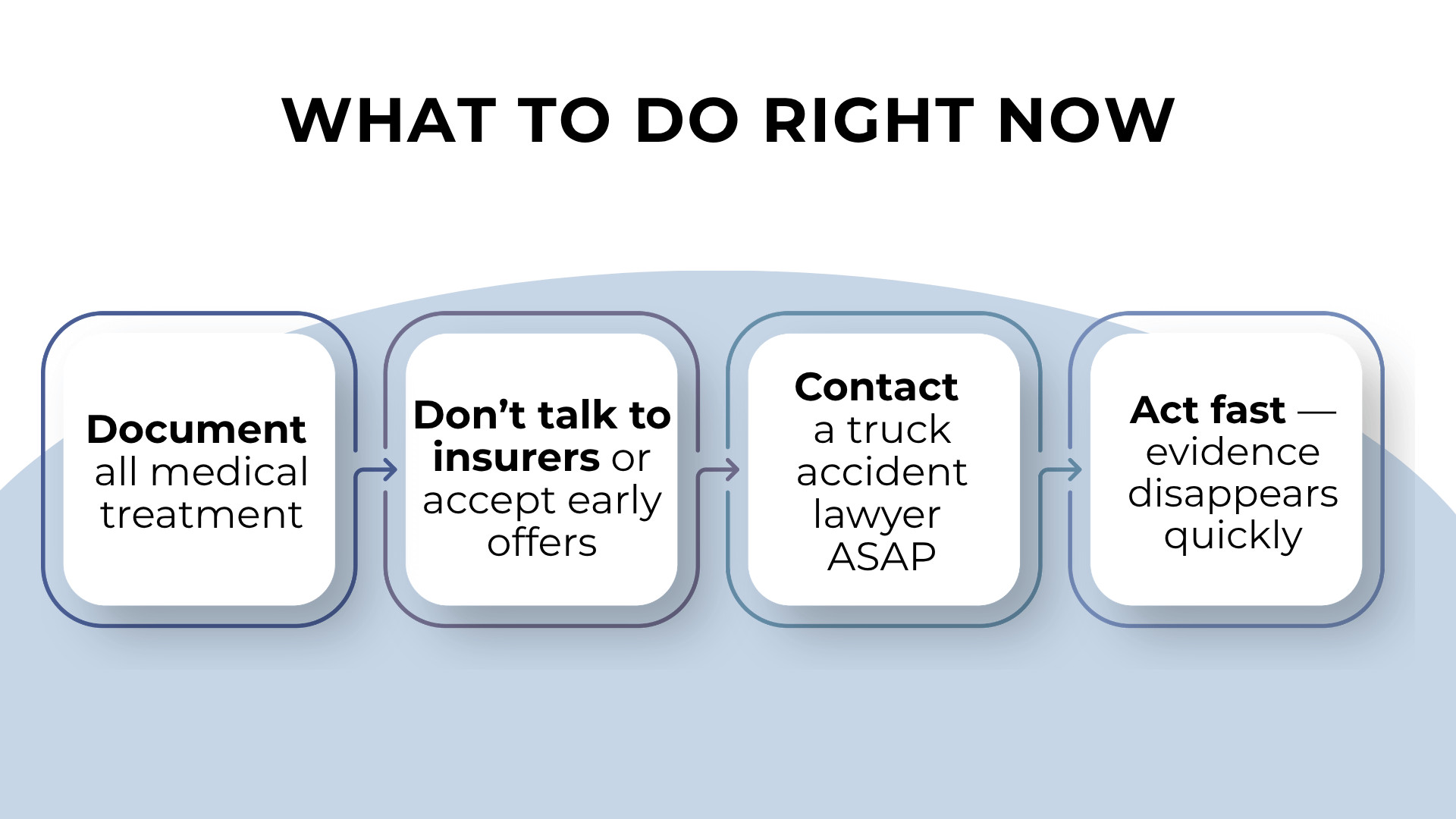
Three steps matter most in the near term. First, get your medical treatment documented — every visit, every diagnosis, every recommendation for follow-up care. Gaps in treatment create gaps in your claim. Second, do not give statements to the trucking company’s insurer or accept any settlement offer before you understand the full scope of your injuries and losses. Third, talk to a truck accident attorney before the evidence window closes. The ELD data retention period is six months. The statute of limitations is two years. But the practical deadline for preserving the evidence that drives settlement value is much shorter than either of those.
If you have questions about a potential truck accident claim, Etemi Law can evaluate your situation, identify the liable parties and applicable insurance coverage, and advise you on the strength of your case — before any critical evidence is lost.