Trucking Company Negligence: When the Company — Not Just the Driver — Is Responsible for Your Crash
When a commercial truck causes a crash, the trucking company that put that truck on the road can be held legally responsible — not just the driver behind the wheel. Connecticut law provides two distinct paths to hold a trucking company liable. The first is through the driver’s actions under a doctrine called respondeat superior. The second is for the company’s own independent failures in hiring, training, supervising, and maintaining its fleet.
This distinction matters because trucking companies carry far more insurance than individual drivers, and their negligence is often the real reason the crash happened. What follows covers how Connecticut law holds trucking companies accountable and the specific failures that create liability.
Can I actually sue the trucking company, not just the driver?
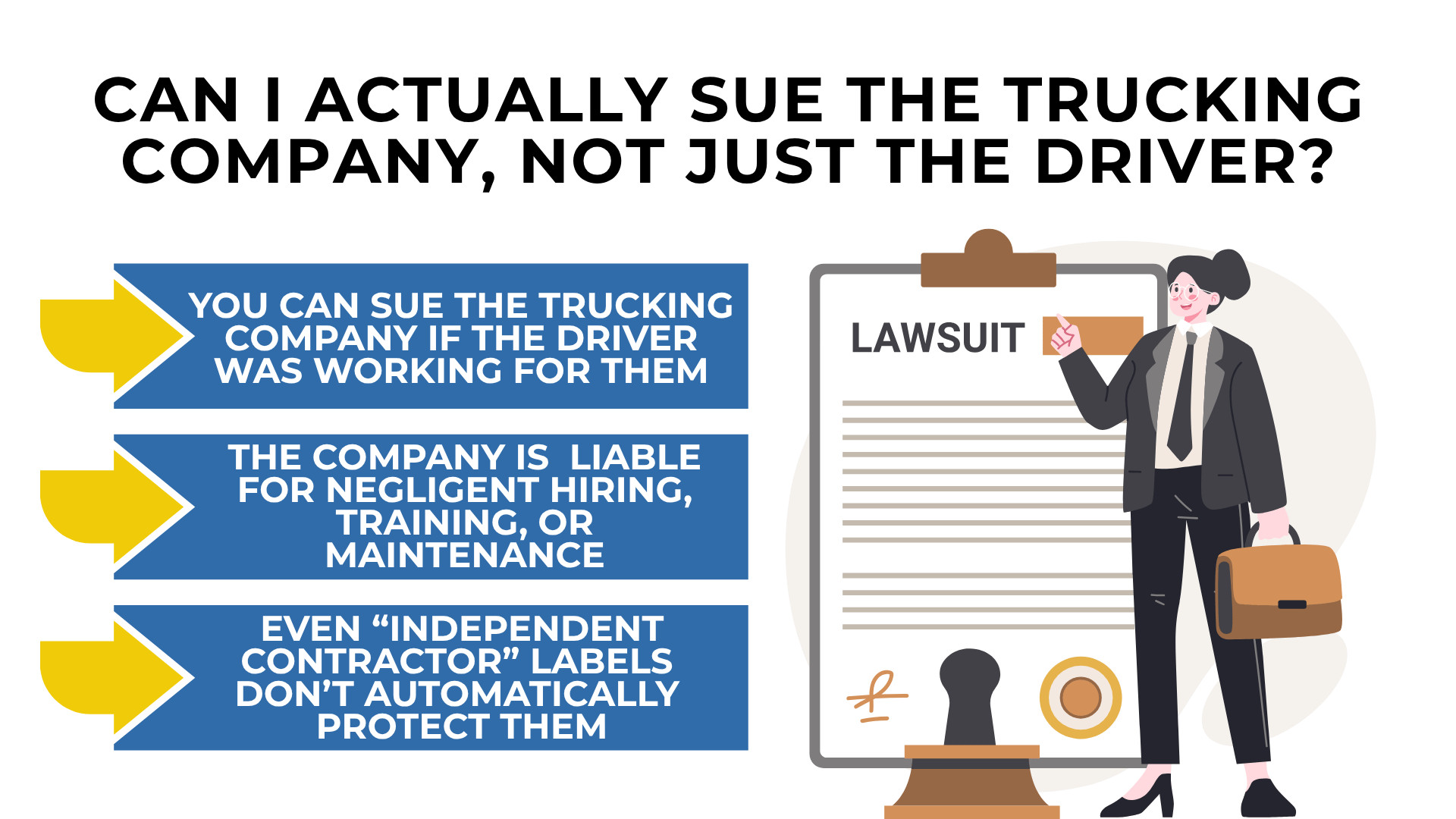
Yes. Connecticut law establishes two separate grounds for holding a trucking company liable when one of its trucks causes a crash.
The first is vicarious liability through respondeat superior. Under this doctrine, employers are liable for the negligent acts of their employees committed within the course and scope of employment. The Connecticut Supreme Court confirmed this principle in Jagger v. Mohawk Mountain Ski Area, Inc., 269 Conn. 672 (2004). The court held that employers are vicariously liable for negligent acts or omissions by employees or agents acting in the course of employment. Connecticut law goes a step further: under Conn. Gen. Stat. § 52-183, there is a rebuttable presumption that anyone operating an owner’s motor vehicle is the owner’s agent and servant operating in the course of employment. That means the trucking company bears the burden of proving the driver wasn’t acting on its behalf — not the other way around.
The second path is direct negligence. This holds the company liable for its own failures — hiring a dangerous driver, skipping required training, ignoring maintenance problems, or pressuring drivers to violate federal safety rules. These claims exist independently of what the driver did or didn’t do. The Connecticut Appellate Court recognized this in Seguro v. Cummiskey, 82 Conn. App. 186 (2004). The court held that claims for negligent hiring, supervision, and retention are direct negligence claims independent of respondeat superior, because they allege the employer itself failed to exercise reasonable care.
Both theories can be pursued at the same time in the same case. They are not mutually exclusive.
Trucking companies sometimes try to avoid liability by classifying their drivers as independent contractors rather than employees. Connecticut courts look past the label. The actual relationship is what matters — specifically, whether the company retains the right to control the means and methods of the driver’s work. Under the federal definition in 49 CFR § 390.5, drivers operating under a motor carrier’s authority are treated as employees even when their contract says otherwise. This can create broader liability risk than the company expected.
What kinds of negligence do trucking companies commit?
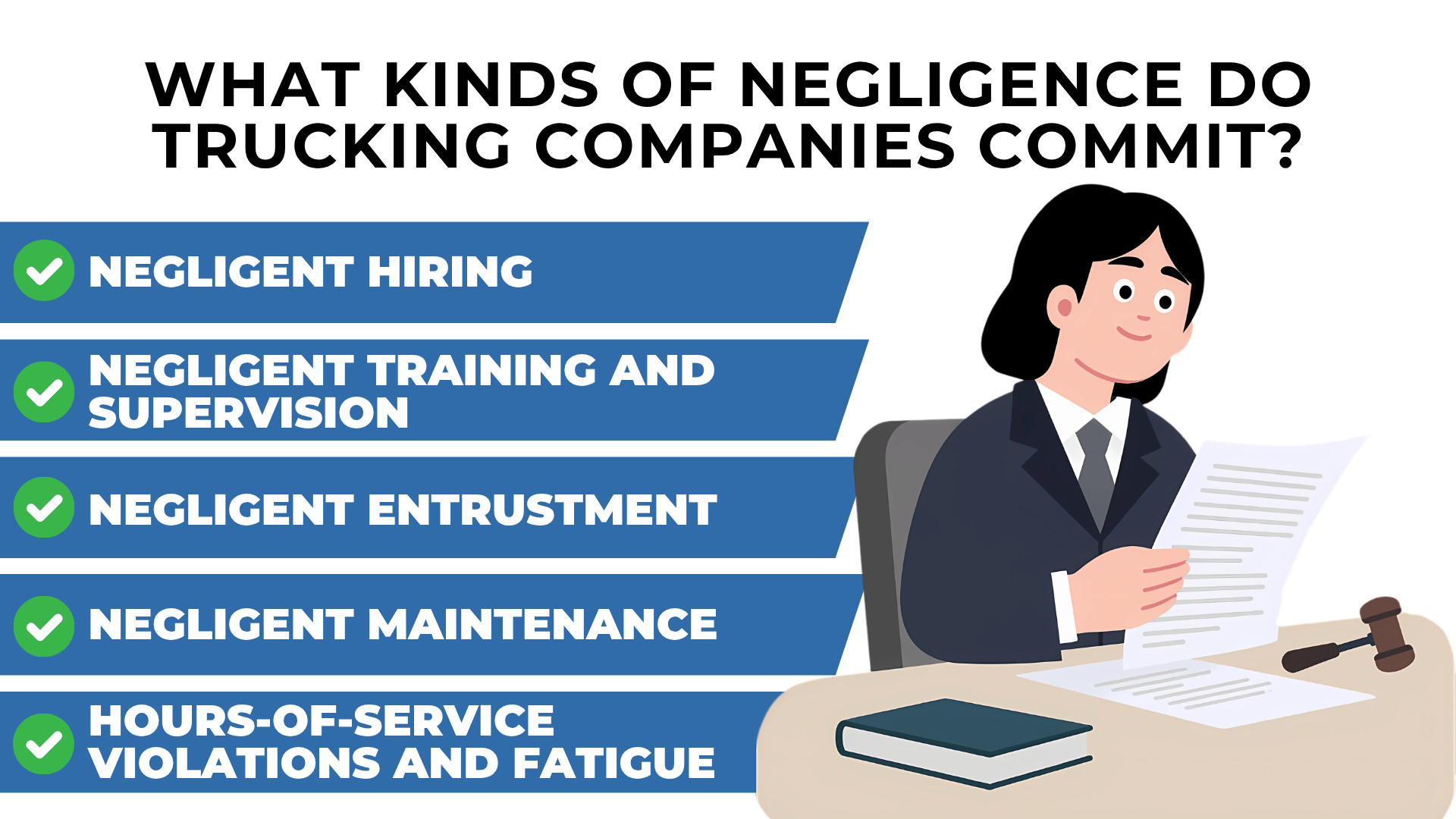
Trucking company negligence typically falls into several common categories — each reflecting a decision the company made (or failed to make) before the truck ever left the yard.
Negligent hiring. Trucking companies are required under 49 CFR Part 391 to verify that their drivers are qualified — including reviewing driving records, employment history, and physical fitness. When a company hires a driver with a history of violations, suspensions, or substance abuse problems and that driver causes a crash, the company can be held directly liable. The Connecticut Supreme Court recognized this theory in Shore v. Stonington, 187 Conn. 147 (1982). The court held that negligent hiring imposes liability when an employer fails to select an employee fit or competent to perform the job.
Negligent training and supervision. Putting a qualified driver in the seat is only the starting point. Companies must train drivers on the specific equipment they operate and supervise ongoing compliance with safety regulations. Failures here — assigning a driver to an unfamiliar route without preparation, failing to review electronic logging data for patterns of fatigue, ignoring repeated moving violations — are independent grounds for liability.
Negligent entrustment. This theory applies when a company entrusts a vehicle to someone it knows or should know is unfit to operate it. Connecticut first recognized this cause of action in Greeley v. Cunningham, 116 Conn. 515 (1933). The court held that an owner who entrusts a vehicle to someone the owner knows or should know is incompetent to operate it is liable for resulting injuries. In trucking cases, this often involves assigning a truck to a driver the company knows has medical issues, substance abuse problems, or a worsening safety record.
Negligent maintenance. Federal regulations require trucking companies to regularly inspect, repair, and maintain every vehicle in their fleet. The consequences of cutting corners here are well documented. According to the federal Large Truck Crash Causation Study, nearly 30% of large trucks involved in crashes had brake problems coded as an associated factor — the single most commonly cited vehicle defect. This is not an outdated finding. During the 2024 CVSA International Roadcheck, brake defects accounted for 25% of all vehicle violations found across North America. Nationally, more than one in five commercial vehicles inspected in 2023 had safety violations serious enough to be placed out of service — meaning the vehicle was too dangerous to continue operating.
Hours-of-service violations and fatigue. Federal law limits commercial truck drivers to 11 hours of driving within a 14-hour on-duty window, following 10 consecutive hours off duty, under 49 CFR § 395.3. These limits exist because fatigued driving is deadly. In the federal crash causation study, 13% of crash-involved truck drivers were coded as fatigued at the time of the crash. When a trucking company pressures drivers to exceed these limits, manipulates electronic logs, or creates dispatch schedules that make compliance impossible, the company — not just the driver — is negligent. During the 2024 Roadcheck enforcement blitz, hours-of-service violations accounted for 32.1% of all driver violations found.
The foreseeability of harm ties every one of these theories together. As the Connecticut Supreme Court has consistently held, the question is whether an ordinary person in the company’s position, knowing what the company knew or should have known, would anticipate that harm of the general nature suffered was likely to result. Trucking companies operate in one of the most heavily regulated industries in the country. The regulations themselves establish what is foreseeable.
Do I need a lawyer who understands federal trucking regulations?
A trucking negligence case is not a car accident case with a bigger vehicle. It involves a federally regulated industry with its own body of law, and defendants represented by corporate legal teams from the moment the crash occurs. The trucking company’s insurer will often have an investigator at the scene before you have left the hospital.
Building a case means identifying which theory of company liability applies. That could be respondeat superior for a driver’s conduct within the scope of employment. Or it could be direct negligence for the company’s own failures in hiring, training, supervision, maintenance, or entrustment. It means understanding the federal regulations that define the company’s duty of care and knowing how to connect a specific violation to a specific legal claim. These theories must be identified early. The evidence that supports them is controlled by the company and subject to limited record-keeping deadlines under federal law.
At Etemi Law in Waterbury, Connecticut, our attorneys handle commercial trucking accident cases with the understanding that these claims demand both regulatory knowledge and trial readiness. Ron Etemi has tried over 100 cases to verdict and is known for confronting corporate defendants directly. Peter Brown spent his first 15 years practicing as a civil defense lawyer — he understands how the other side builds its case because he used to build it himself. That perspective shapes how we investigate, prepare, and present trucking negligence claims.
If you or someone in your family has been injured in a crash involving a commercial truck, contact Etemi Law to discuss your case.