Trucking Regulations: What Rules Apply and Why They Matter After a Crash in Connecticut
Federal trucking regulations are a set of safety rules — set out in 49 CFR Parts 382 through 397 — that govern nearly every aspect of commercial trucking. They dictate how long a driver can stay behind the wheel, how a carrier must maintain its vehicles, who is qualified to drive a commercial truck, and how companies must test drivers for drugs and alcohol. Connecticut has adopted these federal regulations as state law under Conn. Gen. Stat. § 14-163c. That means a violation doesn’t just trigger a federal penalty — it can establish negligence as a matter of law in a Connecticut courtroom.
If you’re reading this after a truck crash, or because someone you care about was hurt in one, the regulations discussed below are likely at the center of what happened and what comes next. This page covers what the major trucking regulations require, how frequently they’re violated, how Connecticut law treats those violations in a personal injury case, and why the evidence that proves a violation has a limited shelf life.
Why do trucking regulations exist in the first place?
A fully loaded tractor-trailer can weigh 20 to 30 times as much as a typical passenger car. That size disparity makes the consequences of a crash drastically unequal. Of the 5,472 people killed in large truck crashes nationally in 2023, 70 percent were occupants of other vehicles — not the truck. Of the 5,472 people killed in large truck crashes nationally in 2023, 70% were occupants of other vehicles — not the truck.
Federal trucking regulations exist because of this imbalance. The people sharing the road with commercial trucks bear almost all of the fatal risk. The federal government imposes specific safety obligations on the carriers and drivers who create that risk. These aren’t suggestions. They’re mandatory standards enforced through inspections, audits, and — when someone gets hurt — civil litigation.
Connecticut didn’t leave enforcement to the federal government alone. Under Conn. Gen. Stat. § 14-163c, the state adopted the Federal Motor Carrier Safety Regulations for both interstate and intrastate motor carriers. The statute applies to motor vehicles with a gross vehicle weight rating of 18,001 pounds or more for intrastate operations and 10,001 pounds or more for interstate operations. It also covers vehicles designed or used to transport eight or more passengers including the driver for compensation, vehicles designed or used to transport more than 15 passengers including the driver and not used for compensation, and vehicles carrying hazardous materials requiring placards. Once adopted into state law, these regulations become the measuring stick for what Connecticut courts consider reasonable conduct by a trucking company or its driver.

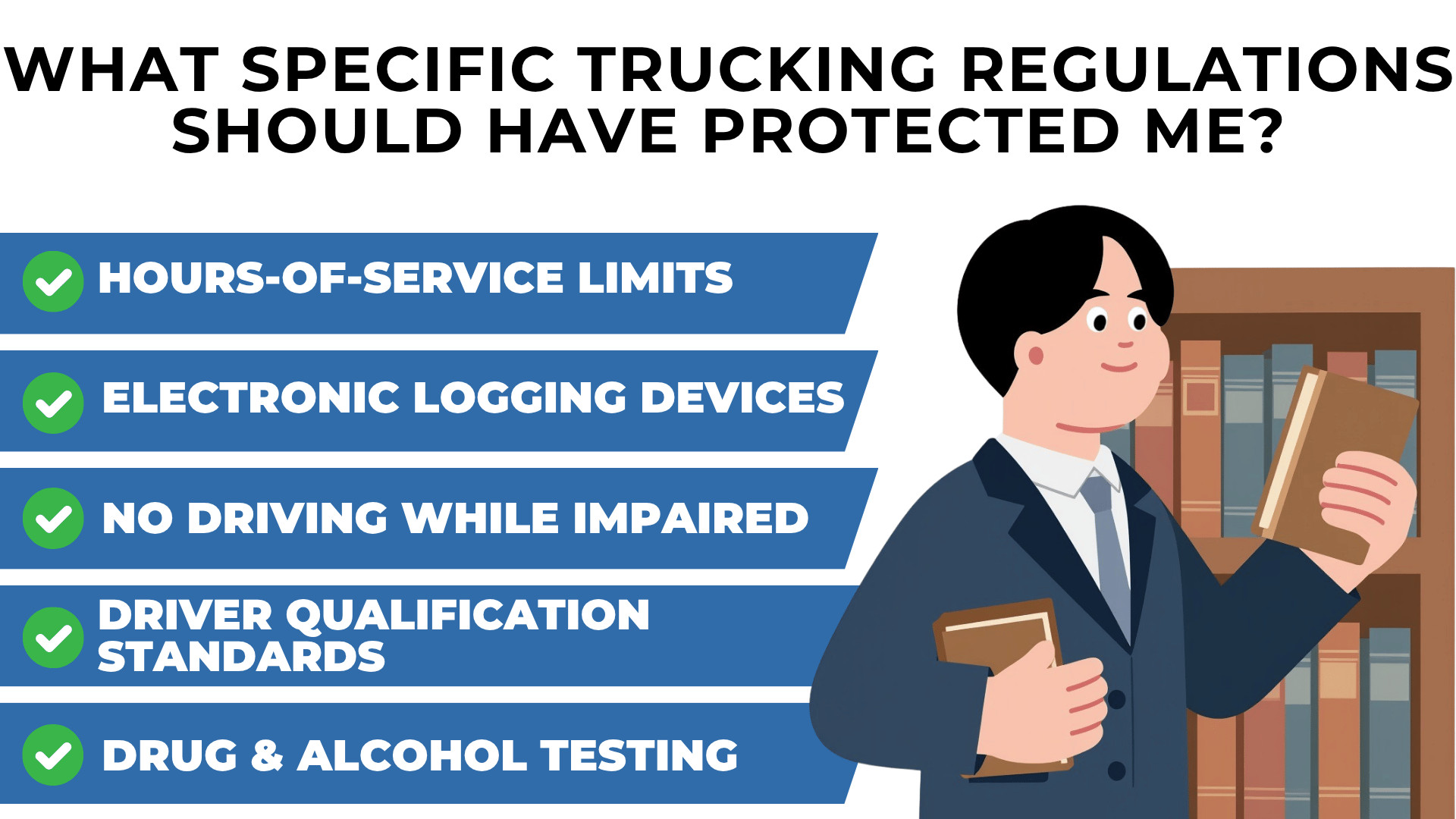
What specific trucking regulations should have protected me?
The federal regulations cover nearly every aspect of commercial trucking operations. The ones most commonly relevant after a crash fall into a few major categories.
Hours of service. Under 49 CFR § 395.3, a truck driver may not drive more than 11 hours during a 14-consecutive-hour window after coming on duty following 10 consecutive hours off duty. Weekly limits cap driving at 60 or 70 hours depending on the carrier’s operating schedule. A driver must also take at least a consecutive 30-minute break after eight hours of driving. These limits exist because fatigued driving is deadly. 13 percent of truck drivers involved in crashes studied by the federal Large Truck Crash Causation Study were coded as fatigued at the time of the collision.
Electronic logging devices. Under 49 CFR § 395.8, carriers must maintain records of duty status through ELDs, which automatically track driving time. These devices replaced the old paper logbooks that were widely known to be easy to falsify. ELD data creates a documented record of whether a driver was within legal hours — or whether the carrier pushed a driver past the limit. Federal law also prohibits altering or erasing original ELD data under 49 CFR § 395.30(f).
Prohibition on driving while impaired. Under 49 CFR § 392.3, a driver may not operate a commercial motor vehicle while impaired by fatigue, illness, or any other cause. This is a broader prohibition than many people realize — it covers any condition that affects a driver’s ability to operate safely.
Driver qualifications. 49 CFR Part 391 establishes the standards carriers must meet when selecting drivers for commercial vehicles. These federal qualification requirements inform what may constitute reasonable hiring and supervision practices. A carrier’s failure to comply with them can become central to a negligence case.
Drug and alcohol testing. 49 CFR Part 382 governs drug and alcohol testing requirements for commercial motor vehicle drivers. Carriers are required to maintain testing programs, and failures in this area can serve as evidence of negligent hiring or supervision.
How often do trucking companies actually break these rules?
Regulatory violations in the trucking industry are not rare. The data from federal inspections and crash investigations paints a picture of widespread rule-breaking.
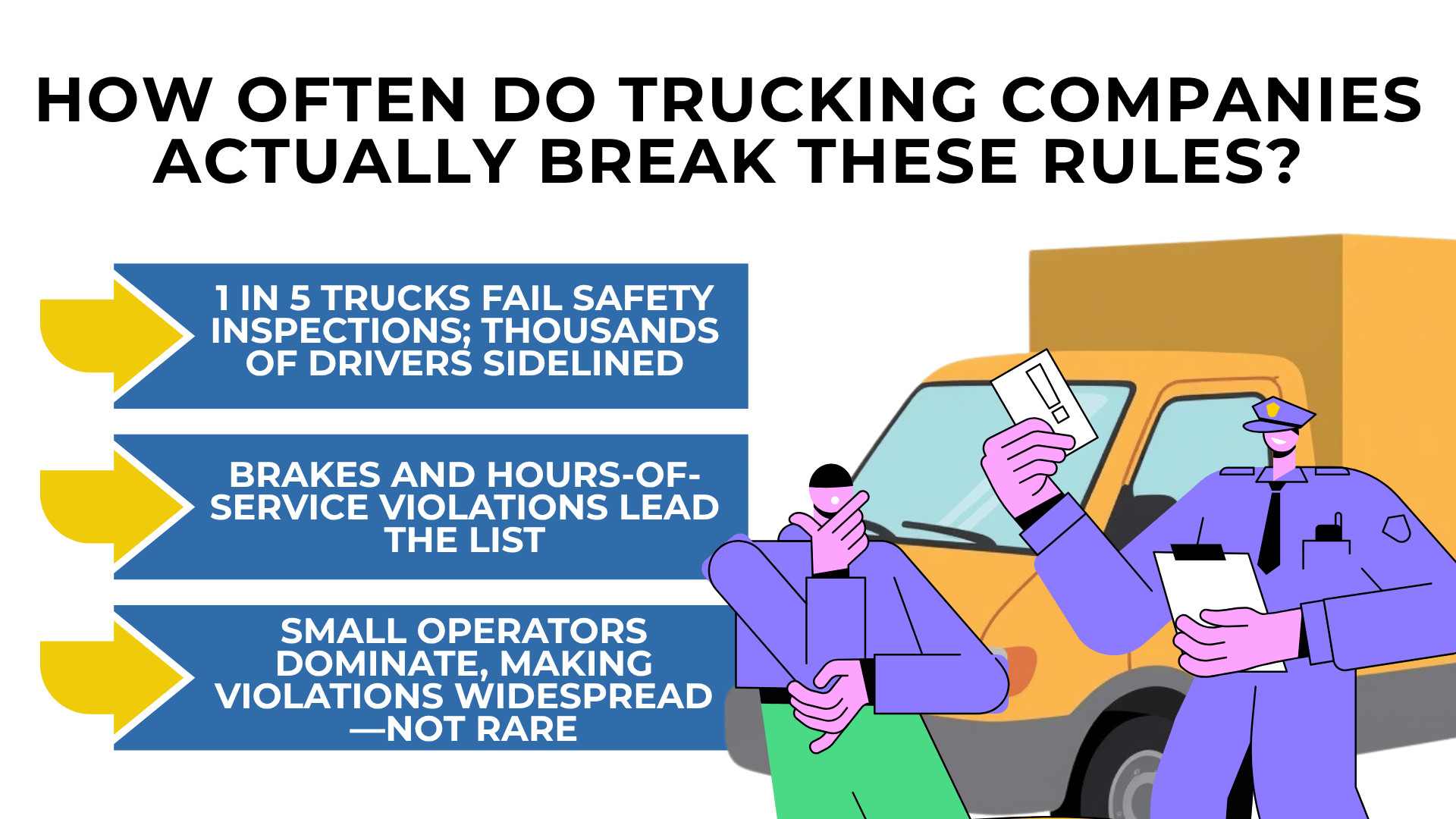
In 2023, federal and state inspectors conducted over 3 million roadside inspections nationally. The national vehicle out-of-service rate — the percentage of trucks found with safety defects serious enough to be pulled off the road immediately — was 22.6 percent. More than one in five trucks inspected were too dangerous to keep driving. The driver out-of-service rate was 6.4 percent, meaning tens of thousands of drivers were found in violation of rules serious enough to sideline them on the spot.
Brake defects are the most persistent vehicle problem. During the 2024 CVSA International Roadcheck — a concentrated 72-hour enforcement blitz — brake violations accounted for 25 percent of all vehicle violations. The federal Large Truck Crash Causation Study found that 29.4 percent of trucks involved in crashes had brake problems coded as a contributing factor — nearly one in three.
Hours-of-service violations are the leading driver compliance failure. During the same 2024 Roadcheck, HOS violations represented 32.1 percent of all driver violations, the single largest category. Speed-related factors were present in nearly 23 percent of truck crashes in the causation study.
This is not a portrait of an industry where violations are rare exceptions. It is a portrait of industry-wide risk — and an important reason why regulatory violations are often provable after a crash. The industry is overwhelmingly composed of small operators. 91.5 percent of carriers run 10 or fewer trucks, which affects the resources available for safety investment, maintenance, and compliance.
Connecticut sees the consequences directly. The state recorded 1,607 large truck crashes in 2024 alone, including 28 fatal crashes and 723 injuries. Over the four-year period from 2022 through 2025, Connecticut experienced 8,599 total large truck crashes resulting in 119 fatalities.
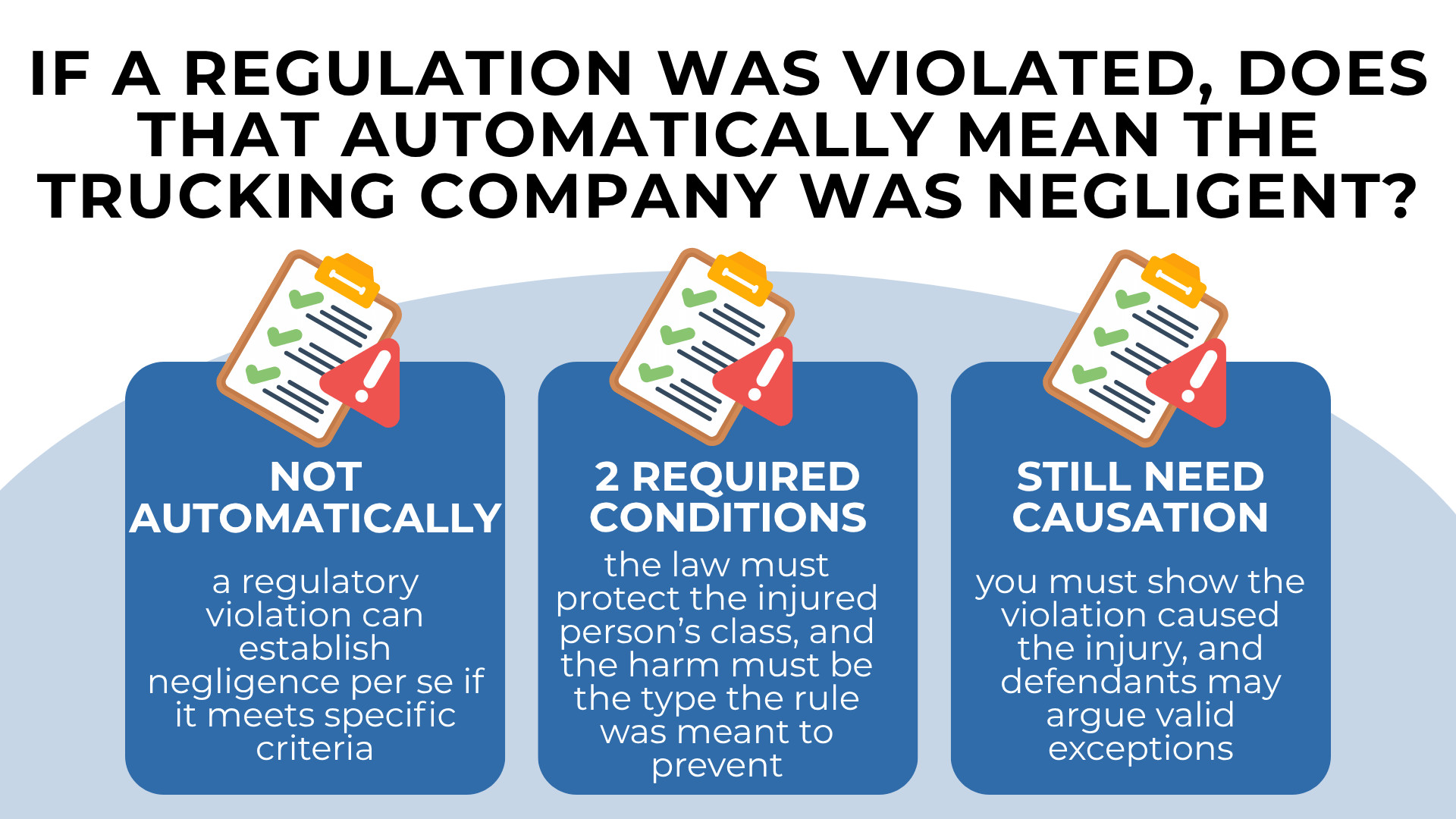
If a regulation was violated, does that automatically mean the trucking company was negligent?
In Connecticut, it often does — and this is one of the most powerful features of the state’s legal rules for trucking cases.
Connecticut follows a doctrine called negligence per se. Under this doctrine, a violation of a statute or regulation counts as negligence as a matter of law if two conditions are met. First, the injured person must have been within the class of people the regulation was designed to protect. Second, the harm suffered must have been the type of harm the regulation was designed to prevent. The Connecticut Supreme Court stated the principle directly in Gore v. People’s Savings Bank, 235 Conn. 360 (1995): in a negligence per se case, the jury need not decide whether the defendant acted as an ordinarily prudent person would have acted under the circumstances. The jury merely decides whether the relevant statute or regulation has been violated. If it has, the defendant was negligent as a matter of law.
Because Connecticut has adopted the Federal Motor Carrier Safety Regulations through Conn. Gen. Stat. § 14-163c, a violation of those regulations — hours-of-service limits, maintenance requirements, driver qualification standards — can trigger negligence per se in a Connecticut courtroom. The Connecticut Supreme Court confirmed in Wendland v. Ridgefield Construction Services, Inc., 184 Conn. 173 (1981), that federal safety regulations can serve as the basis for negligence per se jury instructions. And even where negligence per se does not technically apply, the court held that the regulations are still admissible as evidence of the applicable standard of care.
This matters enormously if you’ve been injured in a truck crash. Instead of arguing in general terms about what a “reasonable” trucking company should have done, your case can focus on concrete, documented facts: Did the driver exceed the 11-hour driving limit? Did the carrier fail to comply with required drug and alcohol testing obligations? Were the brakes out of adjustment? If the answer is yes, and the violation caused the crash, the negligence question may already be answered.
There are limits. A defendant may raise valid excuses for a regulatory violation — such as a sudden emergency or that reasonable efforts to comply were made — under Connecticut Civil Jury Instruction 3.6-14. And even where negligence per se is established, you must still prove that the violation was a proximate cause of your harm. But the doctrine removes one of the most significant hurdles in any negligence case: the debate over whether the defendant’s conduct fell below the standard of care.
What if the trucking company was also careless about who they hired or how they trained their drivers?
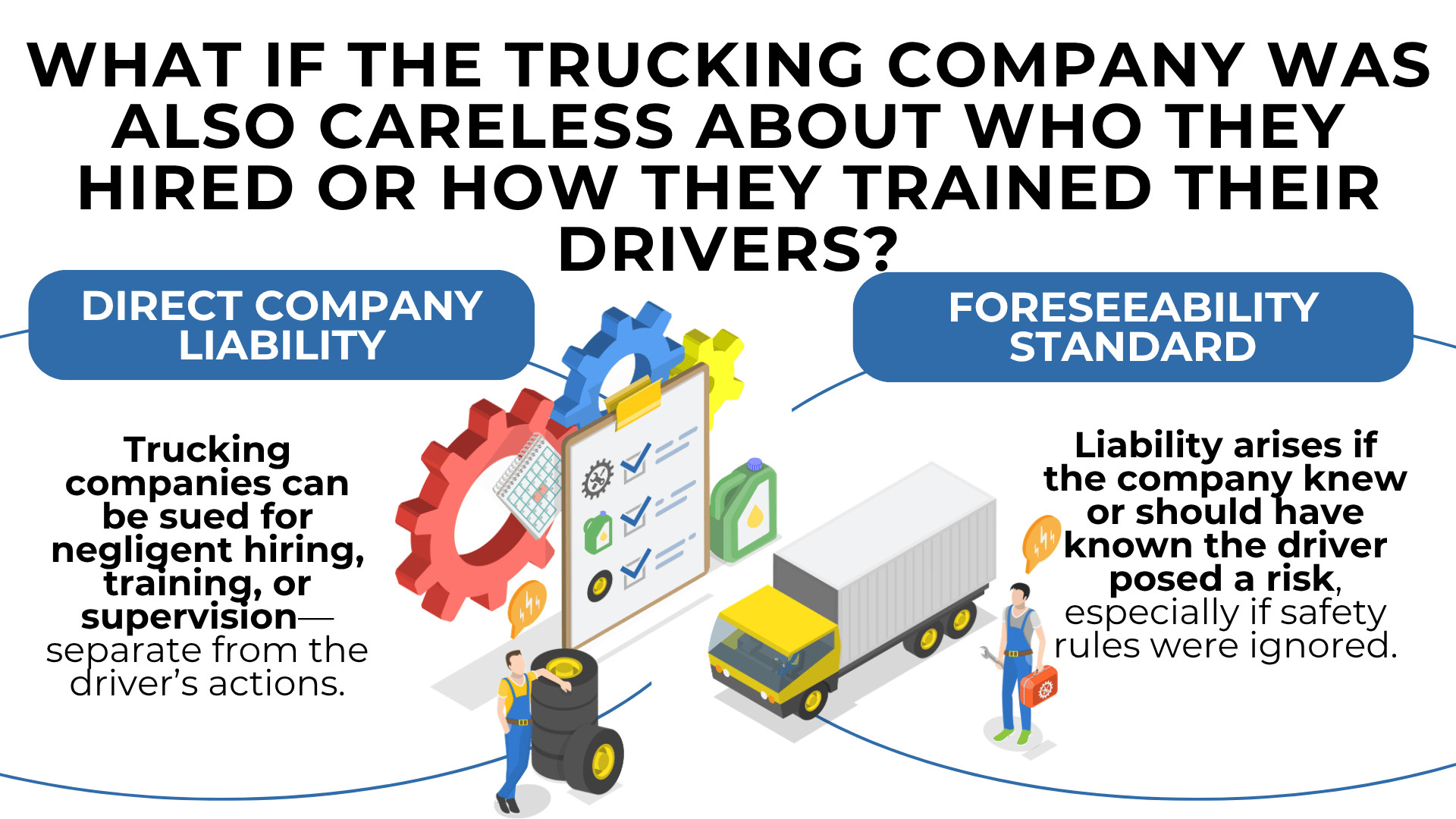
A truck crash is rarely just about what one driver did in one moment. Connecticut recognizes direct negligence claims against trucking companies for negligent hiring, negligent supervision, negligent retention, and negligent entrustment. These claims are independent of whether the company is also liable for the driver’s actions under respondeat superior.
The central question is foreseeability. As the Connecticut Supreme Court held in Shore v. Stonington, 187 Conn. 147 (1982), negligent hiring is a theory of liability where a third party is injured by the employer’s own negligence in failing to select an employee fit or competent to perform the services of employment. The Connecticut Appellate Court confirmed in Seguro v. Cummiskey, 82 Conn. App. 186 (2004), that these claims exist independently because they allege direct negligence against an employer who failed to exercise reasonable care — not the driver’s negligence attributed to the employer.
Federal regulations inform what reasonable care looks like in this context. The research packet identifies 49 CFR Part 391 (driver qualifications) and 49 CFR Part 382 (drug and alcohol testing) as relevant regulatory standards that inform what may constitute reasonable hiring and supervision practices. A carrier that fails to comply with these qualification and testing requirements has not just violated a regulation — it has created the factual basis for a negligent hiring or supervision claim.
For negligent entrustment of a vehicle specifically, Connecticut requires proof that the person in control of the vehicle entrusted it to someone they knew or should have known posed a risk, as the court recognized in Greeley v. Cunningham, 116 Conn. 515 (1933). But the standard isn’t about whether the driver had a license. Shea v. Brown, 146 Conn. 631 (1959), held that a suspended license alone is insufficient as a matter of law to establish incompetence as an operator of a motor vehicle. The question is whether the carrier knew or should have known about the driver’s dangerous tendencies.
These claims matter because they allow you to hold the company accountable for its own decisions — not just the driver’s. And Connecticut permits both respondeat superior and direct negligence claims to proceed simultaneously.
What evidence proves a trucking regulation was violated, and can it disappear?
Proving a regulatory violation requires specific types of evidence — and much of it is controlled by the trucking company.
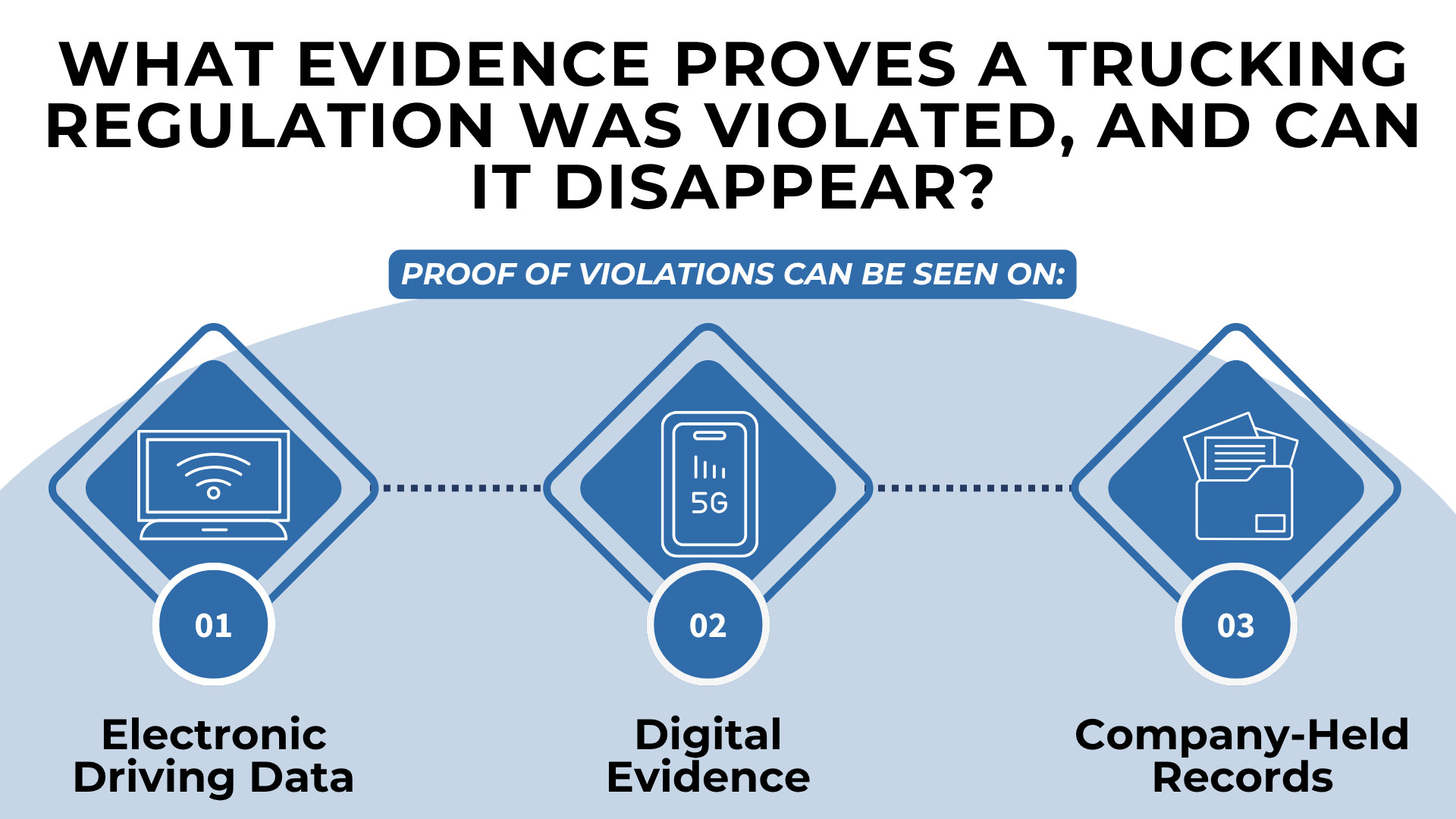
The most critical sources include electronic logging device data, which records driving hours and duty status. Event data recorder information — the truck’s “black box” — captures speed, braking, and other data in the seconds before a crash. Other key evidence includes dashcam footage, GPS records, dispatch communications, driver qualification files, and drug and alcohol testing results. Each of these can establish whether a specific regulation was followed or broken.
The problem is that this evidence has a limited life. Federal regulations require carriers to retain ELD records for only six months from the date of receipt under 49 CFR § 395.8(k). Dashcam systems overwrite footage on a rolling basis. Dispatch records and GPS logs may be stored only as long as the carrier’s internal policies require. If no one acts to preserve this evidence, it can be gone before a case is even filed.
Connecticut law provides meaningful protections against evidence destruction — but only after the fact. The Connecticut Supreme Court held in Beers v. Bayliner Marine Corp., 236 Conn. 769 (1996), that a jury may draw a permissive adverse inference from intentional spoliation. In practical terms, if a carrier deliberately destroys evidence, the jury can infer the evidence would have been unfavorable to the carrier. Under the Beers standard, four conditions must be met. The spoliation must have been intentional. The destroyed evidence must have been relevant to the issue at hand. The party seeking the inference must have acted with due diligence with respect to the evidence. And the jury must be instructed that it is not required to draw the inference.
Connecticut goes further than most states. In Rizzuto v. Davidson Ladders, Inc., 280 Conn. 225 (2006), the Connecticut Supreme Court recognized an independent tort of intentional spoliation of evidence. This means a party that willfully destroys evidence to disrupt a plaintiff’s case can be held liable for the damages caused by that destruction — as a separate claim. The court identified five elements. There must be pending or probable litigation involving the plaintiff. The defendant must have known that litigation was pending or probable. The destruction of evidence must have been willful and designed to disrupt the plaintiff’s case. The plaintiff’s case must have been actually disrupted. And the damages must have been proximately caused by the defendant’s acts.
These protections are important, but they are protections that apply after evidence is already gone. They are not substitutes for early preservation. The common-law duty to preserve evidence arises when litigation is reasonably anticipated, and it overrides routine retention schedules. But a carrier that claims to have followed its standard deletion policies before receiving notice of a claim may argue the destruction was not intentional.
This is why timing matters more in trucking cases than in most other types of personal injury claims. The window to secure the evidence that proves a regulatory violation is short, and it begins closing the day of the crash.
What should I do now?
The regulations described above were written to prevent exactly the kind of harm that truck crashes cause — and Connecticut law gives those regulations real force in civil litigation. A proven violation can establish negligence as a matter of law. A pattern of hiring or supervision failures can hold the carrier directly accountable. But the evidence that makes those claims possible is time-sensitive, and much of it is in the trucking company’s hands.
If you or someone in your family has been injured in a truck crash in Connecticut, the most important step right now is getting a legal team involved early enough to identify and preserve the evidence that matters. At Etemi Law in Waterbury, Connecticut, our attorneys handle commercial trucking accident cases and understand both the federal regulatory framework and how Connecticut courts treat violations. A consultation can help you understand which regulations may have been broken in your specific situation and what needs to happen to protect the evidence before it’s gone.