
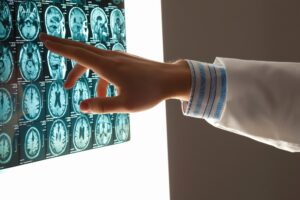
 Did you suffer a brain injury in an accident in Watertown, CT?
At Etemi Law Injury Lawyers, we pursue full recovery for injured clients and their families in brain injury matters.
If a crash or a fall in Watertown left you with a concussion or a more serious brain injury, insurance adjusters value the claim by what the first scan showed. A normal scan does not mean a normal recovery. A Watertown, CT brain injury lawyer at Etemi Law Injury Lawyers deals with the adjuster from the day you retain us, so the symptoms that appear later are documented and paid for.
Our founder lists traumatic brain injury among the core areas of his practice. He has litigated hundreds of cases since 2010. The consultation is free.
Brain Injury Lawyer Watertown, CT
A brain injury attorney in Watertown proves two things the defense disputes: that the injury exists, and that it came from the accident. Most brain injuries in these cases are mild by medical definition, which means no bleeding on the CT scan and no coma. Memory loss, headaches, light sensitivity, and slowed thinking can last for years. They are documented through neuropsychological testing rather than imaging.
The CDC counted 68,663 deaths from traumatic brain injury in 2023, about 190 per day, and 214,110 hospitalizations in a single year. In Connecticut, the Department of Public Health reports that more than half of fatal falls involve a serious head injury. A Watertown brain injury attorney handles the crash and fall claims behind those numbers.
Types of Brain Injury Cases We Handle in Watertown, CT
A brain injury is an injury type, not an accident type. The claim follows the rules of whatever caused it, and the medical proof is the same in each of these cases:
- Car accidents. Rear-end and intersection collisions cause concussions without any contact between the head and the car. The whiplash motion alone is enough. The other driver’s carrier should pay the claim.
- Truck accidents. The force involved in a collision with a commercial vehicle produces the most severe injuries we handle, including diffuse axonal injury, which damages nerve fibers throughout the brain.
- Motorcycle accidents. A helmet reduces the risk of a skull fracture but does not prevent a concussion. Riders thrown from the bike sustain brain injuries at a higher rate than any other road user.
- Slip and fall accidents. A fall backward onto ice or concrete drives the head into the surface with no chance to brace. The property owner’s liability policy is the source of recovery.
- Pedestrian and bicycle accidents. A person struck by a car takes the impact twice, once from the vehicle and once from the ground. Head injuries are common in both. The driver’s carrier pays first, and the pedestrian’s own underinsured motorist coverage can pay the rest.
- Workplace injuries. Falls from ladders and scaffolding, struck-by incidents, and vehicle collisions on job sites cause brain injuries. Workers’ compensation pays medical benefits, and a separate claim against a negligent third party can pay the rest.
- Sports and recreation injuries. Concussions from organized sports and recreational activities support a claim when a coach, league, or facility ignored return-to-play rules or failed to supervise.
- Assaults. A brain injury from an assault in a bar, a parking lot, or an apartment complex can support a claim against a property owner that failed to provide reasonable security.
Why Choose Etemi Law Injury Lawyers as my Brain Injury Lawyer in Watertown, CT?
Traumatic Brain Injury Is a Named Part of Our Founder’s Practice
Our founder, Ron Etemi, works with clients who have experienced traumatic brain injuries, spinal injuries, catastrophic injuries, and the wrongful deaths of family members. That focus matters because a brain injury claim is won on the choice of witnesses: a neuropsychologist can document the deficits, a neurologist can explain the mechanism, and a vocational specialist and an economist can put a numerical value on the lost career. Ron’s approach to every case starts with evidence and witness selection, and a brain injury case is where that approach counts most.
Seven-Figure Results in Crash Cases
Our firm has recovered millions of dollars for injured clients, including $2,490,000 and $1,600,000 in commercial truck crash cases and $1,200,000 and $1,100,000 in car accident cases. The crash cases that produce brain injuries are the cases where those results come from. Super Lawyers has recognized Ron every year since 2022; before that, he spent eight years on its Rising Star list. Before founding our firm, he worked in insurance defense, so he has read the internal guidelines carriers use to discount a concussion claim with a clean scan.
Brain injury claims get the same neuropsychologist and life-care planner that a personal injury lawyer in Watertown, CT from Etemi Law Injury Lawyers retains for spinal and catastrophic cases. A brain injury attorney in Watertown, CT reviews your medical records at no charge before recommending that testing.
Understanding Brain Injury Cases
What Are Important Aspects of a Brain Injury Case?
The defense in a brain injury case argues that the injury is minor, pre-existing, or exaggerated. A brain injury lawyer in Watertown prepares for each of those arguments in the same order.
- Objective proof. Neuropsychological testing measures memory, attention, and processing speed against normal ranges and against the person’s own education and work history. It is the closest thing to a scan for a mild brain injury.
- Baseline records. School records, employment reviews, and prior medical records show what the person was like before the accident, which is the comparison the case depends on.
- Witnesses who knew you before. A spouse, a coworker, or a supervisor who describes the change in the person is often more persuasive than any specialist.
- Symptom documentation. Post-concussion symptoms such as light sensitivity, sleep disturbance, and anxiety have to be reported to a treating provider to count. Untreated symptoms are treated as nonexistent by the defense.
- Support and continuity of care. The Brain Injury Alliance of Connecticut runs support groups across the state, and consistent treatment records from a concussion clinic or a neurologist carry the claim.
What Should You Bring to Your Brain Injury Consultation?
Bring the emergency room records if you have them and the names of every provider you have seen since. The rest can be gathered later.
- Discharge papers from the emergency room or urgent care, including any imaging report
- The police report or incident report for the crash or fall
- A list of symptoms you have noticed since the accident, with dates
- Contact information for a family member or coworker who has seen the change
- Your employer’s name and any documentation of missed work or reduced duties
The consultation is free and confidential. If the records show a concussion that resolved within a few weeks, we will say so at that meeting, because a claim presented as a permanent injury and proven as a temporary one loses value at mediation.
What Is the Brain Injury Case Timeline?
Connecticut allows two years from the accident to file a negligence claim, with a three-year outer limit from the act itself. Brain injury claims are not settled early, because the value depends on how much recovery occurs in the first year.
- Medical treatment and symptom reporting begin immediately, and the insurer is put on notice
- Neuropsychological testing is scheduled once the acute phase has passed, usually three to six months after the injury
- A repeat evaluation at or near the one-year mark establishes which deficits are permanent
- A demand is sent with the testing results, the treating providers’ opinions, and the economic projection
- Suit filed in Waterbury Superior Court when the carrier’s offer falls short of the injury’s value, with discovery running another 12 to 24 months
Damages, Liability, and Compensation for Brain Injury Cases
Liability follows the accident. The at-fault driver, the property owner, the trucking company, or the employer’s negligent contractor is responsible under the same negligence standard that governs any injury claim. What changes in a brain injury case is the damages. Medical expenses include neurology, neuropsychology, cognitive therapy, and medication over a period of years. Lost earning capacity is often the largest item, because a person who cannot concentrate for a full workday cannot return to the same job. Non-economic damages cover the loss of memory, personality changes, and the strain on family relationships that follow a brain injury. Connecticut places no cap on any of these categories, and a Watertown, CT brain injury attorney presents each of them with its own proof.
Reach Out to Etemi Law Injury Lawyers to Schedule a Consultation
Brain injury symptoms are easiest to prove when they are documented from the start, and a brain injury attorney in Watertown, CT can arrange the neuropsychological testing that documents them. The consultation is free, and we handle the insurer from the first call. Contact us online or by phone to schedule a free consultation about your head injury and the accident that caused it.