What a Semi Truck Accident Lawsuit Actually Involves — and When It’s the Right Path
A semi truck accident lawsuit is a civil action filed in court against a commercial motor carrier, the driver, and any other party whose negligence contributed to a crash. It becomes the appropriate path when an insurance claim stalls, liability is denied, or the settlement offered doesn’t come close to covering the real medical, economic, and long-term costs involved.
The difference between a car accident case and a trucking case isn’t just scale. A carrier’s exposure is defined by a federal rulebook — the Federal Motor Carrier Safety Regulations. Connecticut has adopted that rulebook as state law through Conn. Gen. Stat. § 14-163c. Violations of that rulebook can establish negligence as a matter of law. The evidence that proves those violations lives on the truck’s onboard systems and the carrier’s servers. There is no guarantee it will still exist six months after the crash. The defendants are rarely limited to the driver. And the commercial insurance behind the case is often far larger than the coverage on a passenger vehicle — large enough to fund a long, well-resourced defense.
The sections below walk through who can be sued, which federal rules matter, and how evidence is protected — and lost. They cover what a case may be worth under Connecticut law, how long the deadline is, and what happens after filing. And they explain why the defense side of these cases is different from what a general personal injury practice is built to handle.
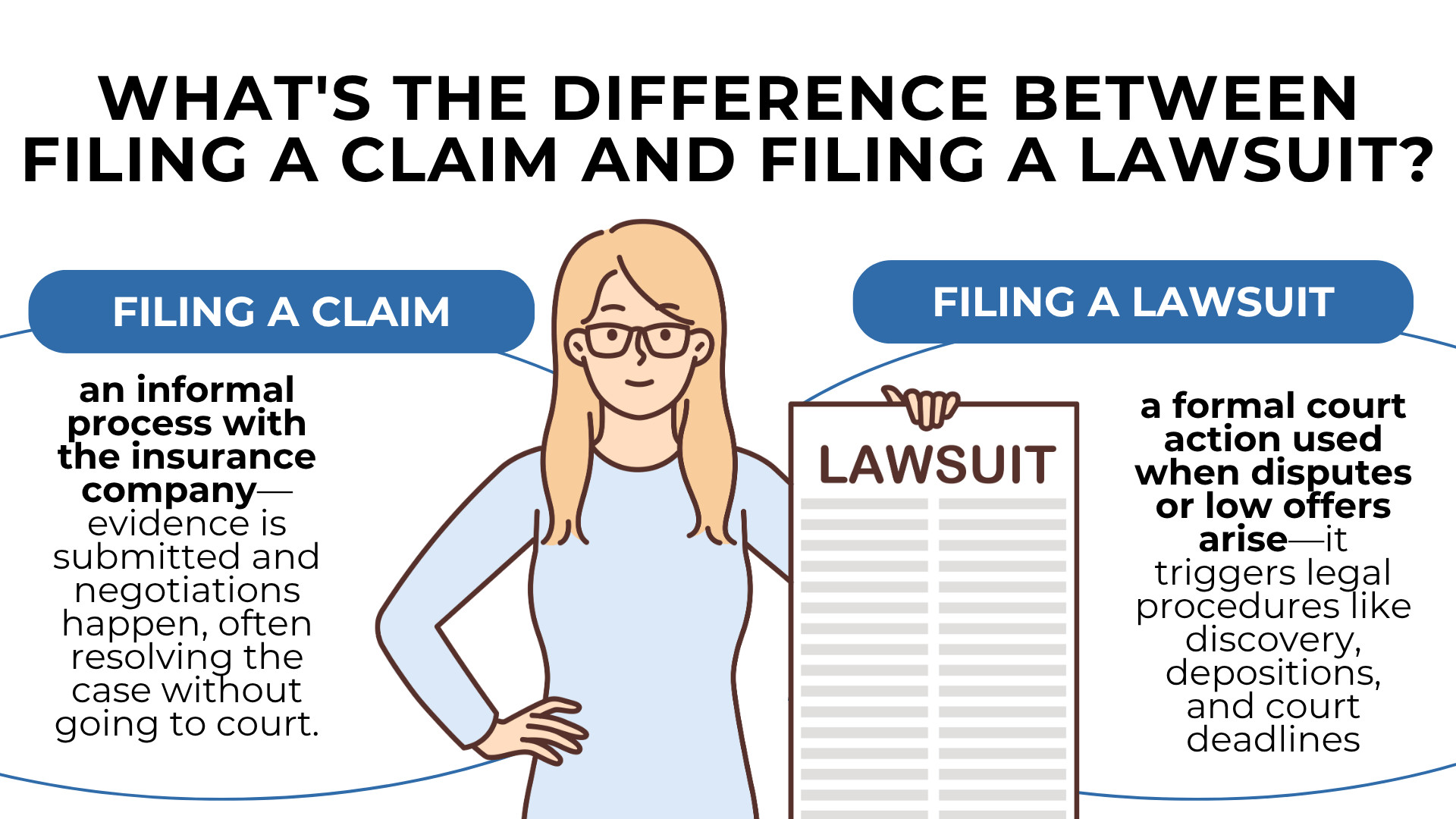
What’s the difference between filing a claim and filing a lawsuit?
Most trucking cases start as insurance claims. A demand is made to the carrier’s insurer, medical records and wage documentation are submitted, and negotiation follows. When that process produces a fair number, a lawsuit never gets filed.
A lawsuit becomes necessary when one of a few things happens. Liability is disputed — the carrier argues the driver wasn’t at fault, or shifts blame to the injured driver, or claims a third party caused the crash. The offer is inadequate — the adjuster treats a commercial trucking case like a fender-bender and ignores future medical costs, lost earning capacity, or the severity of the injuries. Negotiations drag — time passes, statutes of limitations approach, and nothing moves. Or liability is denied outright.
Filing a lawsuit changes how the case works. It triggers formal discovery. Under court rules, the trucking company is then required to produce records it would never hand over voluntarily — driver qualification files, hours-of-service logs, maintenance records, dispatch communications, post-crash drug and alcohol testing. It allows sworn depositions of the driver, safety director, and corporate representatives. It puts the case on a schedule a court controls. And it signals to the carrier’s insurer that the claim will cost more to defend than to resolve. That is often when serious settlement conversations begin.
None of that is automatic. Filing also starts a clock on evidence preservation duties and imposes pleading requirements for certain claims (like enhanced damages). And it opens the door to the defense’s own procedural moves, including apportionment complaints that attempt to add third parties as defendants.
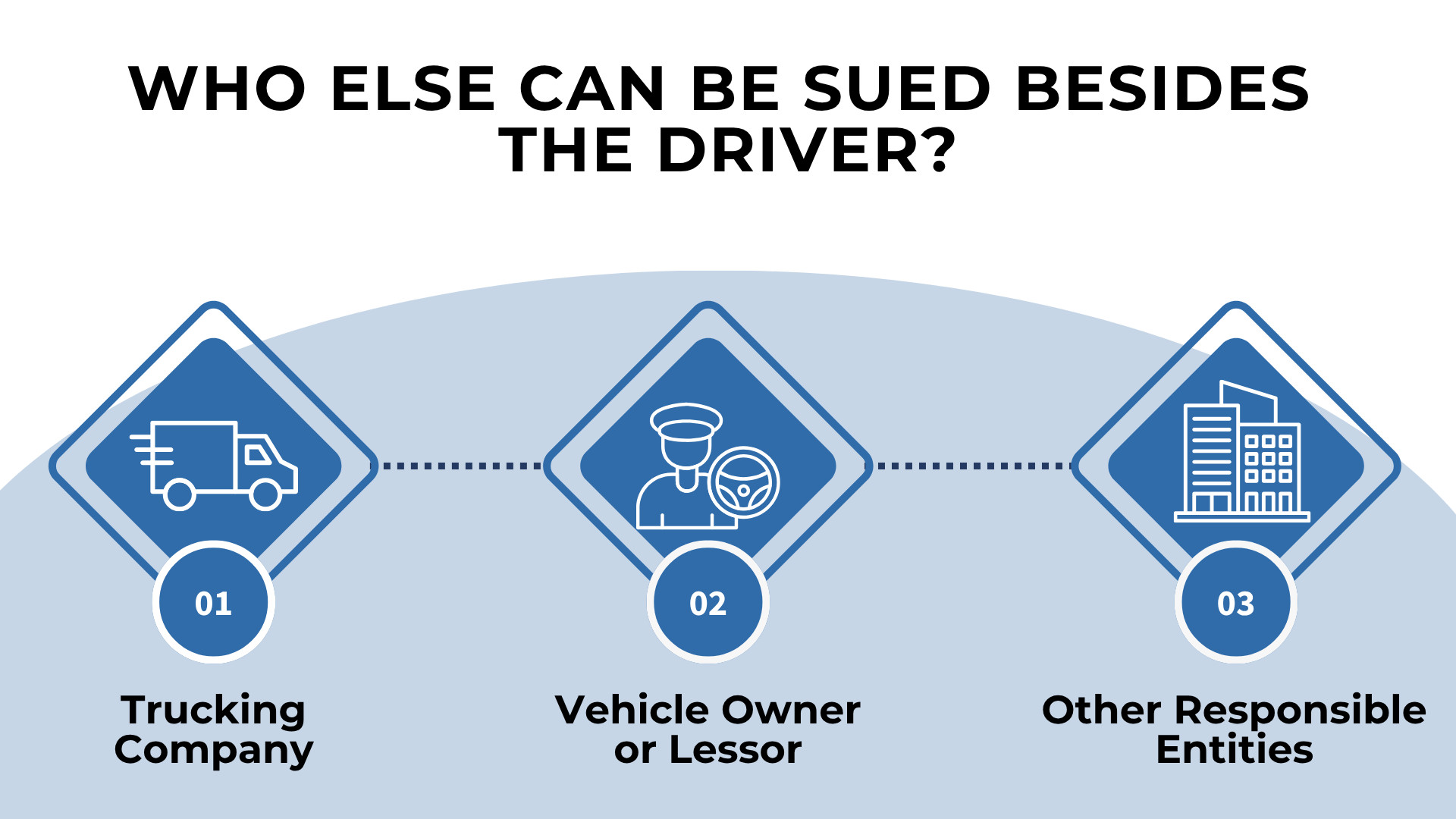
Who else can be sued besides the driver?
One of the most important early decisions in a trucking case is identifying every party whose conduct contributed to the crash. In most cases, that list extends well beyond the person behind the wheel.
The motor carrier — the company that employed the driver and operated the truck — is typically the primary defendant. Connecticut applies the common-law doctrine of respondeat superior: an employer is vicariously liable for the negligent acts or omissions of its employees committed within the course and scope of employment. On top of that, Conn. Gen. Stat. § 52-183 creates a rebuttable presumption that the operator of an owner’s motor vehicle is the owner’s agent and servant operating in the course of employment. The burden is on the defendant to rebut the presumption.
The vehicle owner is another potential defendant when the tractor or trailer is owned by a different entity than the carrier. Conn. Gen. Stat. § 14-154a imposes vicarious liability on lessors and renters of motor vehicles. The federal Graves Amendment (49 U.S.C. § 30106) preempts purely vicarious liability against rental and leasing companies, while leaving intact claims based on the owner’s own negligence, such as negligent maintenance or negligent entrustment.
The carrier can also face direct liability — separate from the driver’s conduct — for negligent hiring, supervision, retention, and entrustment. These claims target the company’s own failures and exist independently of respondeat superior. Seguro v. Cummiskey, 82 Conn. App. 186 (2004). The central question is whether the carrier knew or should have known the driver posed a risk. Federal qualification and testing standards under 49 CFR Parts 391 and 382 define what reasonable vetting looks like. In a lawsuit, the discovery process is how you obtain the company’s hiring files, testing records, and internal communications that establish whether the carrier met that standard.
Carriers often try to sidestep liability by classifying drivers as independent contractors rather than employees. That label isn’t decisive in Connecticut. Courts look at the actual relationship and the right to control the means and methods of work. For statutory employment questions, Connecticut applies the stricter ABC test under Conn. Gen. Stat. § 31-222(a)(1)(B). That test presumes employment unless the employer proves freedom from direction and control, services outside the employer’s usual course of business, and that the worker is customarily engaged in an independently established trade. And under 49 CFR § 390.5, the federal definition of “employee” includes drivers operating under a commercial motor carrier’s authority even when the paperwork says “independent contractor.” For FMCSR-based claims, that definition often cuts through the dodge entirely.
The federal rulebook every trucker has to follow — and how a violation becomes your evidence
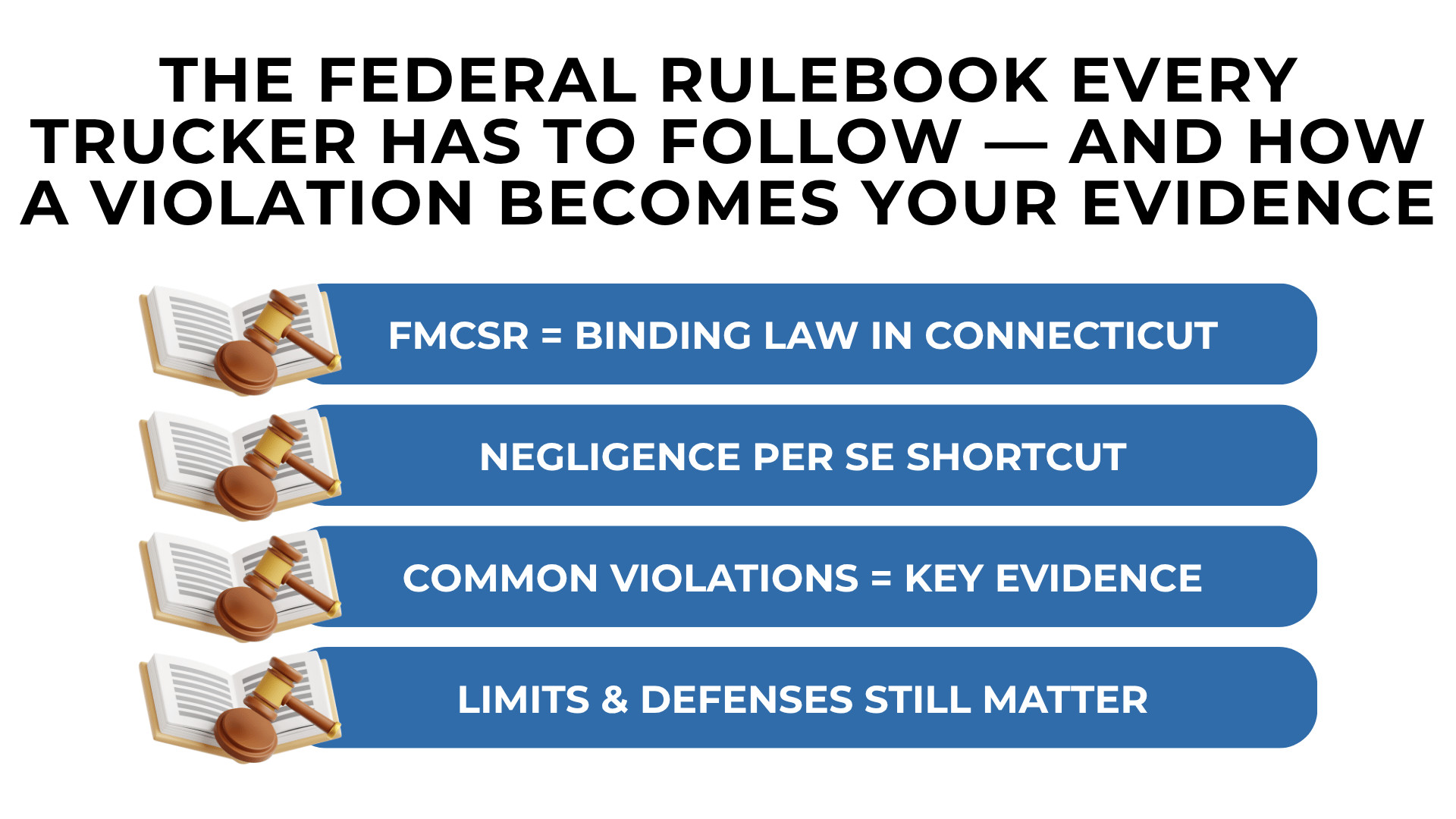
Connecticut has adopted the Federal Motor Carrier Safety Regulations (49 CFR Parts 382–397) as state law under Conn. Gen. Stat. § 14-163c. Under Connecticut’s negligence per se doctrine, a violation of these adopted regulations can constitute negligence as a matter of law if the plaintiff is within the class the regulation was designed to protect and the harm is of the type the regulation was designed to prevent. When those conditions are met, the jury decides only whether the regulation was violated — not whether the defendant acted reasonably.
The regulations most often at issue in trucking cases:
Hours-of-service limits under 49 CFR § 395.3, which cap driving time and mandate rest breaks. A driver who exceeds them has, in a literal legal sense, violated the standard of care.
Electronic logging device requirements under 49 CFR § 395.8. ELDs are the primary record of duty status. Their data shows when the driver was driving, when on-duty but not driving, and when off-duty — information that can confirm or refute hours-of-service violations.
Prohibition on driving while impaired under 49 CFR § 392.3. This regulation prohibits the driving of a commercial motor vehicle while impaired by fatigue, illness, or any other cause. It also prohibits a motor carrier from permitting such driving.
Driver qualification requirements under 49 CFR Part 391.
Drug and alcohol testing requirements under 49 CFR Part 382.
There are defenses available to a regulatory violation. Under Connecticut Civil Jury Instruction 3.6-14, a defendant may argue that reasonable efforts to comply were made, that a sudden emergency prevented compliance, or that compliance would have created greater risk. And even where a violation and the two-part test are established, the plaintiff still has to prove proximate causation — that the violation was a substantial factor in producing the harm.
Two Connecticut traffic statutes frequently come in alongside FMCSR violations in trucking cases. Conn. Gen. Stat. § 14-218a prohibits operating at a speed greater than is reasonable given prevailing conditions. Conn. Gen. Stat. § 14-222 covers reckless driving and treats operation exceeding 85 mph as a per se violation. Both can support negligence per se and — when combined with recklessness — open the door to enhanced damages under § 14-295, discussed below.
The evidence that wins your case is disappearing right now
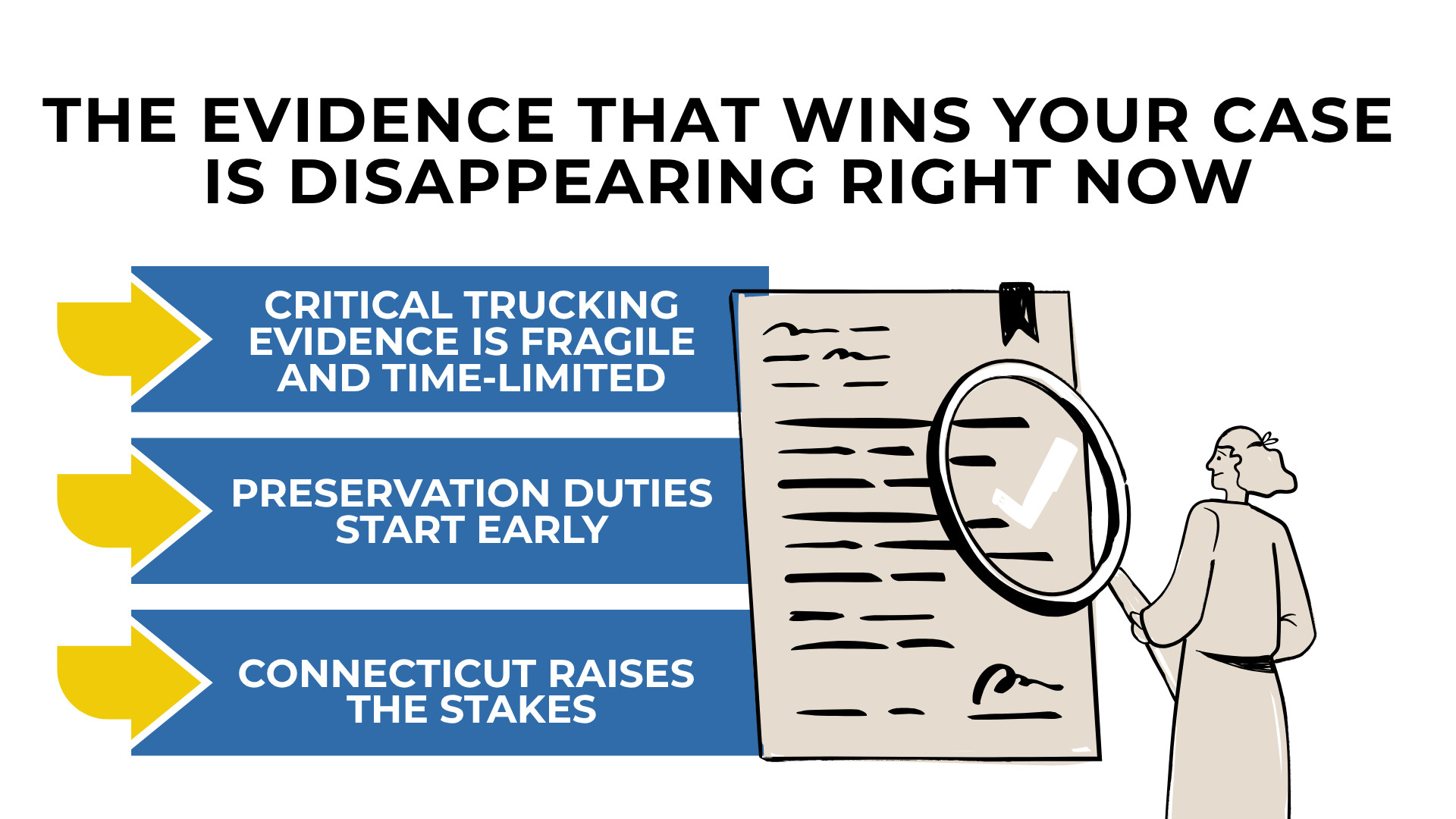
Trucking cases turn on electronic and documentary evidence that lives inside the carrier’s operations: ELD data, engine control module or “black box” data, dashcam or forward-facing camera footage, GPS records, Qualcomm and dispatch communications, the driver’s qualification file, maintenance and inspection records, and post-crash drug and alcohol testing results.
Federal regulations require carriers to retain ELD records of duty status for six months. They also have to produce those records on request by an authorized safety official (49 CFR § 395.8(k) / § 395.22(j)). They also prohibit alteration or erasure of original ELD data or hours-of-service source data (49 CFR § 395.30(f)). Six months is a floor, not a guarantee. Other categories of evidence — dashcam footage in particular — often have much shorter default retention windows on the carrier’s own systems.
Connecticut imposes a common-law duty to preserve evidence once litigation is pending or reasonably anticipated. That duty extends to ELD data, event data recorder information, dashcam footage, GPS records, and dispatch communications. If a party intentionally destroys evidence after that duty attaches, the trier of fact may draw a permissive adverse inference that the destroyed evidence would have been unfavorable to the destroying party. The destruction has to be intentional, and the party seeking the inference has to have acted with due diligence. Negligent spoliation is not enough for the instruction.
Connecticut goes further than most states on this point. In Rizzuto v. Davidson Ladders, Inc., 280 Conn. 225, 905 A.2d 1165 (2006), the Connecticut Supreme Court recognized an independent tort of intentional spoliation. That tort allows a plaintiff to recover the full amount of compensatory damages lost due to the intentional destruction of evidence. Most jurisdictions do not have this cause of action. It is a meaningful deterrent to evidence destruction in Connecticut trucking cases. It raises the stakes for carriers who might otherwise let retention periods lapse.
Connecticut Practice Book § 13 authorizes discovery sanctions for failure to comply with preservation obligations — including establishment of facts as admitted, preclusion of evidence, default judgment, or monetary sanctions. There is a narrow safe harbor under Practice Book § 13-14(d) for electronically stored information lost through routine, good-faith system operation. But that safe harbor does not apply once the carrier knows or reasonably should know that litigation is on the way.
The practical takeaway is that evidence preservation duties attach when litigation is reasonably anticipated — not when a lawsuit is filed. A spoliation letter from counsel, sent promptly, is usually what triggers the duty in writing. Delay in getting that letter out can mean evidence is gone before anyone has a chance to ask for it.
What a semi truck accident lawsuit is actually worth
Connecticut recognizes two categories of compensatory damages under Conn. Gen. Stat. § 52-572h(a). Economic damages are financial losses — medical care, rehabilitative services, custodial care, and loss of earnings or earning capacity. Non-economic damages are non-financial losses — physical pain and suffering and mental and emotional suffering. Connecticut imposes no statutory cap on either category in personal injury or wrongful death cases.
The scale of damages in trucking cases tends to be much larger than in car accident cases for a practical reason: the difference in vehicle mass produces disproportionately severe injuries. Nationally, 5,472 people were killed and an estimated 153,452 were injured in large-truck crashes in 2023. The survivors of these crashes are frequently left with catastrophic injuries — traumatic brain injury, spinal cord damage, multiple orthopedic injuries, burns. The lifetime costs of these injuries are measured in millions, not thousands.
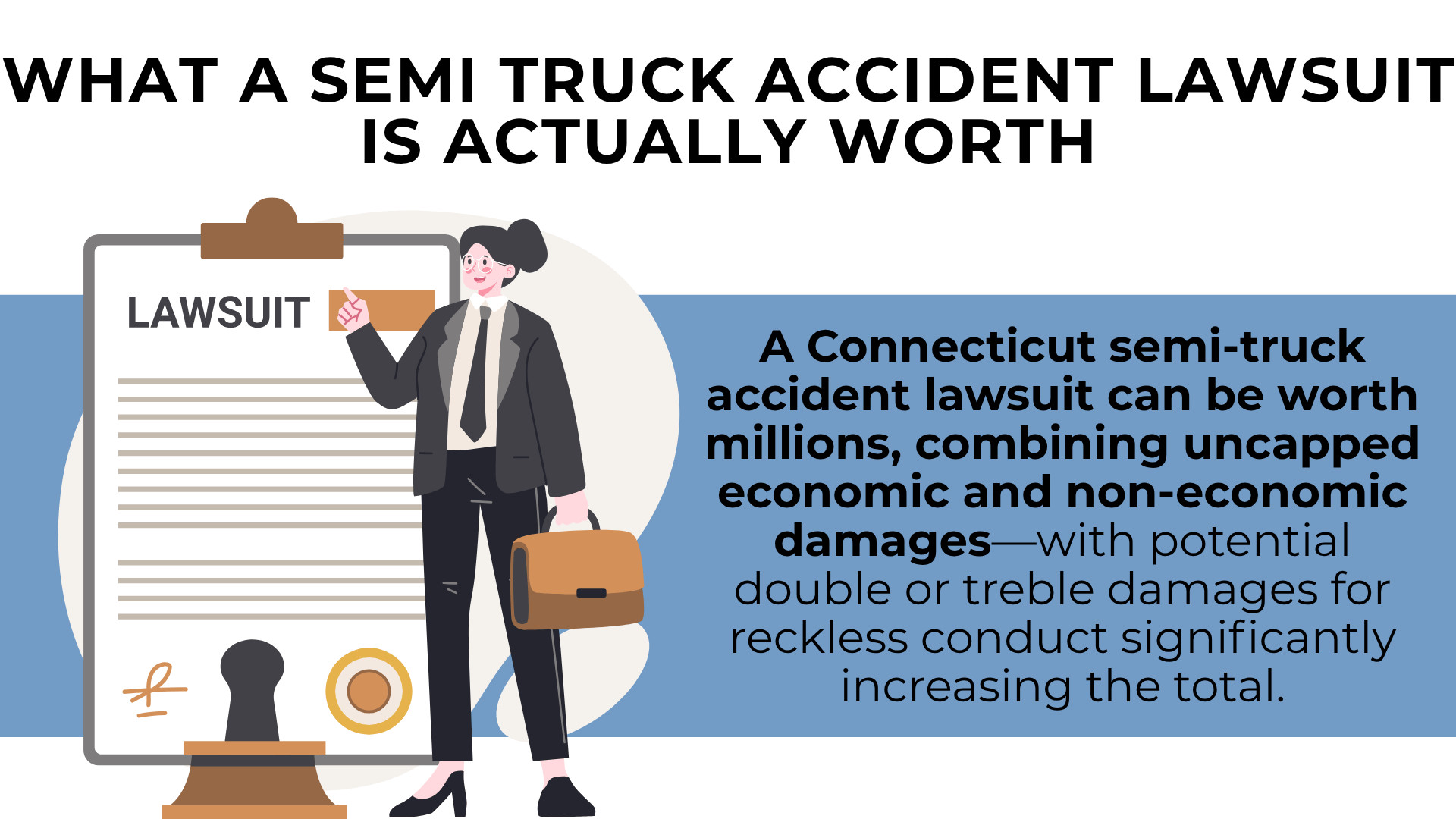
Beyond compensatory damages, Connecticut allows enhanced damages under Conn. Gen. Stat. § 14-295. These are available in cases where a party deliberately or with reckless disregard violated one of several listed traffic statutes, and the violation was a substantial factor in causing injury, death, or property damage. The statute authorizes double or treble damages. The claim must be specifically pleaded — it is not available as an afterthought. This matters especially in trucking cases involving clear hours-of-service violations, driving while impaired, or operation at extreme speeds, where the conduct often crosses from negligent into reckless.
One consequence of recklessness that is sometimes overlooked: under Conn. Gen. Stat. § 52-572h(o), apportionment of liability does not apply where liability is based on any ground other than negligence — including recklessness. Once a driver’s conduct is found reckless, the carrier cannot reduce its share of a verdict by pointing to an injured plaintiff’s own comparative fault. That feature of Connecticut law is one reason pleading recklessness carefully, where the facts support it, changes the mathematics of a case.
Connecticut’s common-law punitive damages are restrictive — limited to the plaintiff’s litigation costs, meaning attorney’s fees and nontaxable costs. Most of the “above compensatory” exposure in trucking cases therefore comes through § 14-295, not through a common-law punitive award.
How long you have to file — and why the deadline is shorter than many people assume
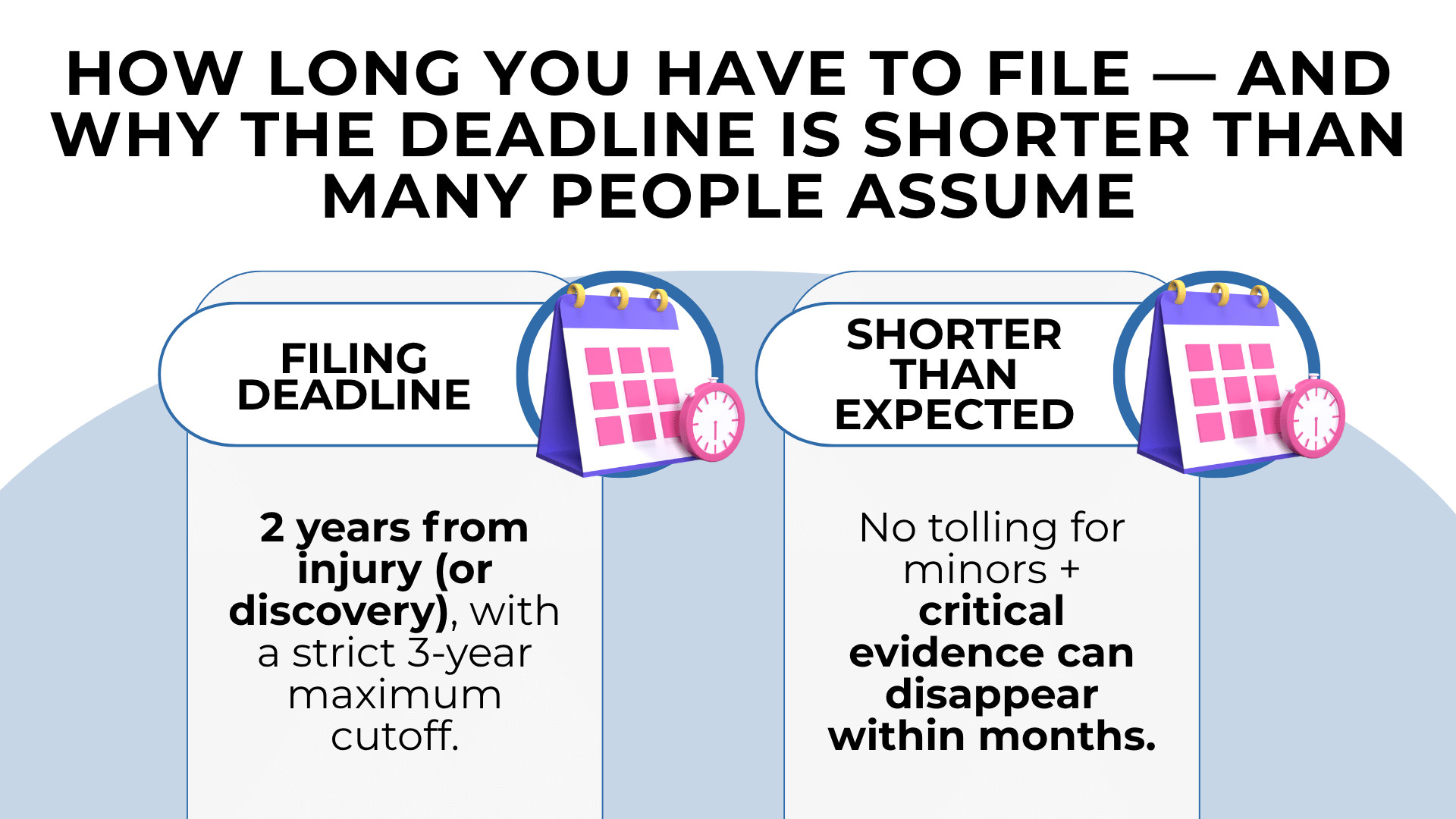
Connecticut’s statute of limitations for motor vehicle negligence claims is governed by Conn. Gen. Stat. § 52-584. The rule is two years from the date the injury is first sustained, discovered, or in the exercise of reasonable care should have been discovered. That two-year period is subject to an absolute three-year statute of repose from the date of the act or omission. The three-year repose is a hard bar, not subject to the discovery rule, and cannot be extended even if the injury has not yet been discovered.
One Connecticut-specific rule deserves emphasis: Connecticut is the only state in the country that does not toll the negligence statute of limitations under § 52-584 for minors or incapacitated persons. Parents must bring the claim within the standard two-year period — there is no grace period until the child turns 18.
Wrongful death claims follow a different clock. Under Conn. Gen. Stat. § 52-555, a wrongful death action must be brought within two years from the date of death. It also must be brought no more than five years from the date of the act or omission complained of. That is a related but distinct set of rules. Families facing a fatal truck crash should get advice on it specifically rather than relying on the general negligence limitations period.
The deadline interacts directly with the evidence question. Waiting to file — even waiting to retain counsel — means letting the six-month ELD retention floor run, letting dashcam footage cycle out of the carrier’s systems, and letting witness memories fade. The filing deadline is the outer limit; the practical deadline for preserving a case is much earlier.
What actually happens once the lawsuit is filed
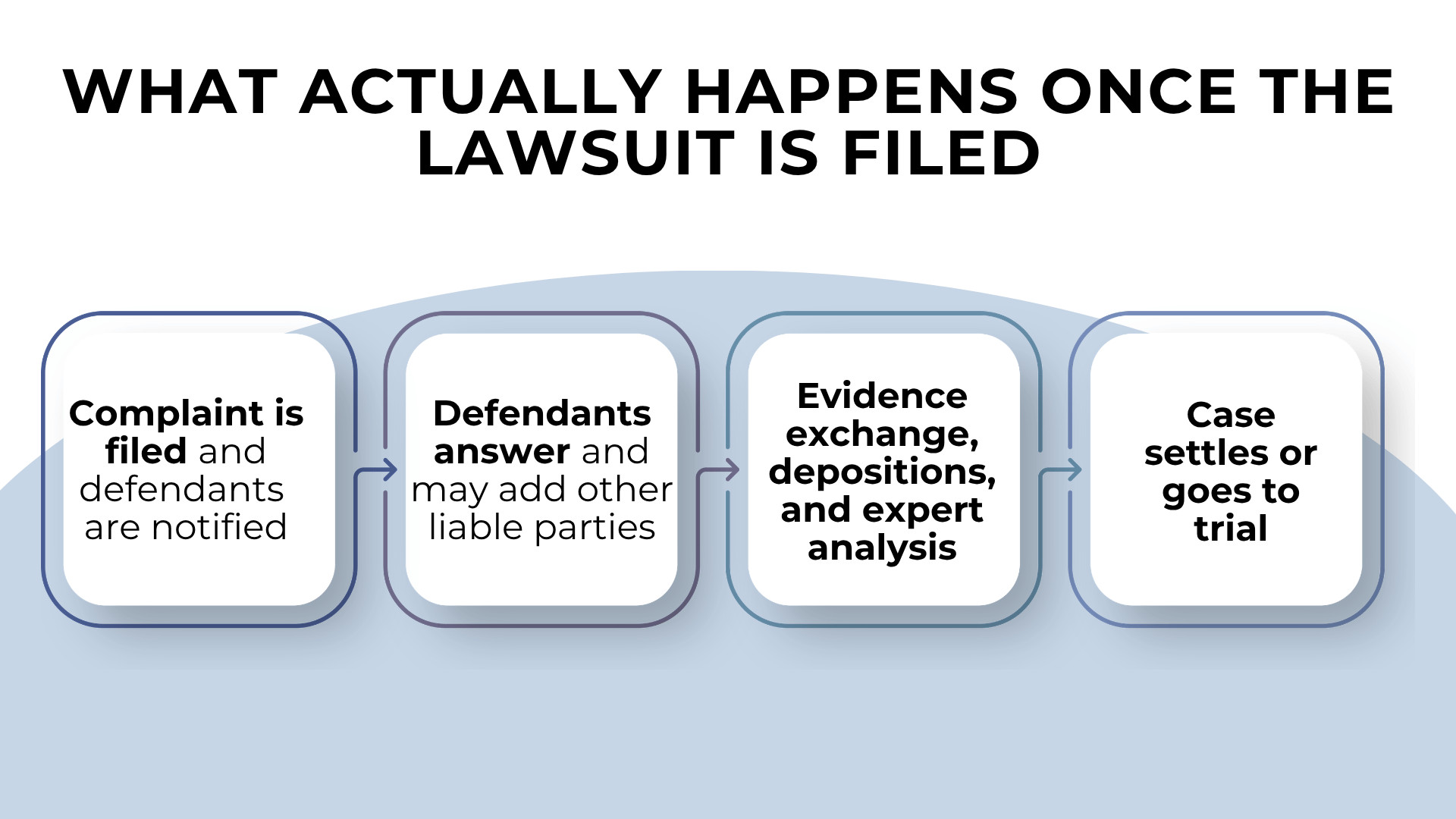
The first formal step is the complaint, which identifies the defendants, the legal theories, and the damages sought. Service of process on each defendant follows. In Connecticut, the complaint has a return date — a procedural deadline that controls several downstream clocks, including the window for apportionment complaints.
Once served, a defendant typically answers the complaint and may file an apportionment complaint under Conn. Gen. Stat. § 52-102b. This procedure allows a defendant to bring in additional parties within 120 days of the return date and seek to have fault apportioned among them. In trucking cases, this is how carriers try to spread liability — naming a co-driver, a maintenance provider, another vehicle operator, or a road authority, for example. Apportionment, however, does not apply where liability rests on a basis other than negligence. Per § 52-572h(o), once reckless or intentional conduct is established, apportionment is off the table.
Discovery is the longest and most demanding phase. It includes written discovery — interrogatories and requests for production — through which you obtain the driver qualification file, hours-of-service records, ELD data, maintenance and inspection records, post-crash testing, and internal safety policies. It also includes depositions under oath: the driver, the safety director, dispatch personnel, and a corporate designee who must testify on the carrier’s behalf about specified topics. Expert work runs alongside discovery — accident reconstruction, trucking safety and regulatory experts, treating physicians and independent medical experts, vocational experts, and economists or life-care planners in catastrophic cases.
Most cases resolve through negotiated settlement or mediation before reaching a verdict. The cases that settle at full value typically do so because they have been built as if they were going to trial — with the driver deposed, the corporate representative’s testimony locked in, the regulatory violations documented, and the damages experts disclosed. Cases that don’t settle go to trial, where the jury decides whether a violation occurred and, if so, the remaining questions of causation and damages.
Trucking cases generally take longer than car accident cases. The defendant list is larger, discovery is more extensive, expert work is heavier, and the stakes usually justify the defense litigating every contested issue. That timeline is a feature of the case type — not a sign anything is going wrong.
Why is trucking defense different — and why does a general injury lawyer struggle against it?
Commercial trucking cases sit on top of a completely different insurance structure than passenger-vehicle cases. Federal law requires interstate carriers to carry a minimum of $750,000 in liability coverage under 49 CFR § 387.9, rising to $5,000,000 for the most dangerous hazmat loads — far above Connecticut’s $25,000 per-person minimum for passenger vehicles.
Connecticut generally does not permit pre-judgment direct action against an insurer. Under Conn. Gen. Stat. § 38a-321, direct action is available only after a final judgment remains unsatisfied for 30 days. For federally regulated interstate carriers, however, the MCS-90 endorsement under 49 CFR § 387.15 in effect creates a direct-action mechanism. It requires the insurer to pay public liability claims even when the policy would otherwise exclude coverage. That endorsement does not apply to every carrier, but where it does, it changes the leverage in settlement discussions.
Carriers and their insurers don’t approach these cases reactively. The rapid-response approach — investigators and defense counsel dispatched to the scene within hours of a serious crash — is designed to control the evidence and the narrative before you have retained anyone. The defense bar that handles commercial trucking cases does it full-time and knows the regulatory landscape in depth. A general personal injury practice that handles trucking cases occasionally tends to miss defendants, miss regulatory violations, miss the narrow window for evidence preservation, or undervalue cases at settlement because the full scope of exposure never gets developed.
Etemi Law handles commercial trucking cases out of Waterbury, Connecticut. The firm’s trial practice focuses on cases that carriers and their insurers expect to defend hard — motor vehicle and commercial trucking matters where the evidence work, regulatory analysis, and willingness to try the case to verdict are what drive real outcomes. If you are weighing whether filing a lawsuit is the right step after a semi truck crash, the most time-sensitive action is getting counsel involved early enough that the evidence discussed in this article still exists when it’s needed.