What Insurance Does a Commercial Truck Have to Carry — and What Does That Mean for Your Claim?
Federal law requires most commercial trucks to carry at least $750,000 in liability insurance — ten times more than what Connecticut requires from a regular passenger vehicle. That number is the starting point, not the full picture. Multiple policies may apply depending on what the truck was hauling. The actual coverage available could be significantly higher — or frustratingly inadequate for a serious crash. This page breaks down exactly what insurance commercial trucks are required to carry, why those minimums often fall short, what additional coverage may be available, and what stands between you and the money that’s supposed to pay for your injuries.
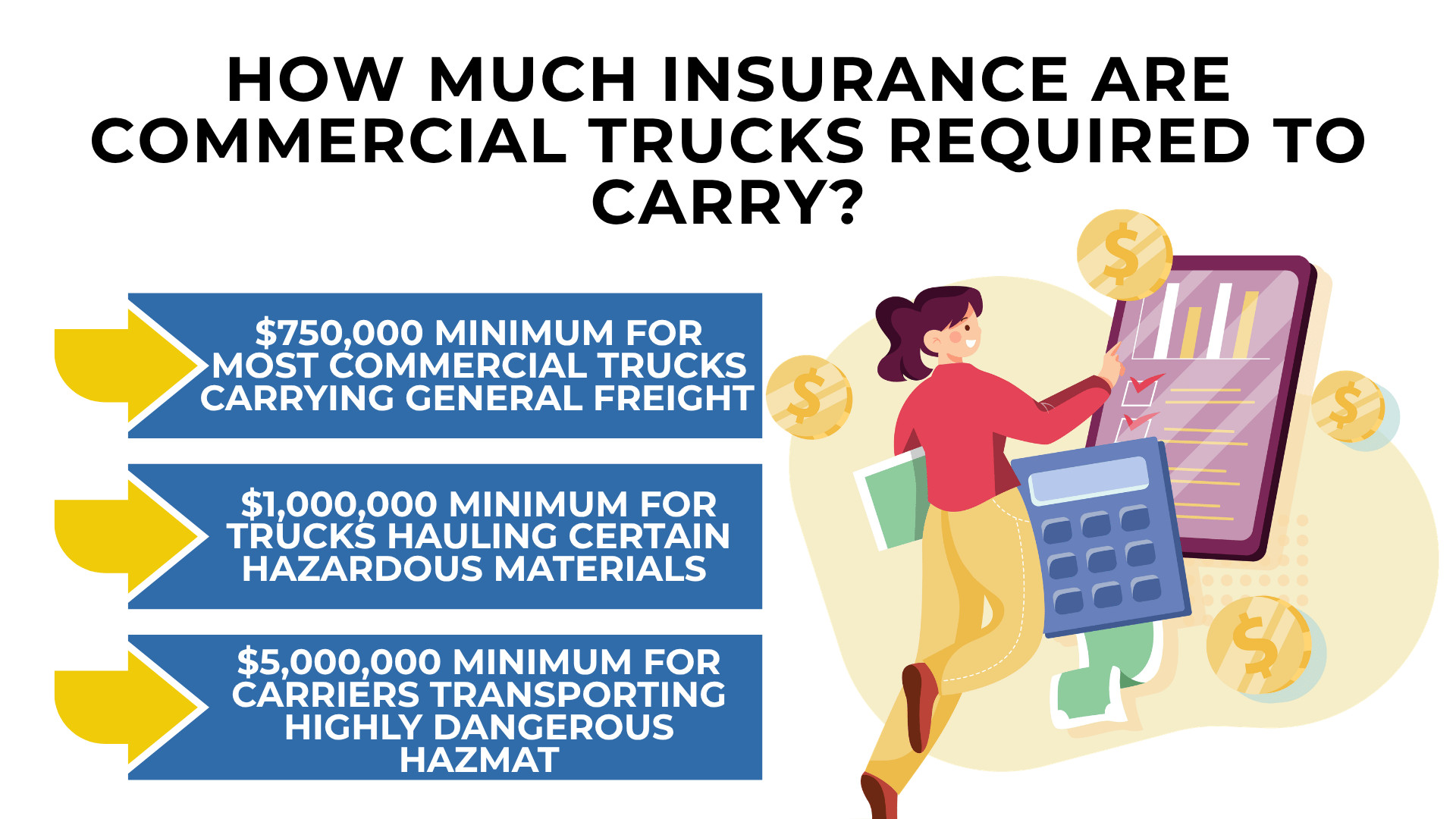
How Much Insurance Are Commercial Trucks Required to Carry?
The federal government sets minimum insurance requirements for commercial motor carriers through 49 CFR § 387.9. These minimums depend on what the truck is carrying.
For general freight — the majority of tractor-trailers, delivery trucks, and commercial vehicles with a gross vehicle weight rating over 10,000 pounds — the minimum is $750,000 in liability coverage. Carriers hauling certain hazardous substances or waste must carry at least $1,000,000. For the most dangerous hazmat categories, the required minimum jumps to $5,000,000.
To put those numbers in context, Connecticut only requires regular passenger vehicles to carry $25,000 per person and $50,000 per accident in bodily injury liability under Conn. Gen. Stat. § 14-112. The federal minimums for trucks exist because the damage a commercial truck causes is in a completely different category than a fender-bender between two sedans.
Connecticut takes the insurance obligation seriously at the state level, too. Under Conn. Gen. Stat. § 14-213b, the owner of a motor vehicle with a commercial registration who knowingly violates the statute’s insurance requirements is guilty of a Class D felony — not a traffic ticket, not a fine, but a felony charge. And through Conn. Gen. Stat. § 14-163c, Connecticut has adopted the Federal Motor Carrier Safety Regulations (49 CFR Parts 382–397), making federal insurance and safety standards enforceable for both interstate and in-state carriers operating in the state.
Is $750,000 Actually Enough to Cover a Serious Truck Accident?
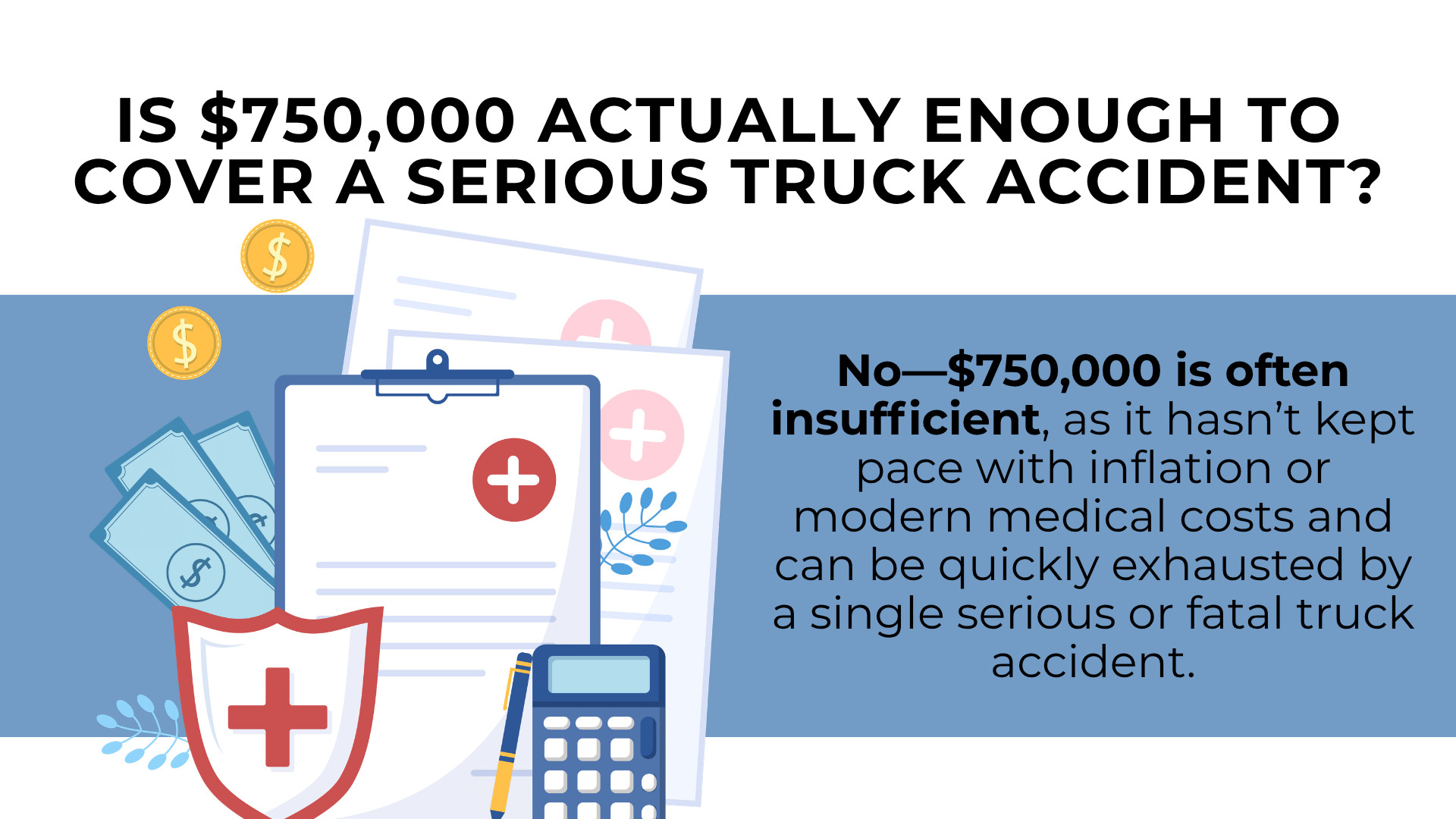
Often, no. The $750,000 federal minimum has not been adjusted since 1980. Adjusted for inflation, that amount would exceed $2.8 million today. Four decades of medical cost increases, and the minimum hasn’t moved.
Consider what a serious truck crash actually costs you. A high-level spinal cord injury (C1–C4) carries average first-year medical and living expenses of $1,446,827. After that, the average annual cost is $251,246 every year. For a 25-year-old, lifetime costs can reach approximately $6.4 million. A single catastrophic injury can consume the entire $750,000 minimum before you even leave the hospital.
The federal government’s own data reflects this mismatch. FMCSA calculates the comprehensive cost of a single fatal large truck crash at $14,578,771 — nearly twenty times the minimum policy. Even a non-fatal injury crash carries an average comprehensive cost of $383,168.
The minimum is a legal minimum. It is not a measure of what a serious truck accident actually costs.
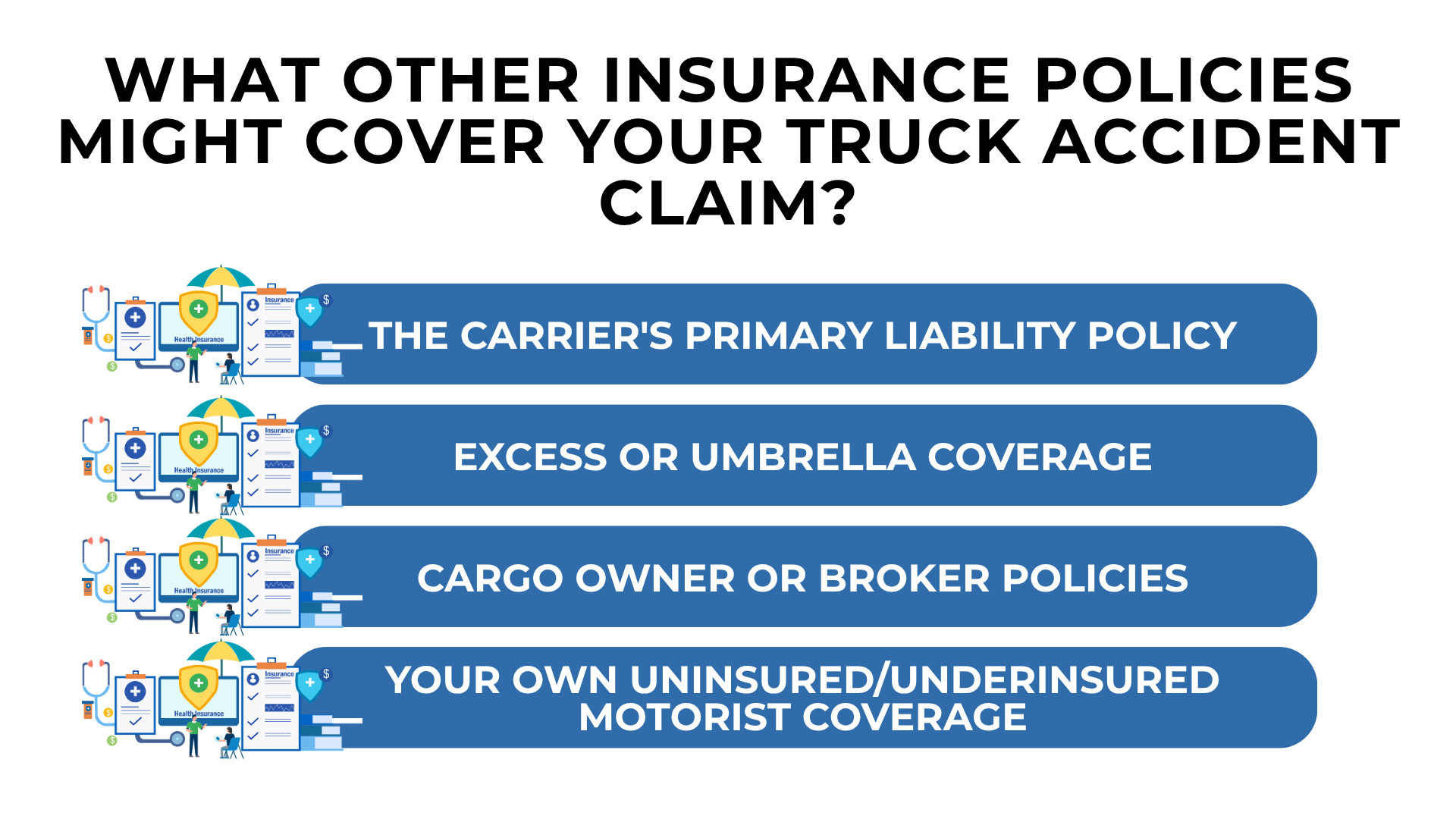
What Other Insurance Policies Might Cover Your Truck Accident Claim?
Most people assume there is one insurance policy — the trucking company’s. In reality, several layers of coverage may apply to a single crash.
The carrier’s primary liability policy. This is the policy that meets the federal minimum. Many carriers, particularly larger fleets, carry limits well above the $750,000 floor because their own risk requires it.
Excess or umbrella coverage. Trucking companies frequently carry additional policies that sit on top of the primary liability coverage. These kick in once the primary policy’s limits are used up. A carrier with a $750,000 primary policy might carry $2 million or $5 million in umbrella coverage on top of it.
Cargo owner or broker policies. Depending on the arrangement, the company that owns the freight or the broker that arranged the load may carry separate liability coverage. These policies don’t always apply, but in crashes involving leased equipment, brokered loads, or shipments that use multiple types of transport, they can open additional sources of recovery.
Your own uninsured/underinsured motorist coverage. Connecticut requires every automobile liability policy to include UM/UIM coverage under Conn. Gen. Stat. § 38a-336. The minimum limits match the state’s liability minimums of $25,000 per person and $50,000 per accident. If the trucking company’s insurance is insufficient to cover your damages — or if there’s a coverage dispute — your own UIM policy may provide additional compensation. Connecticut is generally an anti-stacking state, though, meaning you typically cannot combine UM/UIM limits across multiple vehicles or policies on the same claim.
Identifying every applicable policy is one of the first things an experienced trucking accident attorney does. Leaving a policy on the table means leaving money that should go toward your recovery.
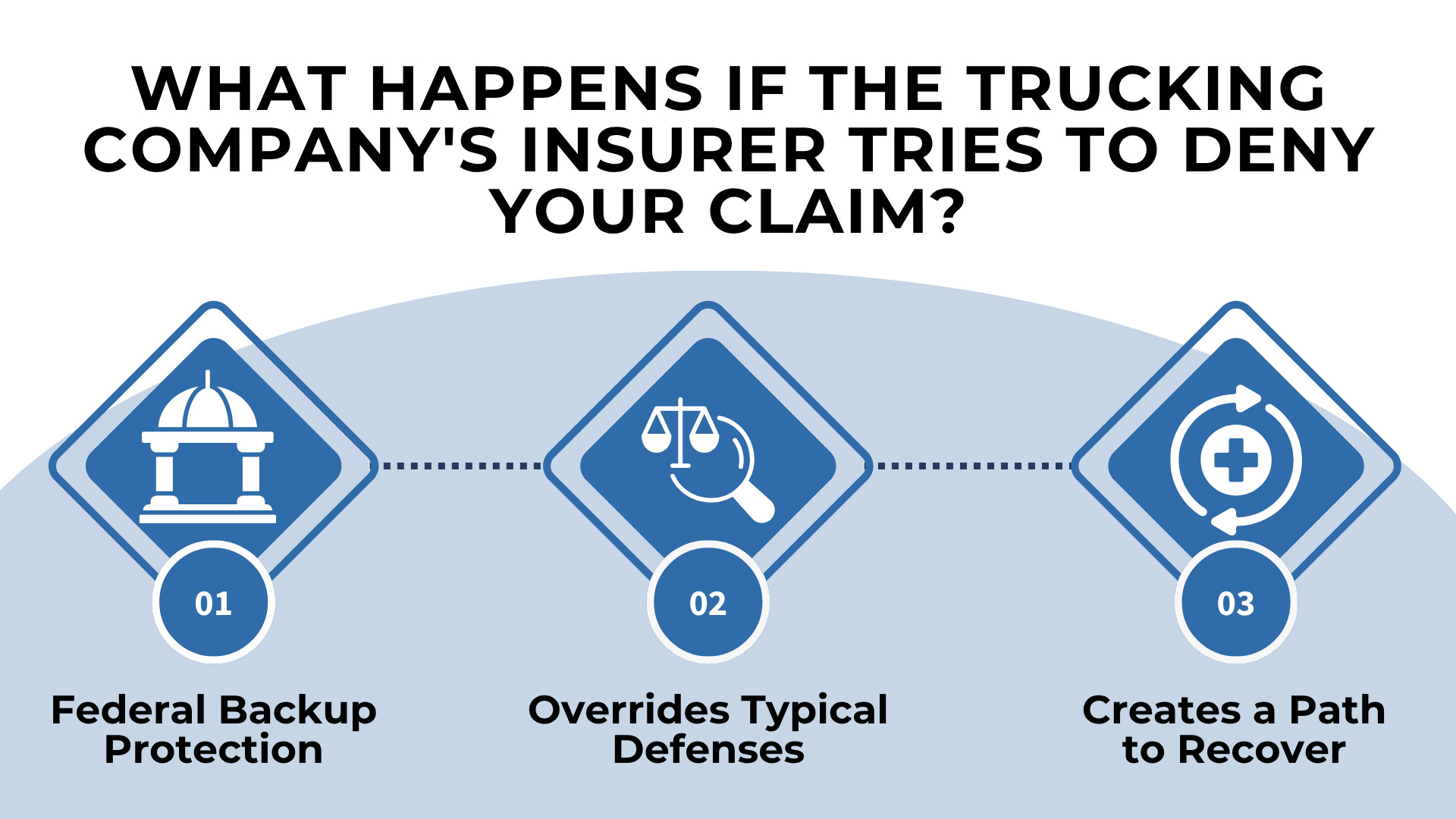
What Happens If the Trucking Company’s Insurer Tries to Deny Your Claim?
There is a federal protection built into the insurance system that most people never hear about unless an attorney explains it.
Under 49 CFR § 387.15, every federally regulated interstate carrier’s insurance policy must include what’s called an MCS-90 endorsement. This endorsement requires the insurer to pay injury claims caused by the carrier’s operations — even if the policy itself would otherwise exclude the claim. If the carrier let coverage lapse, if there’s a policy exclusion the insurer wants to rely on, if the carrier was operating outside the policy’s terms — the MCS-90 endorsement can override those defenses and force payment.
This matters because Connecticut’s general rule makes it difficult to go after an insurer directly. Under Conn. Gen. Stat. § 38a-321, you normally cannot bring a direct action against an insurance company until you have obtained a final judgment against the insured party. That judgment must then go unsatisfied for 30 days. The MCS-90 endorsement creates a separate path — a direct-action right that exists under federal law for interstate carriers, regardless of what state procedural rules would otherwise require.
Not every trucking insurance policy triggers the MCS-90 endorsement. It applies to federally regulated interstate carriers. But when it does apply, it can be the difference between an insurer successfully denying a claim on a technicality and being required to pay it.
Why Don’t Trucking Insurance Companies Just Pay What They Owe?
The insurance exists. The policies are large. But the money doesn’t flow automatically to you.
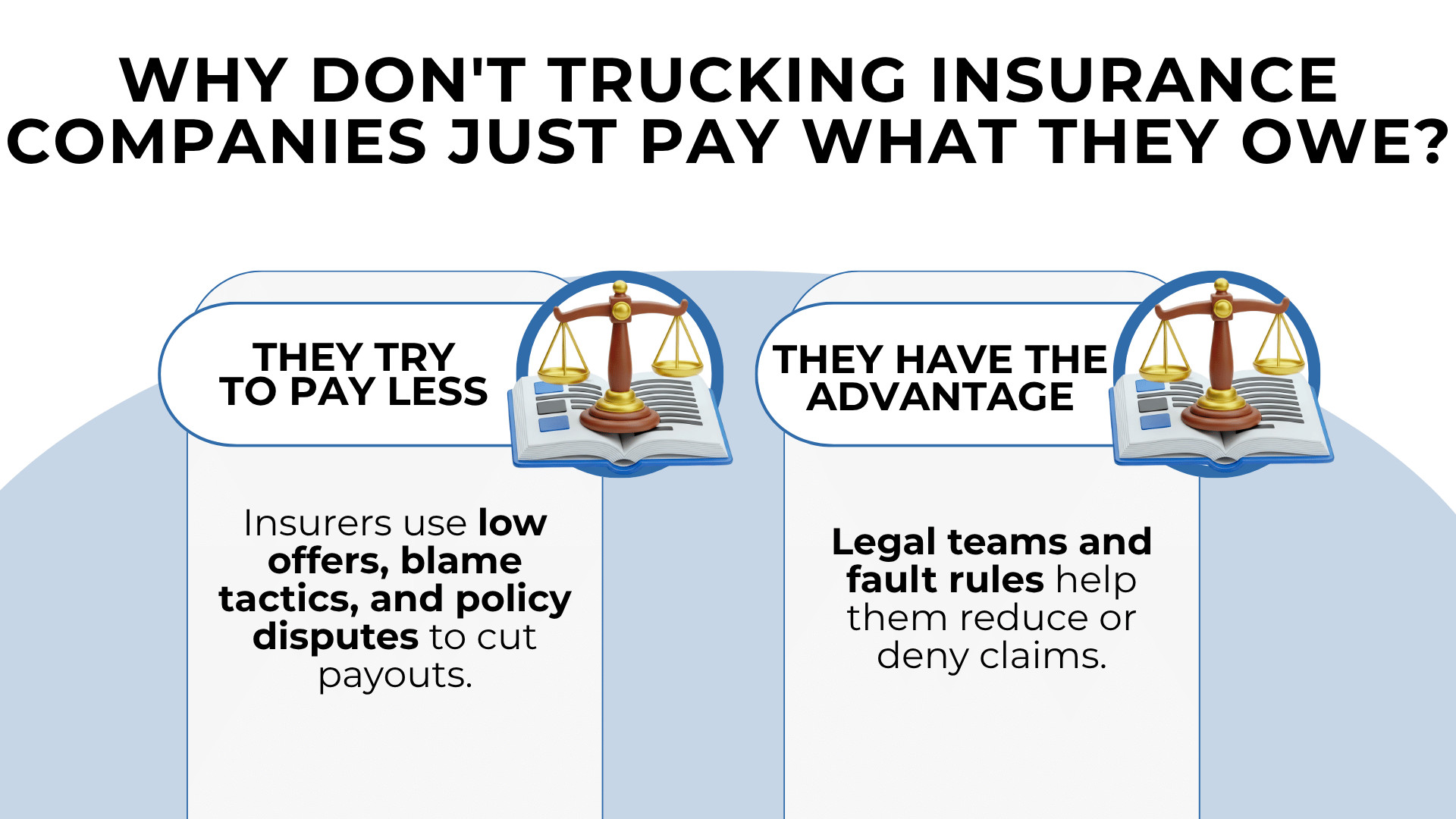
Trucking insurers handle high-value claims routinely, and they are sophisticated in how they minimize payouts. They may offer a fast settlement before the full extent of your injuries is known. They may argue that you share enough fault to reduce or eliminate the claim. They may dispute which policy in a multi-layer coverage arrangement is actually responsible.
The stakes in these disputes are enormous because of how much physical damage commercial trucks inflict. A fully loaded tractor-trailer can weigh 20 to 30 times as much as a passenger car. In 2023, 5,472 people were killed in large truck crashes nationally. Large trucks accounted for 5% of all registered vehicles but 9% of all vehicles involved in fatal crashes — a disproportionate footprint that reflects the physics at work.
The physical reality is lopsided. The insurance process often is too. A trucking company’s insurer has lawyers, adjusters, and accident reconstruction teams working the claim from day one. Their goal is not to figure out what you’re owed — it’s to figure out how to pay less. Connecticut’s modified comparative negligence system under Conn. Gen. Stat. § 52-572h gives them a specific tool. If they can argue your fault was greater than 50%, your recovery is completely barred. Even below that threshold, every percentage point of fault they assign to you reduces what they pay.
That is why having legal representation early changes outcomes. An attorney who understands federal trucking insurance requirements and Connecticut’s fault-sharing rules can counter those strategies before they take hold.
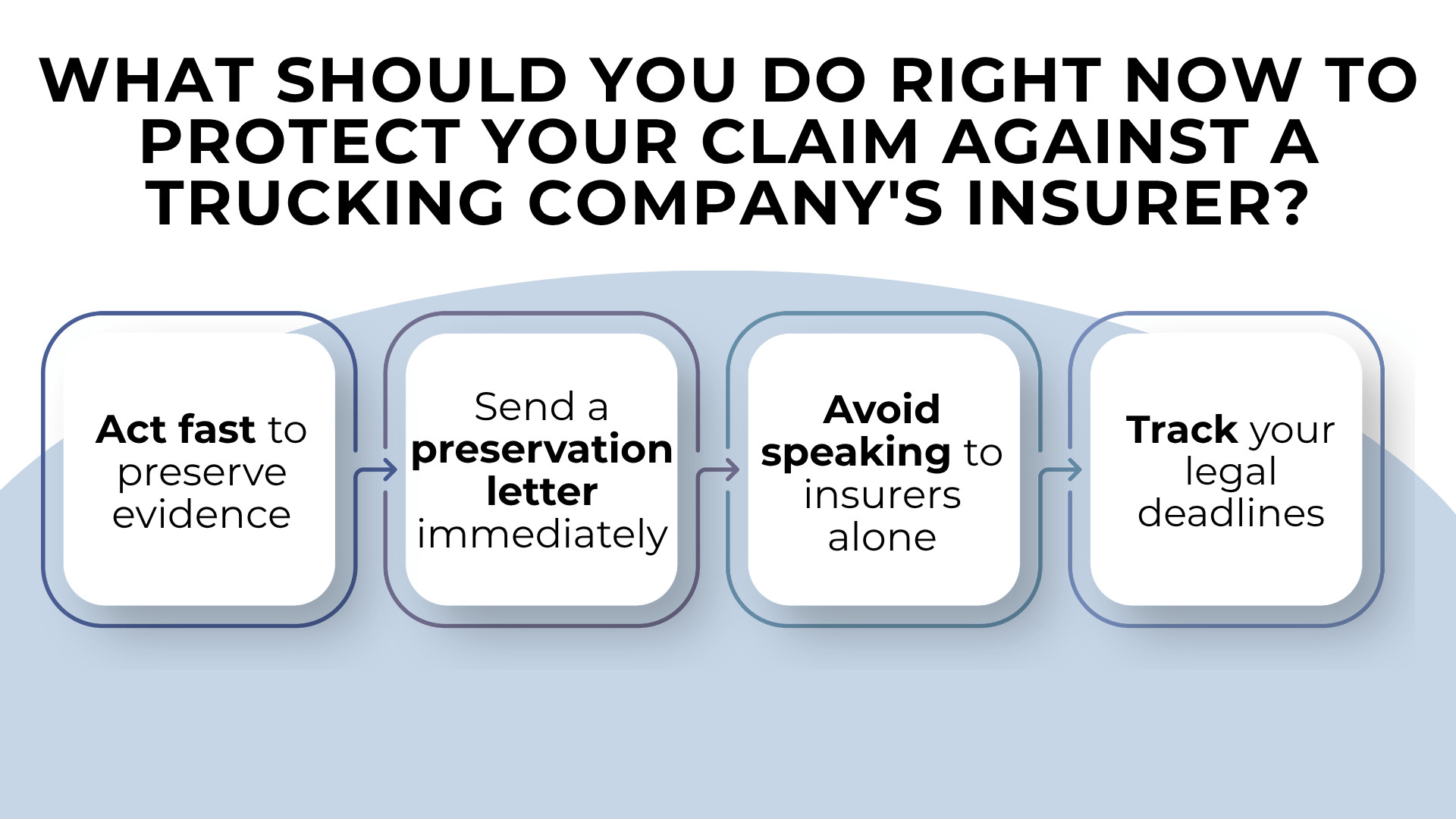
What Should You Do Right Now to Protect Your Claim Against a Trucking Company’s Insurer?
The most time-sensitive issue in a trucking accident claim is evidence. Critical data has a short shelf life.
Federal regulations under 49 CFR § 395.8 require motor carriers to retain electronic logging device records for only six months. Event data recorder information, GPS logs, dashcam footage, and dispatch communications may be overwritten or deleted even sooner under routine business practices. Once that data is gone, it cannot be reconstructed. It is often the strongest proof of what the driver and the carrier were doing in the hours and minutes before the crash.
Connecticut recognizes how critical this evidence is. The state imposes a common-law duty to preserve evidence when litigation is reasonably anticipated. Under the standard established in Rizzuto v. Davidson Ladders, Inc., 280 Conn. 225 (2006), intentional destruction of evidence can lead to an independent tort claim. An attorney can send a preservation letter to the carrier and its insurer immediately, putting them on legal notice that this data must be saved.
Beyond evidence, there are two things to keep in mind. First, do not give a recorded statement to the trucking company’s insurer without legal counsel. Anything you say will be used to build a comparative fault argument against you. Second, the clock is running on your legal deadlines. Connecticut’s statute of limitations under Conn. Gen. Stat. § 52-584 gives you two years from the date the injury is first sustained or discovered. There is also a three-year absolute repose period that cannot be extended.
At Etemi Law in Waterbury, Connecticut, Ron Etemi has handled commercial trucking cases against carriers and their insurers for over 15 years and has tried over 100 cases to verdict. Peter Brown spent his first 15 years in practice trying cases as a civil defense trial lawyer — one of the most respected in the state of Connecticut — which gives him direct insight into how insurers and their counsel approach these claims. When there are multiple policies, federal endorsements, and aggressive adjusters involved, that experience is the difference between accepting a fraction of what’s available and recovering the full value of the coverage that exists.
If you’ve been hurt in a truck accident in Connecticut, call us. The consultation is free, and the sooner we act, the more evidence we preserve and the more leverage we carry into every conversation with the insurer.