What Is the Average Settlement for a Non-Injury Car Accident?

The average property damage claim from a car accident pays roughly $7,191 nationally, according to the National Association of Insurance Commissioners’ most recent data. That number has climbed sharply — up 17.6% in a single year — driven by rising repair costs, more expensive replacement parts, and pandemic-era inflation that hasn’t fully eased. But “average” only tells you so much. What you actually walk away with depends on the specifics of your accident, your vehicle, who was at fault, and the insurance coverage in play. This article breaks down what a realistic payout looks like for a property-damage-only car accident in Connecticut. It explains what moves that number and how to tell whether the offer you’re getting is fair.
What Does a “Settlement” Actually Mean When No One Was Hurt?
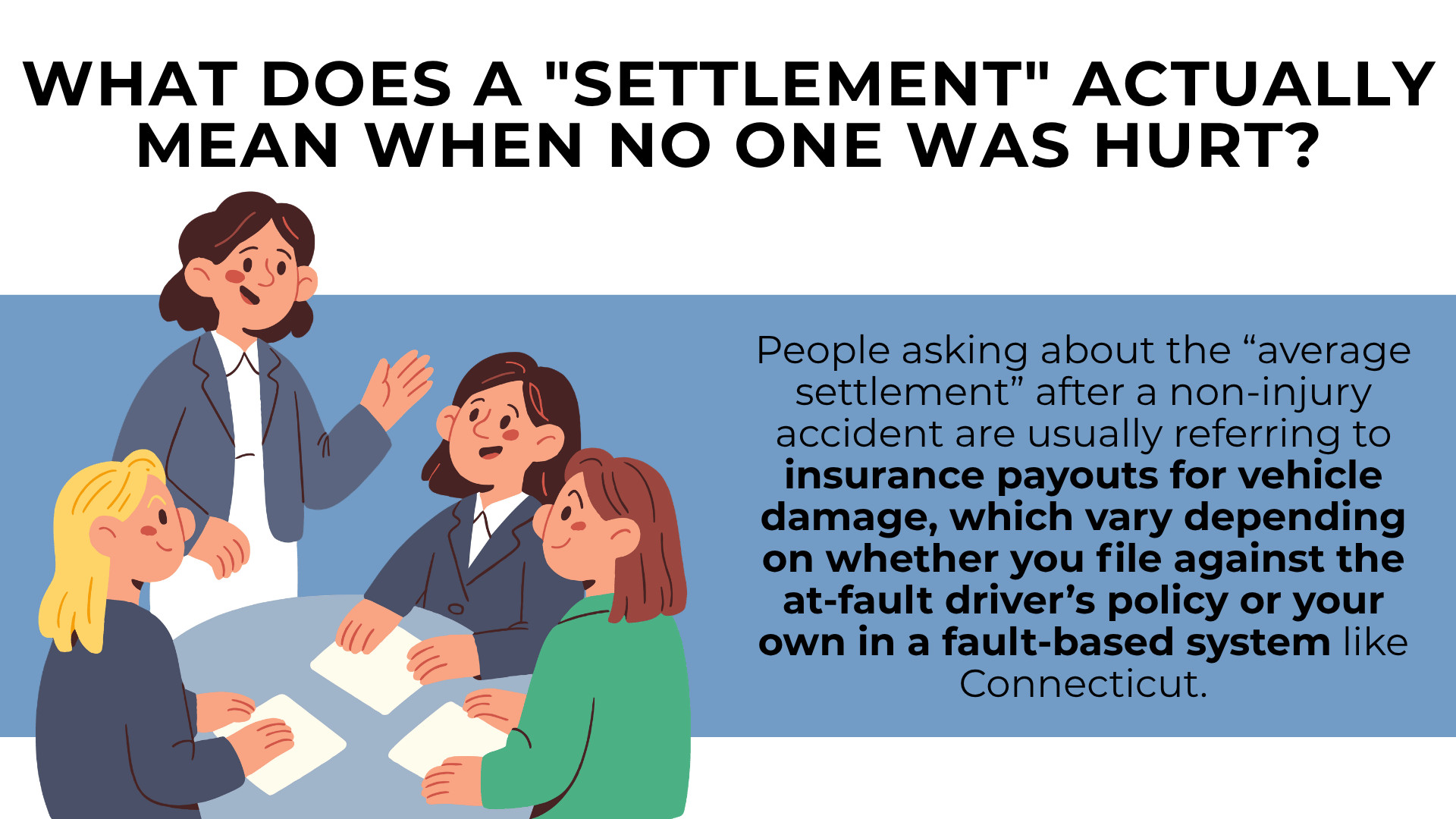
When people search for the “average settlement” after a non-injury accident, they’re usually talking about the insurance payout for vehicle damage — not a courtroom verdict or a formal legal settlement in the traditional sense. It helps to understand which type of claim you’re actually dealing with, because the process and the numbers look different depending on the path.
A property damage liability claim is what you file against the other driver’s insurance when they caused the accident. Their insurer evaluates the damage to your vehicle and pays you up to their policy’s property damage limit. A collision claim, on the other hand, is filed under your own auto policy regardless of who was at fault. You pay your deductible, and your insurer covers the rest. Some people end up filing both or choosing between them depending on the circumstances.
Connecticut is a fault-based state, meaning the driver who caused the accident is financially responsible for the damage. This isn’t the case everywhere — some states use no-fault systems where each driver’s own insurance pays regardless. In Connecticut, though, establishing who was at fault determines whose insurer writes the check. That distinction shapes every step of the process that follows.
What Factors Decide How Much You Get for Property Damage?
There’s no formula that spits out a single dollar amount for every fender-bender. But the variables that adjusters use to calculate your payout are knowable, and understanding them puts you in a much stronger position to evaluate an offer.
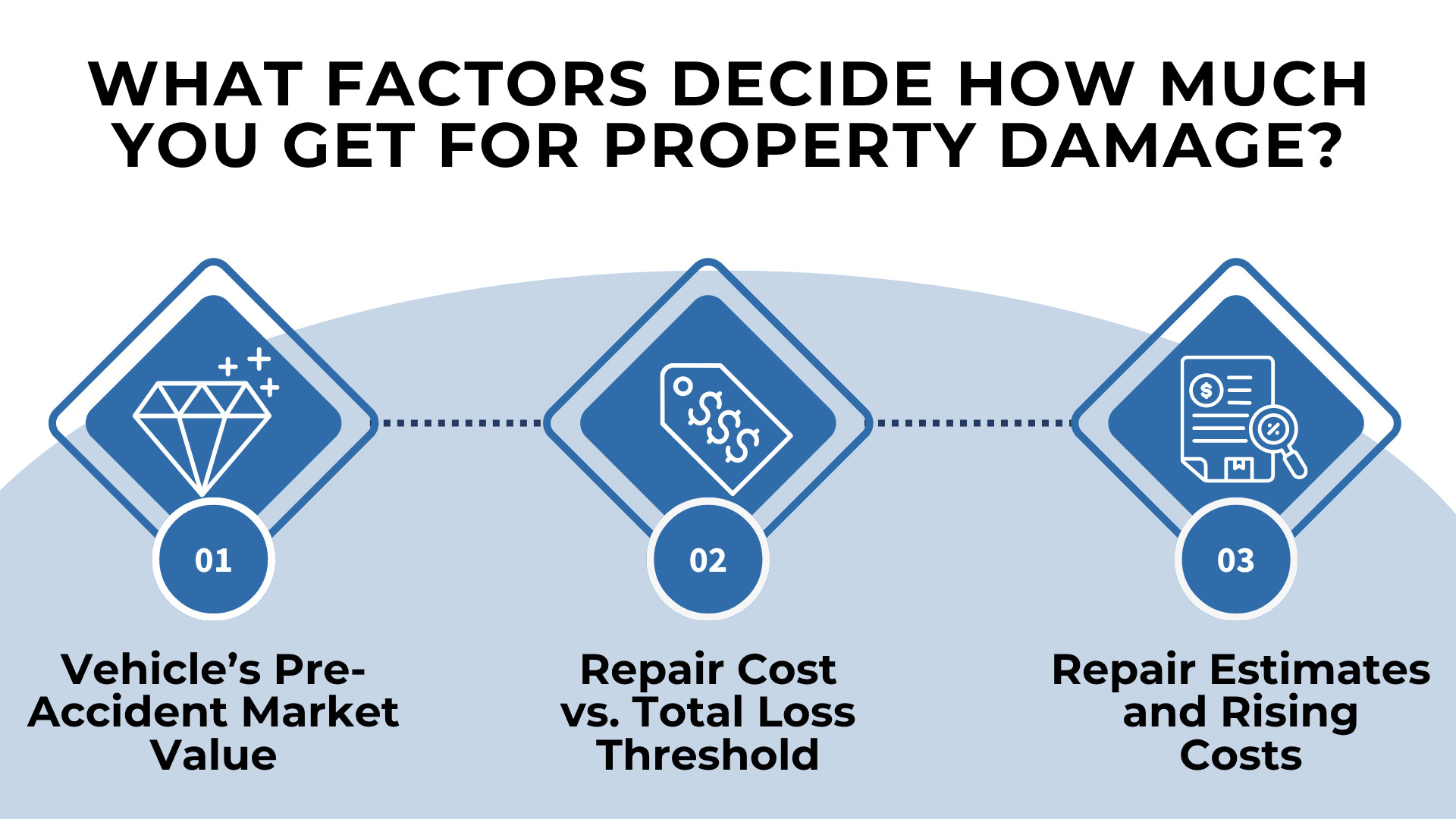
The biggest factor is your vehicle’s fair market value before the accident — not what you paid for it, not what you owe on it, but what a buyer would have reasonably paid for it the day before the crash. Adjusters pull comparable sales data for your vehicle’s year, make, model, mileage, and condition to arrive at this figure. If your repair estimate exceeds a certain percentage of that market value, the insurer may declare your car a total loss. At that point, they offer the pre-accident market value minus your deductible rather than paying for repairs.
When the car is repairable, disputes often center on the extent and cost of repairs — what work is necessary, what parts are appropriate, and whether the estimate reflects the actual cost of restoring the vehicle to its pre-accident condition. These are negotiable points, and the adjuster’s first estimate isn’t necessarily the final word.
It’s also worth noting the broader trend. Over the past two decades, auto claim costs have increased more than 2.25% per year on average. The pandemic years accelerated that rise dramatically. Parts shortages, labor cost increases, and supply chain disruptions have pushed repair bills higher across the board. The $7,191 national average today would have been noticeably lower just a few years ago. And if your accident involves a newer vehicle or one with advanced safety sensors and cameras, repair costs can climb well beyond that average.
What Is Connecticut’s Minimum Insurance, and How Does It Limit Your Payout?
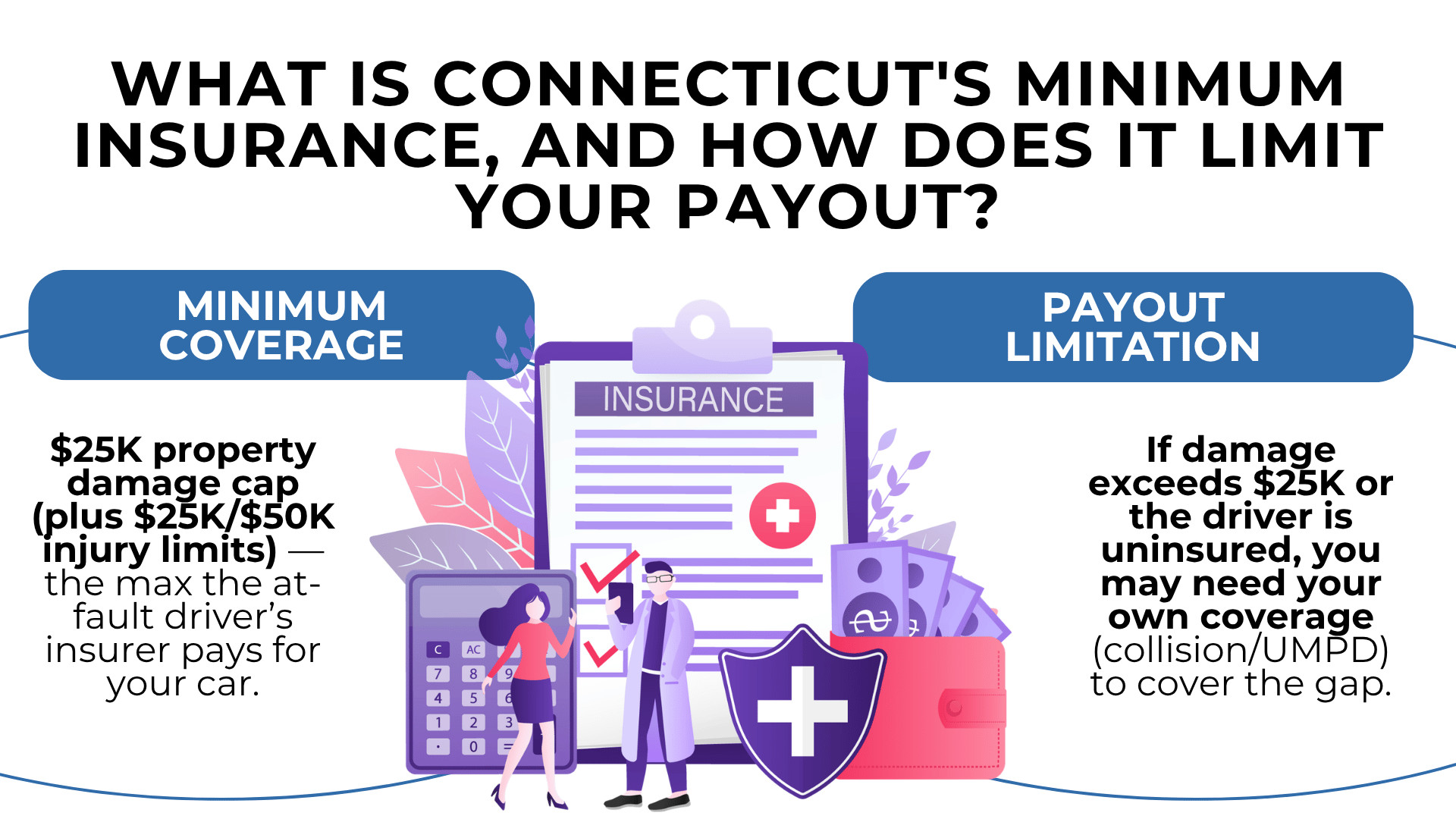
Connecticut law requires every registered vehicle owner to carry liability insurance with minimum limits of $25,000 per person for bodily injury, $50,000 per accident for bodily injury, and $25,000 for property damage under Conn. Gen. Stat. § 14-112. That last number — the $25,000 property damage minimum — is the one that matters most for a non-injury claim. It is the minimum of what the at-fault driver’s policy is required to cover for damage to your vehicle.
For many accidents, $25,000 is enough. But if you drive a newer or higher-value vehicle, a serious collision can produce repair bills or total-loss values that push against or exceed that limit. When the at-fault driver carries only the state minimum, you may not be fully compensated through their policy alone. In that situation, your own collision coverage (if you carry it) can fill the gap, though you’ll typically owe your deductible.
There’s also the possibility that the other driver has no insurance at all. Connecticut ranks 29th among states for its uninsured motorist rate according to the Insurance Research Council — meaning in a meaningful share of accidents, the at-fault driver may have no liability policy to claim against at all. If you carry uninsured motorist property damage coverage on your own policy, it can step in here. But not everyone carries that coverage, and the limits vary. This is one of the scenarios where you’re most likely to be caught off guard.
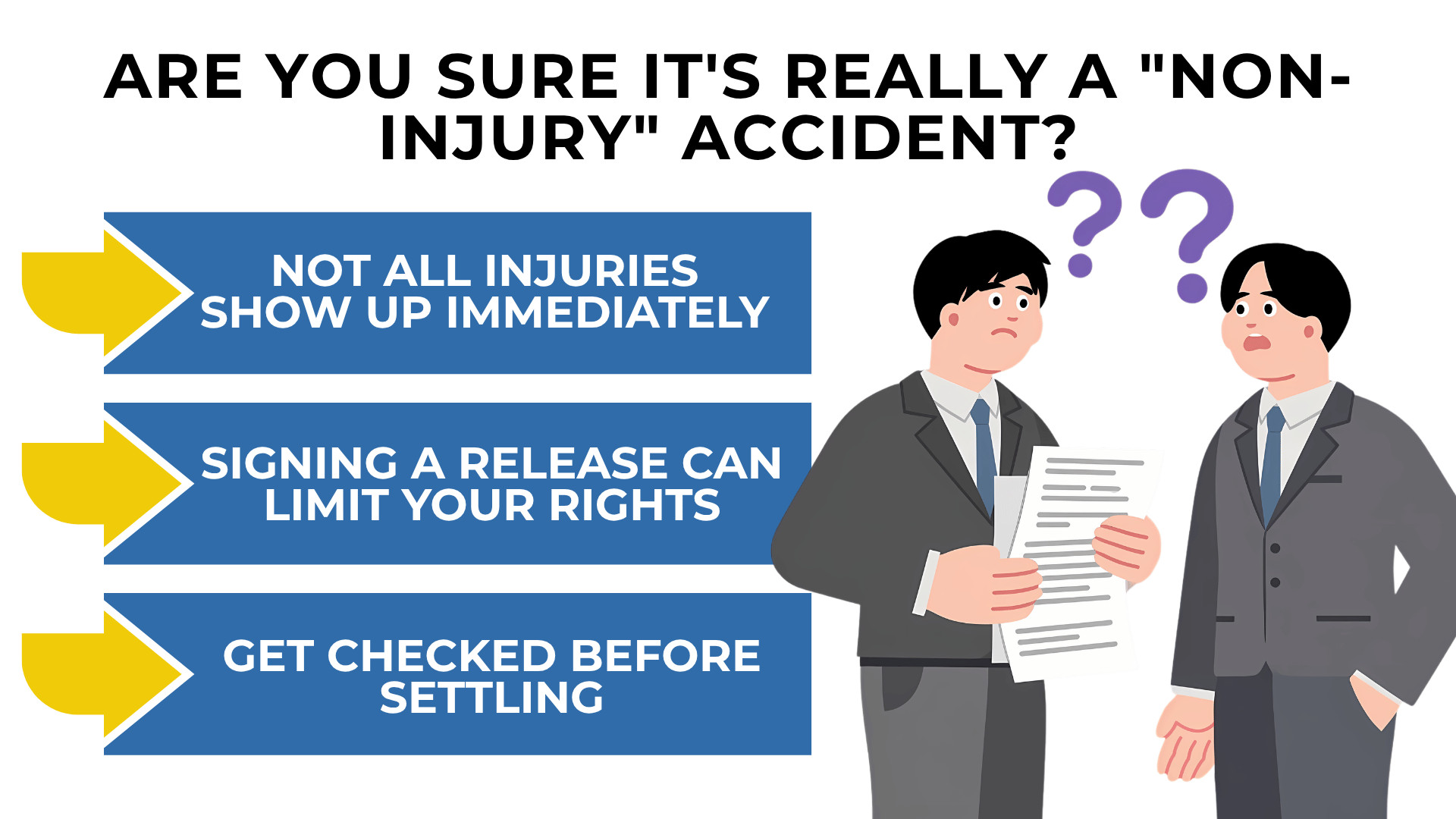
Are You Sure It’s Really a “Non-Injury” Accident?
This is the question worth pausing on before you accept any payout and sign a release.
Some injuries don’t announce themselves at the scene. Whiplash, soft tissue strains, and even mild concussions can take days or sometimes weeks to produce noticeable symptoms. Adrenaline masks pain in the immediate aftermath of a collision. What feels like minor stiffness on day one can develop into something that requires medical attention by day five or ten.
This matters for your property damage claim. Once you sign a release in exchange for a settlement check, you may be giving up the right to pursue additional compensation later — including for injuries you didn’t know about yet. Connecticut’s statute of limitations for personal injury claims is two years from discovery of the injury under Conn. Gen. Stat. § 52-584, subject to a three-year statute of repose. That timeline exists precisely because the law recognizes that harm isn’t always immediately apparent.
The practical takeaway: if there’s any chance you were physically affected by the accident — even if it seems minor — see a doctor before you close out the claim. A property damage settlement and a personal injury claim are separate matters, but settling one carelessly can complicate the other.
Should You Hire a Lawyer for a Non-Injury Car Accident?
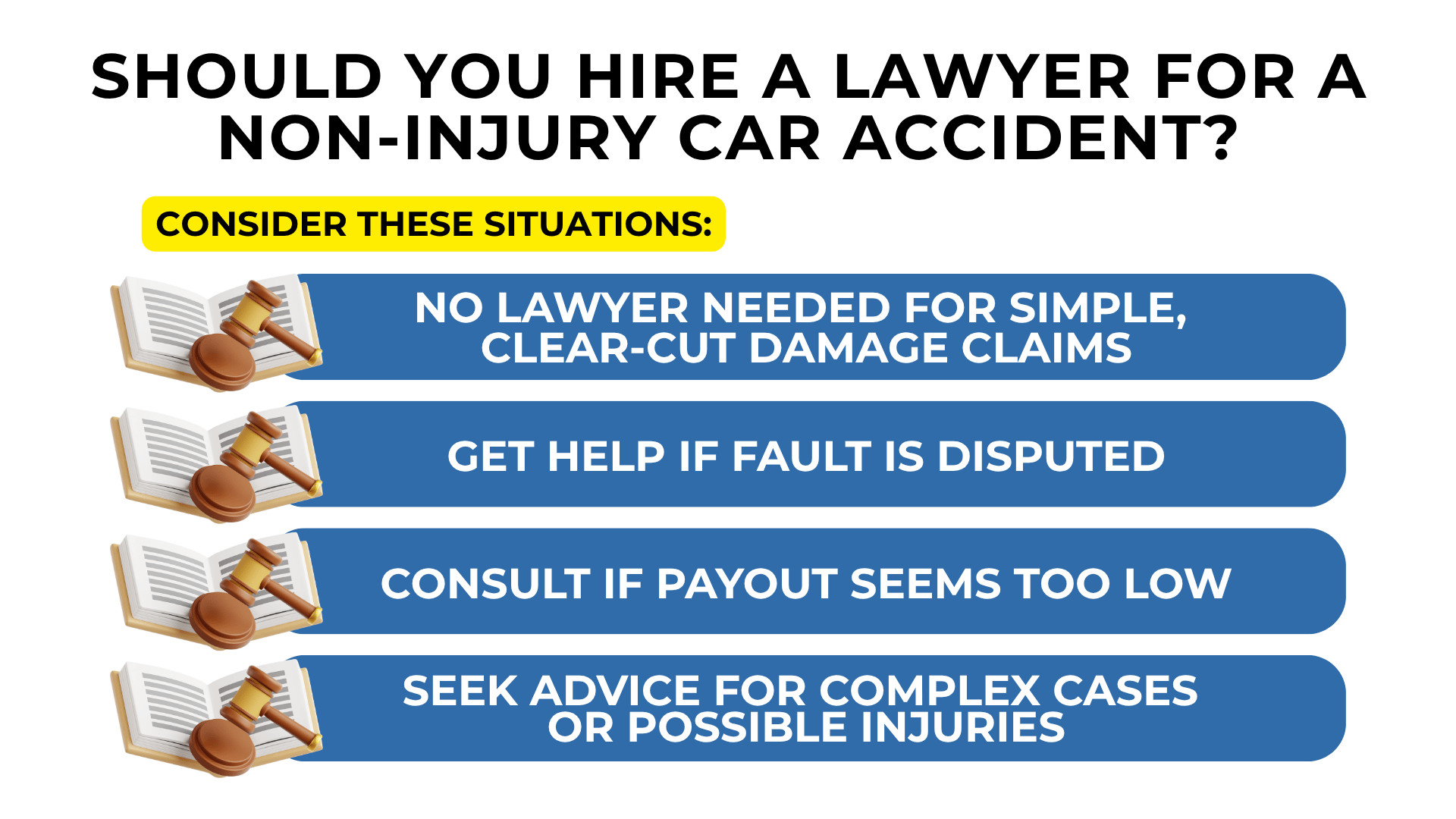
For a straightforward property-damage-only claim where fault is clear, the other driver is insured, and the repair estimate is reasonable, you can usually handle the process on your own. Insurance adjusters process thousands of these claims, and when the facts are simple, the payout tends to follow without much friction.
But not every claim is simple. There are specific situations where having an attorney review your case — even briefly — can meaningfully change the outcome. If the insurance company is disputing fault or assigning you a higher percentage of blame than the facts support, that directly reduces your payout. It’s worth pushing back with someone who understands how fault is determined. If your vehicle has been totaled and the insurer’s market value seems low, an attorney can identify whether comparable sales data supports a higher number. If the at-fault driver is uninsured or underinsured and you’re navigating your own policy’s coverage, the process gets more complex. And if there’s any possibility that injuries may surface — which is more common than you might expect — getting advice early protects options that are difficult to recover once a release has been signed.
Etemi Law in Waterbury, Connecticut handles motor vehicle accident claims and can help you evaluate whether the offer on the table reflects what your claim is actually worth.
How Long Does a Property Damage Claim Take to Resolve in Connecticut?
Timelines vary widely depending on the complexity of the claim. When fault is clear, coverage is confirmed, and the repair estimate is undisputed, the process can move relatively quickly. You’ll need to file and submit photos of the damage, a copy of the police report, and a repair estimate. The insurer inspects or appraises the vehicle, confirms coverage and fault, and issues payment.
When there’s a dispute — over fault, over the repair estimate, over whether the car should be repaired or totaled — the process stretches. What might otherwise resolve in weeks can take considerably longer, especially if the insurer requests additional documentation, hires its own appraiser, or simply moves slowly. During this period, you may be without a vehicle, which adds pressure to accept a lower offer just to close the file.
There are deadlines to keep in mind. Connecticut’s statute of limitations sets a deadline for filing a legal claim if negotiations break down entirely. Your own insurance policy may have reporting and filing deadlines as well. Staying organized — documenting every communication, keeping copies of every estimate and receipt, and following up in writing rather than only by phone — gives you both a paper trail and leverage if the process stalls.
If you’ve been in a car accident in Connecticut and the insurance company’s offer doesn’t seem right — or you’re not sure whether your accident is truly a “no-injury” situation — Etemi Law can help you understand where your claim stands. You can reach the firm in Waterbury or through etemilaw.com.