What Should You Do After a T-Bone Accident in Connecticut?
A t-bone accident can leave you dealing with serious injuries, a totaled vehicle, and immediate questions about who pays for all of it. In Connecticut, the driver who caused the crash is legally responsible for compensating you. But proving fault in a side-impact collision starts with understanding what caused it and why these crashes produce the injuries they do.
This page covers what makes t-bone collisions uniquely dangerous, the specific driving violations that cause them under Connecticut law, and when it makes sense to involve an attorney.
What exactly is a t-bone accident, and why are they so dangerous?
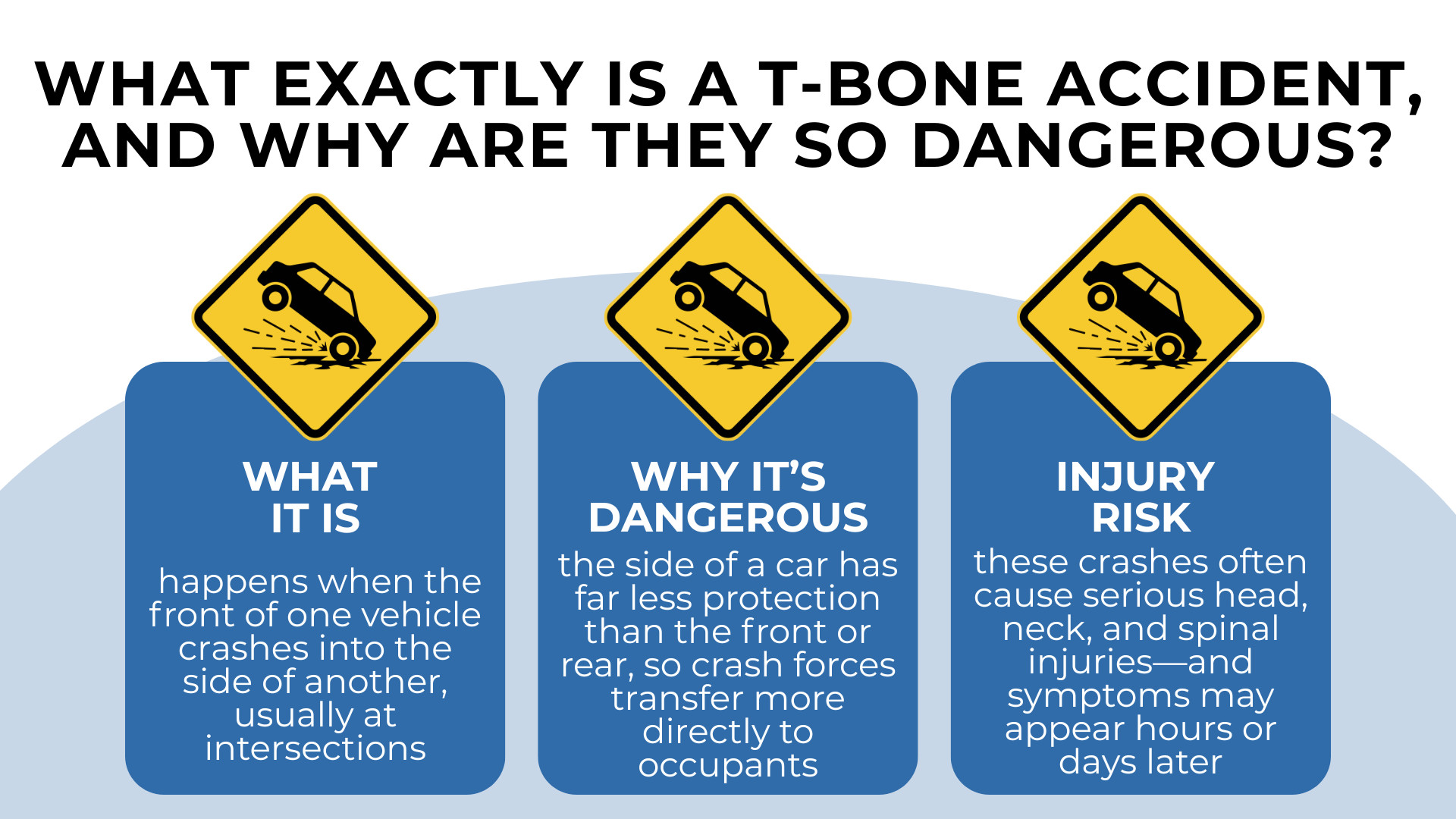
A t-bone accident — also called a side-impact or broadside collision — happens when the front of one vehicle strikes the side of another, forming a rough T shape at the point of impact. These crashes most often occur at intersections, where one driver crosses into another’s path.
What makes t-bone accidents especially dangerous is simple physics. The front and rear of a vehicle are built with crumple zones designed to absorb impact energy. The side of a car has far less structural material between the person inside and the point of collision — often just a door panel, a window, and a few inches of space. That means the force of impact transfers much more directly to the people inside.
The injuries that result tend to reflect this. In 2023, Connecticut recorded 308 traffic fatalities and 1,285 serious injuries from motor vehicle crashes. The National Safety Council estimates each nonfatal disabling injury carries an economic cost of $174,000 — a figure that does not account for pain and suffering. Side-impact crashes carry a disproportionate share of the most severe outcomes because the head, neck, and torso sit inches from the point of contact, with minimal structural protection between occupant and impact.
Even when a t-bone collision doesn’t feel catastrophic in the moment, symptoms like headaches, neck stiffness, numbness, or cognitive difficulty can appear in the hours and days that follow. The severity of side-impact injuries is often underestimated at the scene.
What are the most common causes of t-bone crashes?
Most t-bone accidents happen because one driver entered an intersection when they didn’t have the right to be there. The specific behavior behind that failure usually falls into a few categories, each of which matches a Connecticut traffic law.
Failure to yield the right of way. This is the most common cause. A driver runs a red light, rolls through a stop sign, or turns left into oncoming traffic. Under Conn. Gen. Stat. § 14-245, drivers are required to yield the right of way at intersections. Violating this statute is the single most frequent factor in t-bone collisions.
Distracted driving. A driver looking at a phone doesn’t see a red light or a vehicle already in the intersection. Connecticut law under Conn. Gen. Stat. § 14-296aa prohibits hand-held use of mobile electronic devices while driving. Fines start at $200 for a first offense and climb to $625 for a third. In 2022, 5,318 crashes in Connecticut were caused by distracted driving, resulting in 787 injuries and 8 deaths. Those numbers are widely understood to reflect significant underreporting.
Speeding. A driver going too fast to stop at a changing light or to react to cross traffic. Conn. Gen. Stat. § 14-218a establishes that no person shall operate a motor vehicle at a speed greater than is reasonable given road conditions, traffic, and weather. Speed above a posted limit is prima facie evidence that the driver was traveling unreasonably fast.
Impaired driving. Alcohol and drug impairment slow reaction time and impair judgment, making intersection navigation especially dangerous. Connecticut’s DUI threshold under Conn. Gen. Stat. § 14-227a is a blood alcohol concentration of 0.08%. In 2023, 37% of Connecticut’s traffic fatalities involved alcohol-impaired drivers — seven percentage points above the national average of 30%.
These aren’t just contextual details. Under Connecticut law, each of these violations can directly establish the at-fault driver’s liability. In a t-bone crash, identifying which violation caused the collision is often the central question of the case.

When should you talk to a t-bone accident lawyer?
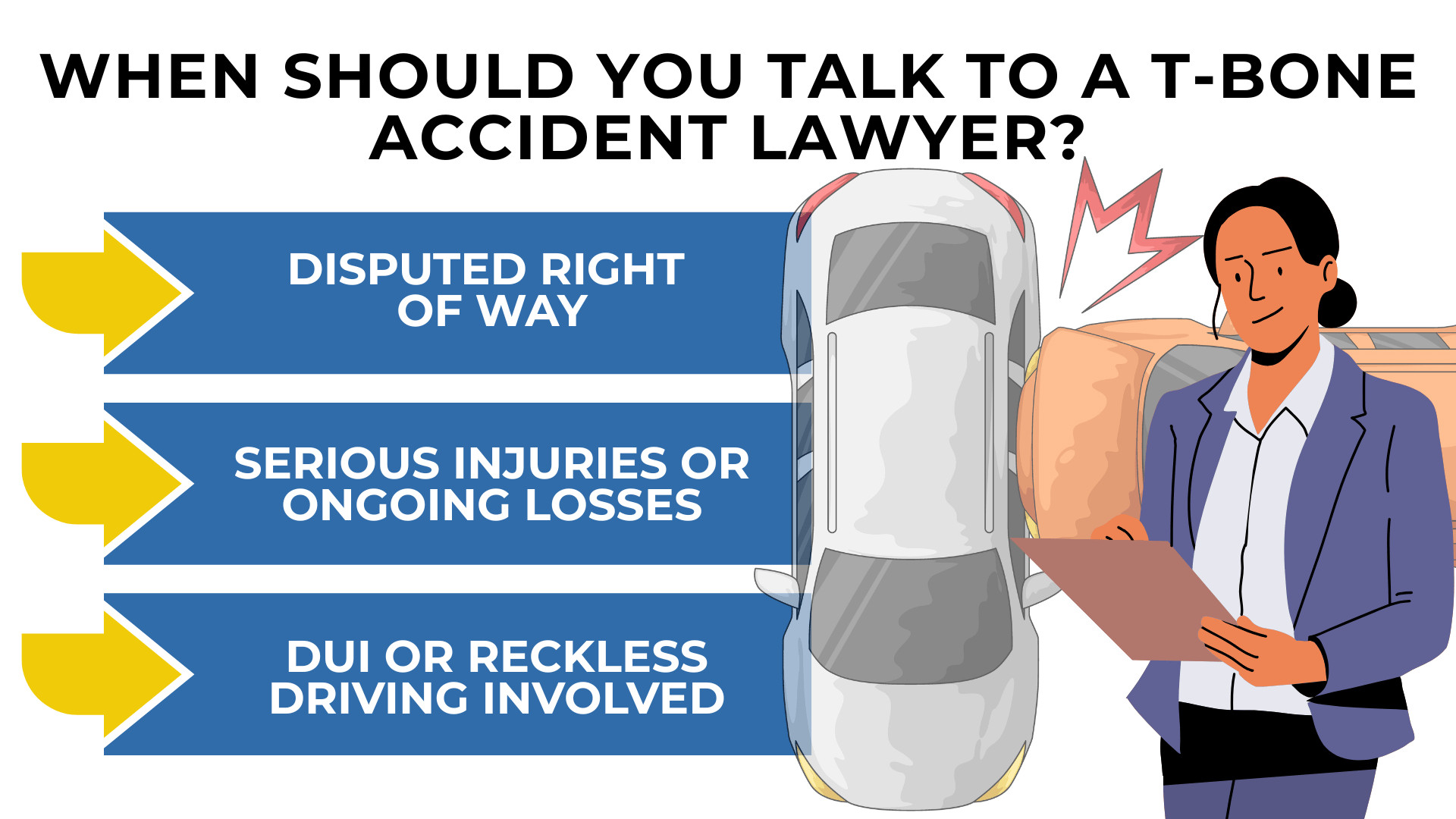
Not every t-bone accident requires an attorney. But several factors make these crashes distinctive: the severity of side-impact injuries, the question of which driver had the right of way, and the potential for the other driver’s violation to carry significant legal consequences. That combination often makes experienced legal guidance worth getting early.
Maybe the other driver’s insurance company is disputing who had the right of way. Or maybe your injuries are serious enough to involve ongoing medical treatment, lost work, or long-term limitations. Either situation benefits from experienced help. T-bone crashes involving violations like DUI or reckless driving can also carry higher legal stakes that affect the value of a claim.
Etemi Law handles motor vehicle accident cases out of Waterbury, Connecticut. The firm’s attorneys — Ron Etemi, Lou Etemi, Semir Dervisi, and Peter Brown — bring deep litigation experience to personal injury cases. Ron Etemi has tried over 100 cases to verdict and received the Top Verdict Award. Peter Brown has 175 jury verdicts and has been practicing since 1990 — his first 15 years were spent trying cases as a defense lawyer, where he was one of the most respected civil defense trial lawyers in the state of Connecticut. That background means the firm understands how the other side prepares and thinks.
If you or someone close to you was involved in a t-bone accident in Connecticut, a conversation with an experienced attorney costs nothing and clarifies a great deal. You can reach Etemi Law through their website at etemilaw.com to discuss your situation.