
Causes of Construction Accidents Connecticut: Common Site Hazards, Safety Violations, and How Fault Is Determined
Estimated reading time: 10 minutes
Key Takeaways
- Falls, struck-by, caught-in/between, electrocutions, and equipment failures are the most common causes of construction accidents in Connecticut.
- Common safety violations—missing guardrails, inadequate scaffolding, lack of GFCIs, and poor trench protection—map directly to these accident types.
- Multiple parties share responsibility: employers, general contractors, subcontractors, and equipment owners can all be liable depending on control and notice.
- Local factors—seasonal weather, tight urban job sites, and older building renovations—often increase risk in Connecticut.
- Documenting hazards, training, and communications is critical to determine negligence and accountability after an incident.
Table of contents
- Causes of Construction Accidents Connecticut
- Common Causes of Construction Accidents in Connecticut
- Falls from Heights
- Struck-By Incidents
- Caught-In/Between Incidents
- Electrocutions and Arc-Flash Injuries
- Equipment and Tool Failures
- Connecticut Realities That Increase Risk
- Construction Safety Violations in CT
- Negligence at Work Site: What It Means and How It’s Evaluated
- Work-Zone and Roadway Incidents Tied to Construction
- Prevention Playbook
- Fault Insight: How Responsibility Gets Sorted Out
- Moving Forward
- FAQ
Common Causes of Construction Accidents in Connecticut
Construction accidents rarely happen out of nowhere. Most follow recognizable patterns. Understanding these categories—and the root causes behind them—is the first step toward prevention.
Falls from Heights
Falls remain the leading cause of death and serious injury on construction sites nationwide, and Connecticut sites are no different.
These injuries happen when workers fall from ladders, scaffolds, roofs, aerial lifts, open edges, or through unprotected floor openings.
Why falls happen:
- Missing or incorrectly installed guardrails
- Unprotected edges and uncovered floor holes
- Ladders set at wrong angles, overreaching, or using damaged equipment
- No personal fall arrest system (harness) or anchoring to weak points
- Poor housekeeping that creates trip hazards
- Weather conditions like ice, rain, or wind
- Rushing to meet deadlines
What prevention looks like:
- Pre-task planning before elevated work begins
- Correct ladder selection and setup
- Guardrail systems on scaffolds and open edges
- Covers secured over floor openings
- Personal fall arrest system training with proper anchor points
- Daily scaffold inspections before use
Struck-By Incidents
Being struck by falling objects or moving equipment is another major category of construction accidents.
This includes everything from a hammer dropped from overhead to a dump truck backing over a worker.
Why struck-by incidents happen:
- Improper rigging and unsecured loads
- Missing toe boards or debris nets on scaffolds
- No exclusion zones around crane operations or heavy equipment
- Missing spotters for backing vehicles
- Poor visibility conditions
- Inadequate traffic control in or near roadways
What prevention looks like:
- Hard hats worn consistently in designated areas
- Tool lanyards to prevent drops
- Controlled access zones around overhead work
- Spotters and backup alarms for equipment
- Clear hand-signal communication plans
- Designated walkways away from equipment paths
Caught-In/Between Incidents
These accidents happen when workers get crushed, pinned, or trapped between equipment, materials, or collapsing structures.
Trench collapses are among the most deadly scenarios in this category.
Why these accidents happen:
- Unshored trenches and unstable soil
- Water accumulation weakening excavation walls
- Working within the swing radius of equipment
- Improper stacking of materials
- Missing machine guards or failure to follow lockout procedures
What prevention looks like:
- Trench protective systems (sloping, shoring, or shielding)
- Competent person inspections before anyone enters an excavation
- Spoil piles kept at safe distances from trench edges
- Barricades around excavations
- Clear swing-radius boundaries marked and enforced
Electrocutions and Arc-Flash Injuries
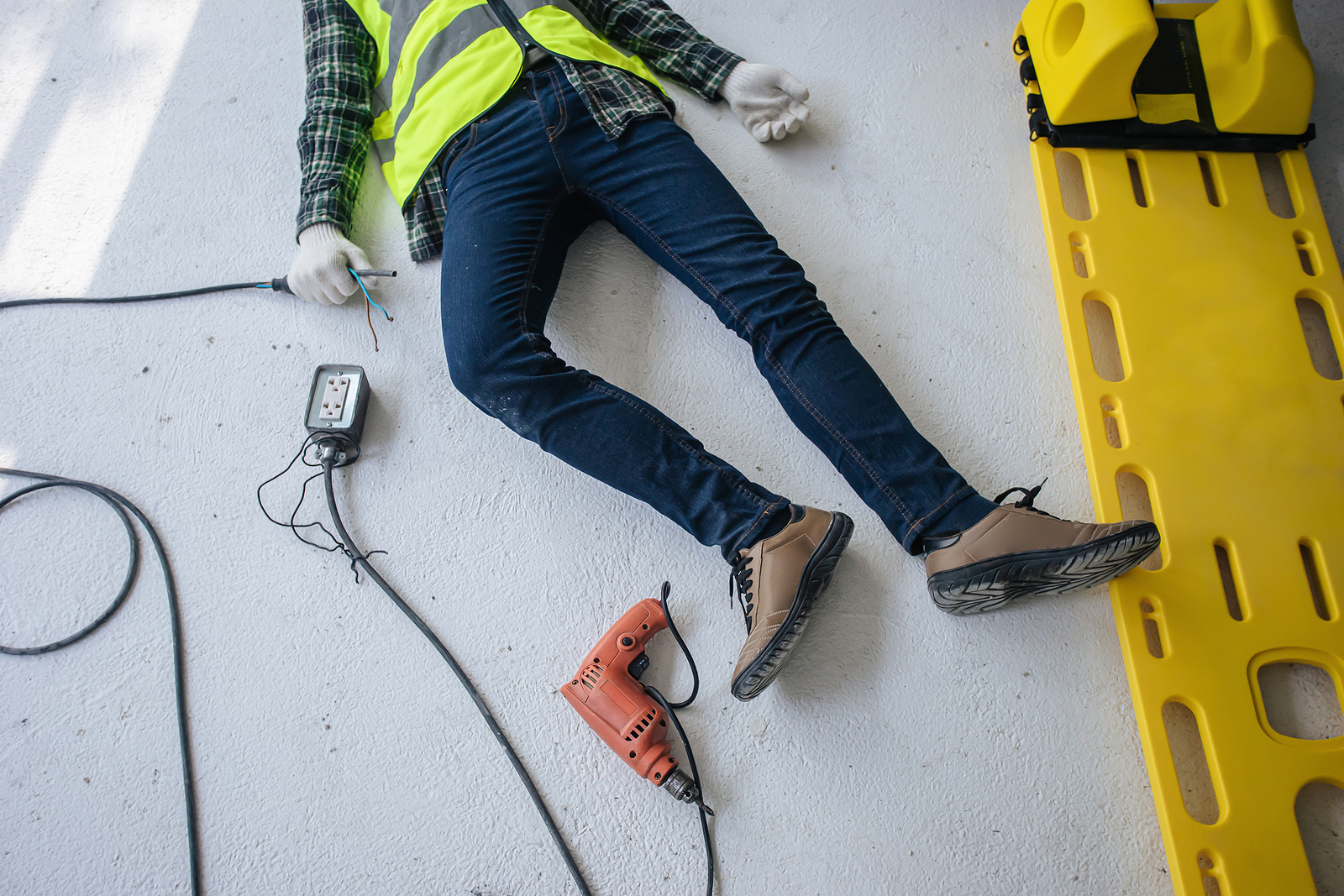
Electrical accidents on construction sites happen when workers contact live wiring, overhead power lines, faulty temporary power systems, or damaged extension cords.
Why electrocutions happen:
- No ground-fault circuit interrupter (GFCI) protection
- Wet conditions combined with electrical equipment
- Unmarked or misidentified underground utilities
- Equipment like ladders or cranes contacting overhead lines
- Damaged cords used without inspection
What prevention looks like:
- Locating and marking all utilities before digging
- Maintaining minimum safe distances from overhead lines
- Using GFCIs on all temporary power
- Inspecting cords and tools daily
- Lockout/tagout procedures where applicable
Equipment and Tool Failures
Machinery malfunctions, missing guards, and improper tool use cause a significant share of construction injuries.
This ranges from table saw kickback to aerial lift failures.
Why equipment failures cause injuries:
- Skipped maintenance or ignored repair needs
- Disabled safety features to “save time”
- Inadequate training on equipment operation
- Using the wrong tool for the job
What prevention looks like:
- Pre-shift equipment inspections
- Documented maintenance logs
- Training and authorization requirements for equipment operators
- Zero tolerance for disabled guards or safety devices

Connecticut Realities That Increase Risk
Certain factors common to Connecticut construction can make hazards worse:
Seasonal weather: Ice, snow, and rain affect footing on elevated surfaces and reduce visibility. Connecticut’s freeze-thaw cycles can deteriorate conditions quickly.
Seasonal weather
Tight urban job sites: Cities like Waterbury often have limited staging areas, which means closer interaction between workers, equipment, vehicles, and pedestrians. This increases struck-by and traffic-related risks.
Older building renovation: Many Connecticut projects involve structures built decades ago. Hidden hazards—unknown wiring, structural deterioration, lead paint, asbestos—add layers of risk beyond the primary accident types.
Construction Safety Violations in CT: What Counts and Why It Matters
When people talk about “safety violations,” they’re referring to failures to follow required safety rules and accepted practices designed to protect workers.
In most cases, these rules trace back to OSHA standards and site-specific safety plans.
Understanding Violations vs. Accidents
A violation is the unsafe condition or practice itself—the missing guardrail, the damaged cord, the skipped training.
An accident is the harmful event that may result. Not every violation causes an accident, but violations dramatically increase the odds that something will go wrong.
Common Categories of Violations
Fall protection failures:
- Unprotected leading edges
- Workers at heights without harnesses where required
- Scaffolds missing guardrails or proper planking
Scaffolding and ladder violations:
- Missing planks or guardrails on scaffolds
- Overloaded scaffolds beyond rated capacity
- Using ladders as work platforms without proper setup
Training and communication failures:
- Workers operating equipment without required training
- No hazard communication for chemicals on site
- Missing toolbox talks or safety briefings
PPE failures:
- No hard hats, eye protection, or high-visibility clothing where required
- PPE rules not enforced by supervision
Electrical safety failures:
- No GFCIs on temporary power
- Damaged extension cords in use
- Unprotected temporary wiring
Trenching and excavation failures:
- No protective systems in trenches over four feet deep
- No competent person conducting daily inspections
- Spoil piles placed too close to edges
How Violations Become Accidents
The connection between violations and injuries is usually straightforward:
- Missing guardrail → fall from edge: A worker steps backward on a rooftop without edge protection.
- No spotter or exclusion zone → struck by equipment: An excavator operator can’t see behind the machine; a worker walks into the blind spot.
- Unprotected trench → cave-in: Soil collapses on workers in an excavation that wasn’t shored or sloped.
- No GFCI + wet surface → electrocution: A worker using a power tool in standing water experiences a fatal shock.
Who Is Responsible for Preventing Violations?
Multiple parties typically share responsibility for site safety:
- Employers are responsible for training workers, providing PPE, establishing safe procedures, and enforcing rules.
- General contractors usually control overall site coordination, including subcontractor oversight and hazard controls that affect the entire project.
- Subcontractors are responsible for task-specific safety for their own crews.
- Equipment owners and rental companies have duties regarding maintenance and equipment condition.
Negligence at Work Site: What It Means and How It’s Evaluated
Negligence is a legal concept, but it’s not complicated. At its core, negligence means failing to act with reasonable care, resulting in foreseeable harm to someone else.
On a construction site, this often looks like ignoring known hazards, skipping required safety steps, or failing to fix dangerous conditions.
Common Examples of Negligence on Construction Sites
- Poor supervision: Allowing workers to skip fall protection without consequence
- Unsafe scheduling pressures: Pushing crews to rush, leading to shortcuts and fatigue
- Inadequate training: Assigning workers to equipment they haven’t been trained on
- Failure to warn: Not communicating about open holes, live wires, or unstable surfaces
- Poor housekeeping: Debris, cords, and materials blocking paths or creating trip hazards
Waterbury-Specific Considerations
Urban construction sites in cities like Waterbury present particular challenges.
Streets are narrow, staging areas are limited, and work often happens near active traffic and pedestrians. Renovation and retrofit projects are common, and conditions can change quickly as older structures reveal hidden hazards.
In tight sites, planning and traffic control become even more critical. Negligence at work site Waterbury projects might involve failure to maintain adequate barriers, missing flaggers for traffic control, or inadequate separation between work areas and public access.
How Negligence Is Typically Documented
When something goes wrong, establishing what happened—and who failed to act reasonably—depends on evidence. People commonly gather:
- Photos and videos of the hazard and surrounding area (missing guardrails, absent signage, equipment positions)
- Incident reports filed immediately after the accident
- Daily logs showing work activities and conditions
- Toolbox talk records and safety meeting notes
- Training records and PPE issuance logs
- Witness statements and contact information
- Equipment inspection and maintenance records
- Work orders or communications showing hazards were reported but not addressed
Work-Zone and Roadway Incidents Tied to Construction
Construction accidents don’t always happen within the boundaries of a job site.
Workers get injured in highway work zones, site vehicles enter and leave public roads, and passing traffic sometimes strikes workers or equipment. When a crash occurs, Connecticut law imposes specific duties.
Connecticut’s Duty to Stop and Report After a Crash
Under Conn. Gen. Stat. §14-224, any driver involved in a crash causing death must immediately stop, render needed aid, and provide their name, address, license, and registration information to any officer or witness.
If unable to do so at the scene, the driver must promptly report the accident location, circumstances, and personal information to police.
The same statute applies to crashes causing serious or minor injury, or only property damage. Drivers must stop, render assistance if needed, and exchange identifying information—or report to police if that’s not possible.
Practical steps after any crash:
- Stop immediately and stay at or near the scene (when safe)
- Call 911 if anyone is hurt
- Provide your name, address, license, and registration as required
- Cooperate with responding officers
- Document conditions if you’re able to do so safely
Non-Motor Vehicle Involvement
Work zones can involve cyclists, pedestrians, or other non-motorized traffic.
Under Conn. Gen. Stat. §14-225, anyone riding or driving a non-motor vehicle on a public road who causes injury or property damage must stop immediately, determine the extent of injury, render aid, and provide their name and address.
Crashes Involving Animals
Under Conn. Gen. Stat. §14-226, any driver who injures or kills a dog must stop, render assistance if possible, and provide identifying information to the owner or a witness—or report to police with the location and description of the dog.
Breakdown Safety Near Work Zones
Work trucks, delivery vehicles, and commuters traveling near construction zones face elevated risks when breakdowns occur. The Connecticut State Police recommends that any driver whose vehicle breaks down on a highway should:
- Pull to the right shoulder immediately
- Turn on hazard lights
- Remain in the vehicle if safe
- Call 911 with your location and vehicle description
Prevention Playbook: What Workers and Supervisors Can Do Tomorrow
Understanding causes is only useful if it leads to action. Here’s what effective prevention looks like in practice.
Pre-Shift Hazard Assessment
Before work begins each day—and whenever conditions change—crews should conduct a brief hazard review.
This is sometimes called a Job Hazard Analysis or “take five” assessment.
Questions to ask:
- Where can someone fall today? What’s our fall protection plan?
- Where are vehicles and equipment moving? Who is the spotter?
- Any overhead power lines or temporary electrical near our work?
- Any trenches or excavations? Who is the competent person inspecting?
- What’s changed since yesterday that could create new hazards?
High-Impact Controls Matched to Top Hazards
For falls: Guardrail systems, personal fall arrest systems, ladder and scaffold rules, secured hole covers
For struck-by hazards: Exclusion zones around equipment, hard hats, tool tethering, written traffic control plans
For caught-in/between hazards: Trench protective systems, clearly marked equipment swing radius boundaries, lockout awareness training
For electrical hazards: GFCIs on all temporary power, daily cord inspections, utility locate and marking before excavation
Reporting Unsafe Conditions
Workers who see hazards should report them immediately. A simple approach:
“I’m reporting an unsafe condition: [describe the hazard]. It’s located at [specific location]. The risk is [type of injury possible]. A safer control would be [guardrail/spotter/GFCI/etc.].”
Workers should also know they have the right to remove themselves from situations presenting imminent danger, and should follow their site’s reporting procedures.
Fault Insight: How Responsibility Gets Sorted Out
When a construction accident happens, investigators work backward from the injury to understand what failed. A useful framework:
Hazard (unsafe condition) → Violation (rule or practice not followed) → Incident (accident event) → Injury (harm suffered) → Evidence (documentation) → Accountability (who had control and duty)
For example, if fall protection was missing and a worker fell, there’s likely a safety violation. Whether that rises to negligence depends on who controlled the area, who knew or should have known about the hazard, and whether reasonable steps were available to prevent it.
When a third-party driver enters a work zone and strikes a worker, the analysis involves both the driver’s conduct and whether the traffic control plan was adequate. More on who can pursue claims is discussed at who can sue construction accident CT.
Moving Forward
The causes of construction accidents Connecticut workers face are, for the most part, predictable.
Falls, struck-by incidents, caught-in/between hazards, electrocutions, and equipment failures follow recognizable patterns—and they’re preventable with proper controls.
Construction safety violations CT inspectors document most frequently map directly to these injury risks.
When rules aren’t followed, the odds of harm increase dramatically.
Negligence at work site Waterbury locations—and across Connecticut—typically involves ignored hazards, weak supervision, or missing controls. Documentation of conditions, training, and communications often determines how responsibility gets assigned.
If you were hurt on a construction site or witnessed a serious hazard:
- Get medical attention first
- Report the incident through proper channels
- Document conditions as thoroughly as possible (photos, notes, witness contact information)
- Preserve any records related to training, safety meetings, or equipment
- Seek appropriate guidance based on your situation — see workers’ compensation benefits Connecticut
This article is provided for informational purposes only and does not constitute legal advice. Construction accident cases involve complex factual and legal questions that vary based on individual circumstances. If you have questions about a specific situation, consult with a qualified attorney.
About the Author
Lou Etemi is a Connecticut personal injury lawyer and co-founder of Etemi Law who represents individuals and families injured by negligence. He has helped hundreds of clients resolve serious injury claims by combining disciplined case preparation, medical understanding, and persistent negotiation with insurance companies. Lou is known for his hands-on advocacy, strong client relationships, and client-first approach to accountability and fair compensation.
FAQ
Q: What are the most common causes of construction accidents in Connecticut?
A: The leading causes are falls from heights, struck-by incidents, caught-in/between incidents, electrocutions, and equipment or tool failures. Local factors like seasonal weather and tight urban sites often increase risk.
Q: Who can be held responsible after a construction accident?
A: Responsibility depends on control and notice; employers, general contractors, subcontractors, and equipment owners may share liability depending on who had the duty and ability to prevent the hazard.
Q: What should I document if I witness a hazard or an accident?
A: Take photos and videos, collect witness contact information, save incident reports and toolbox talk records, and preserve training and equipment inspection logs. These items are often crucial to establishing negligence.
Q: What are my obligations if I’m involved in a crash near a work zone?
A: Connecticut law requires drivers to stop, render aid if needed, and exchange identifying information. See Conn. Gen. Stat. §14-224 for details.
Q: Where can I find more guidance about traffic-related incidents in construction zones?
A: For issues where a vehicle and construction zone interact—such as determining fault in a collision—see resources on work-zone traffic incidents and consult legal counsel as needed.