Causes of Truck Accidents
Most truck accidents are caused by human decisions — not bad luck, not unavoidable mechanical failure, and not weather. Federal crash data shows that when a large truck is the source of the crash, driver-related factors are responsible roughly 87% of the time. The remaining cases split between vehicle defects and road conditions.
That breakdown matters. When a human decision caused a crash, there is usually a person or company that can be held legally accountable for it.
This page walks through the specific causes of truck accidents — what the federal data says and how each one happens. Identifying the cause is the first step toward understanding who is responsible. If you or someone close to you was hurt in a truck crash in Connecticut, knowing what went wrong is how you begin to figure out what comes next.
What Are the Most Common Causes of Truck Accidents?
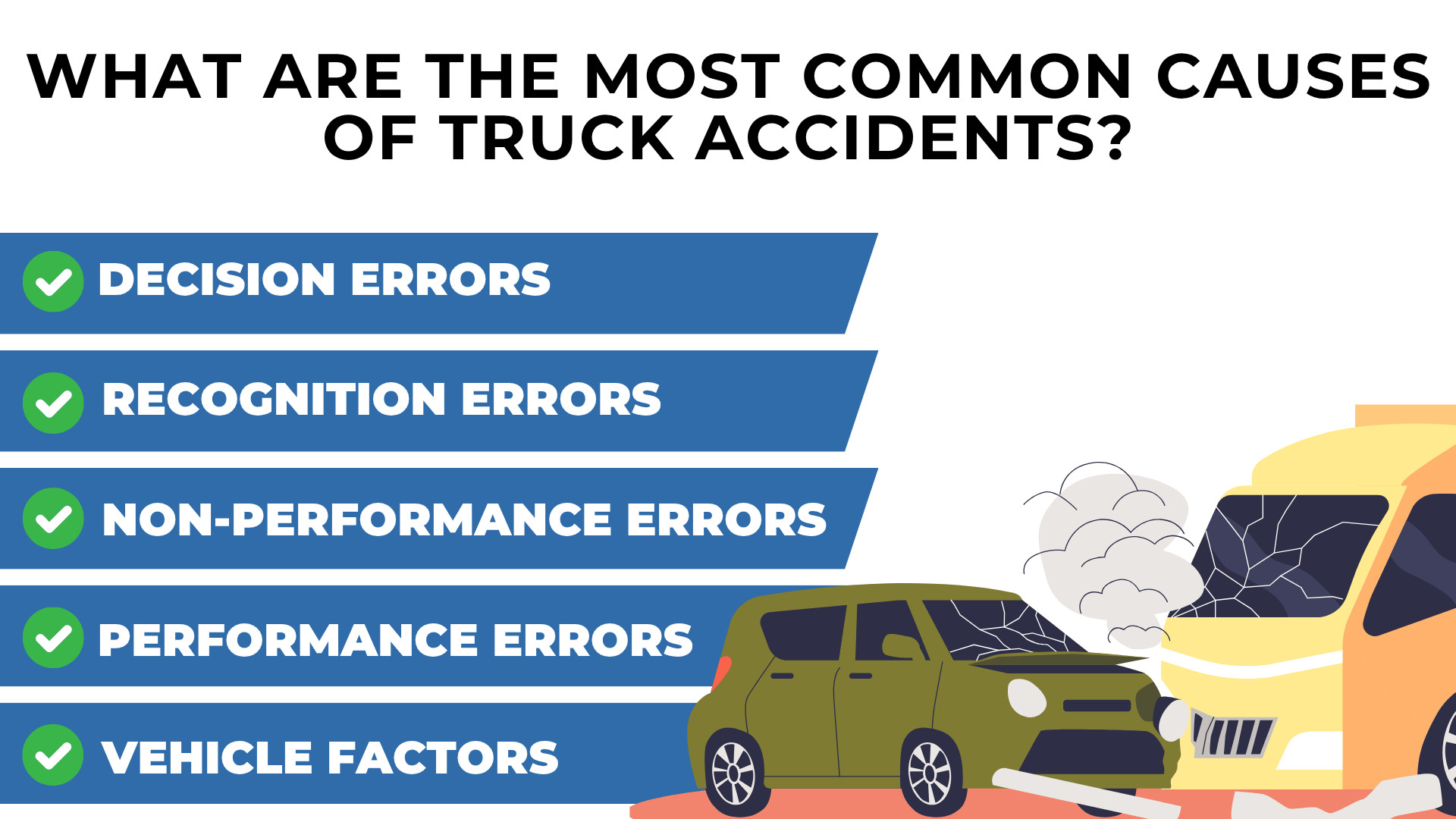
The most comprehensive federal study of truck crash causation is the Large Truck Crash Causation Study (LTCCS), conducted jointly by FMCSA and NHTSA. It remains the primary federal reference for understanding why these crashes happen. When the large truck was assigned the critical reason for the crash, the causes broke down into four categories of driver error, plus vehicle and environmental factors:
Decision errors accounted for 38% of truck-at-fault crashes — things like following too closely, driving too fast for conditions, or misjudging the speed of surrounding traffic. Nearly 23% of large trucks in crashes studied were identified as traveling too fast for conditions, making speed the second most commonly cited driver factor.
Recognition errors accounted for 28.4% — the driver failed to observe what was happening around them. This includes inattention, distraction, and failure to scan the road adequately.
Non-performance errors — primarily falling asleep or becoming physically unable to drive — accounted for 11.6%.
Performance errors such as oversteering, panicking, or poor directional control accounted for 9.2%.
Vehicle factors — primarily mechanical defects like brake failure — were the critical reason in 10.1% of cases. Environmental factors such as weather and road conditions accounted for just 2.4%.
One thing worth noting: in two-vehicle crashes between a truck and a passenger vehicle, the passenger vehicle was assigned the critical reason 56% of the time and the truck 44%. That means in nearly half of these crashes, the truck driver or the truck itself was the primary cause. The sections below look at the most serious of those causes in detail.
How Does Driver Fatigue Cause So Many Truck Crashes?
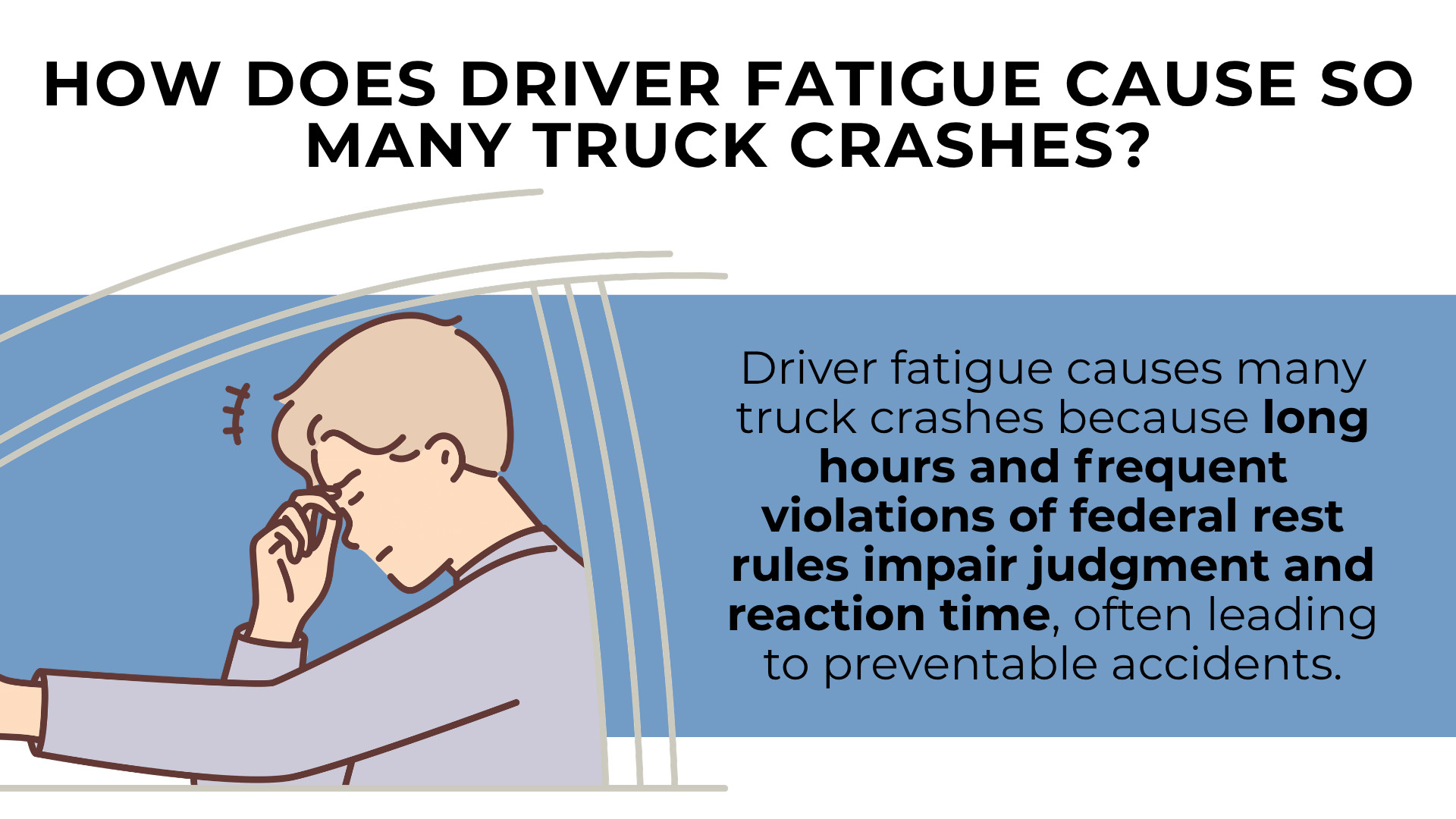
Fatigue is one of the hardest causes to see from the outside — and one of the most preventable. In the LTCCS, 13% of truck drivers involved in studied crashes were identified as fatigued at the time of the crash, representing approximately 18,000 trucks nationally. That figure likely understates the real number. Fatigue is difficult to confirm after the fact unless the driver self-reports or electronic records reveal a clear violation.
The federal government regulates how long truck drivers can be on the road precisely because fatigue is so dangerous. Federal hours-of-service rules under 49 CFR § 395.3 cap driving time and mandate rest periods, while 49 CFR § 392.3 separately prohibits operating a commercial motor vehicle while impaired by fatigue.
These are not suggestions. Connecticut has adopted the full Federal Motor Carrier Safety Regulations by statute under Conn. Gen. Stat. § 14-163c. That makes them binding on both interstate and intrastate carriers operating in the state. The enforcement data suggests violations are widespread. During the 2024 CVSA International Roadcheck, hours-of-service violations accounted for 32.1% of all driver violations — the single largest category.
When a trucking company pushes a driver past legal limits — or when a driver falsifies electronic logging records to stay on the road longer — and a crash results, that violation is more than evidence of fault. Under Connecticut’s negligence per se doctrine, a violation of an adopted safety regulation can establish negligence as a matter of law — the remaining question is whether the violation caused the harm.
What Role Do Brake Failures and Equipment Problems Play?
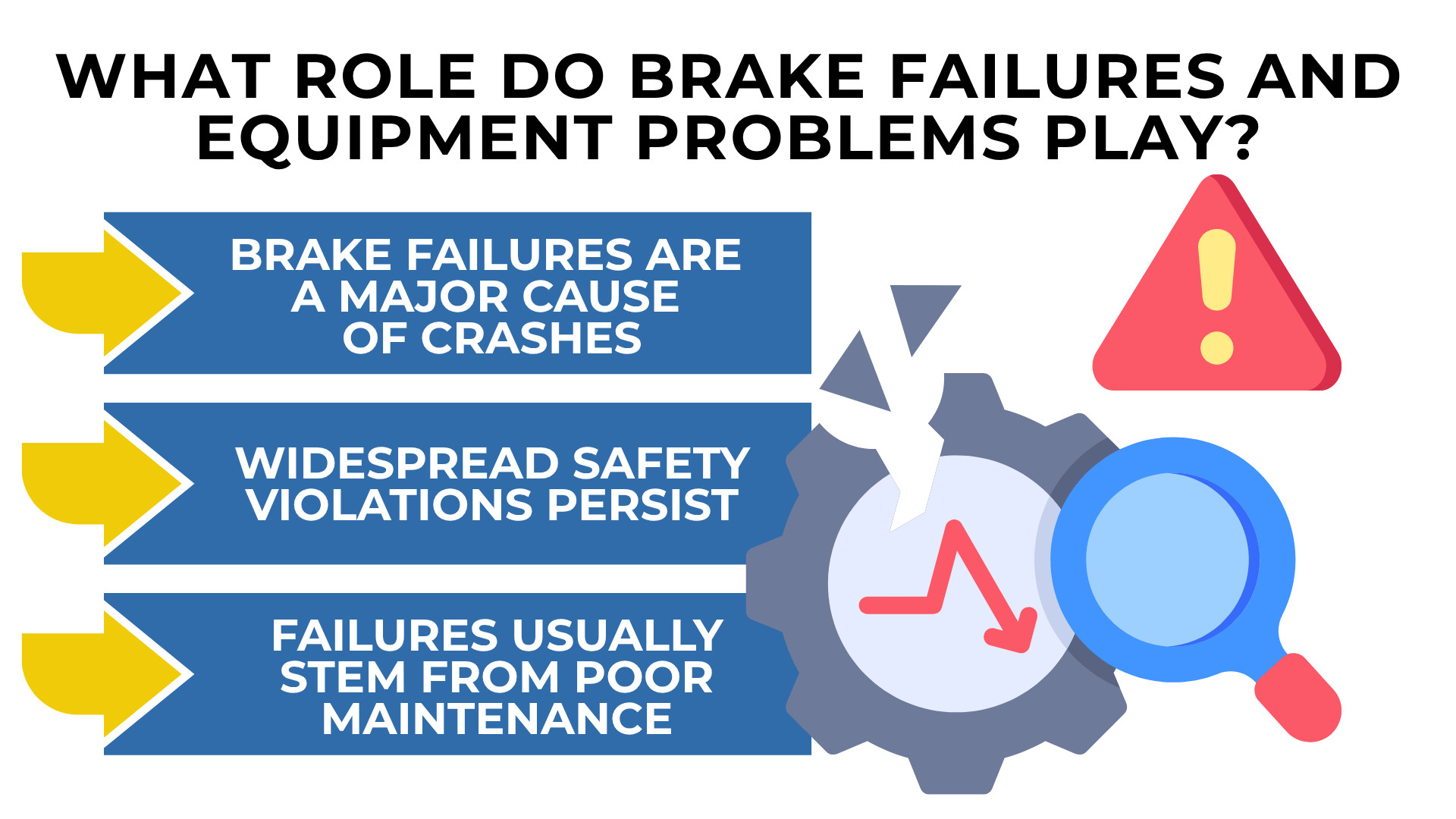
After driver error, vehicle defects — particularly brake problems — are the most significant cause of truck crashes. The LTCCS found that 29.4% of large trucks involved in studied crashes had brake failure, out-of-adjustment brakes, or other brake problems identified as a contributing factor. That is nearly one in three trucks.
This is not a problem that has gotten better. During the 2024 CVSA International Roadcheck, defective brakes accounted for 25% of all vehicle violations. Nationally, more than one in five commercial vehicles inspected — 22.6% — had safety violations serious enough to be placed out of service in 2023. That means they were found too unsafe to continue operating.
Equipment failure in trucking rarely appears out of nowhere. Brakes wear. Tires degrade. Coupling devices loosen. Federal regulations require carriers to conduct systematic inspections, maintenance, and repairs — and to document all of it. When a brake system fails on a truck that was supposed to be inspected last week, the question becomes: who was responsible for maintaining that truck, and did they do it?
In some cases, the defect traces back to the manufacturer or a parts supplier — a design problem or a manufacturing flaw in the brake system, tire, or coupling device. Connecticut’s Product Liability Act (Conn. Gen. Stat. §§ 52-572m through 52-572q) provides a cause of action against product sellers — including manufacturers, distributors, and parts suppliers — for harm caused by a defective product. You do not need a contract with the seller.
But more often than not, equipment failure in a truck crash traces back to a maintenance decision. Someone chose not to fix what needed fixing, or chose not to pull a truck off the road when the inspection report said they should. That is a human cause, not a mechanical one.
What Should I Do If I Think One of These Caused My Accident?
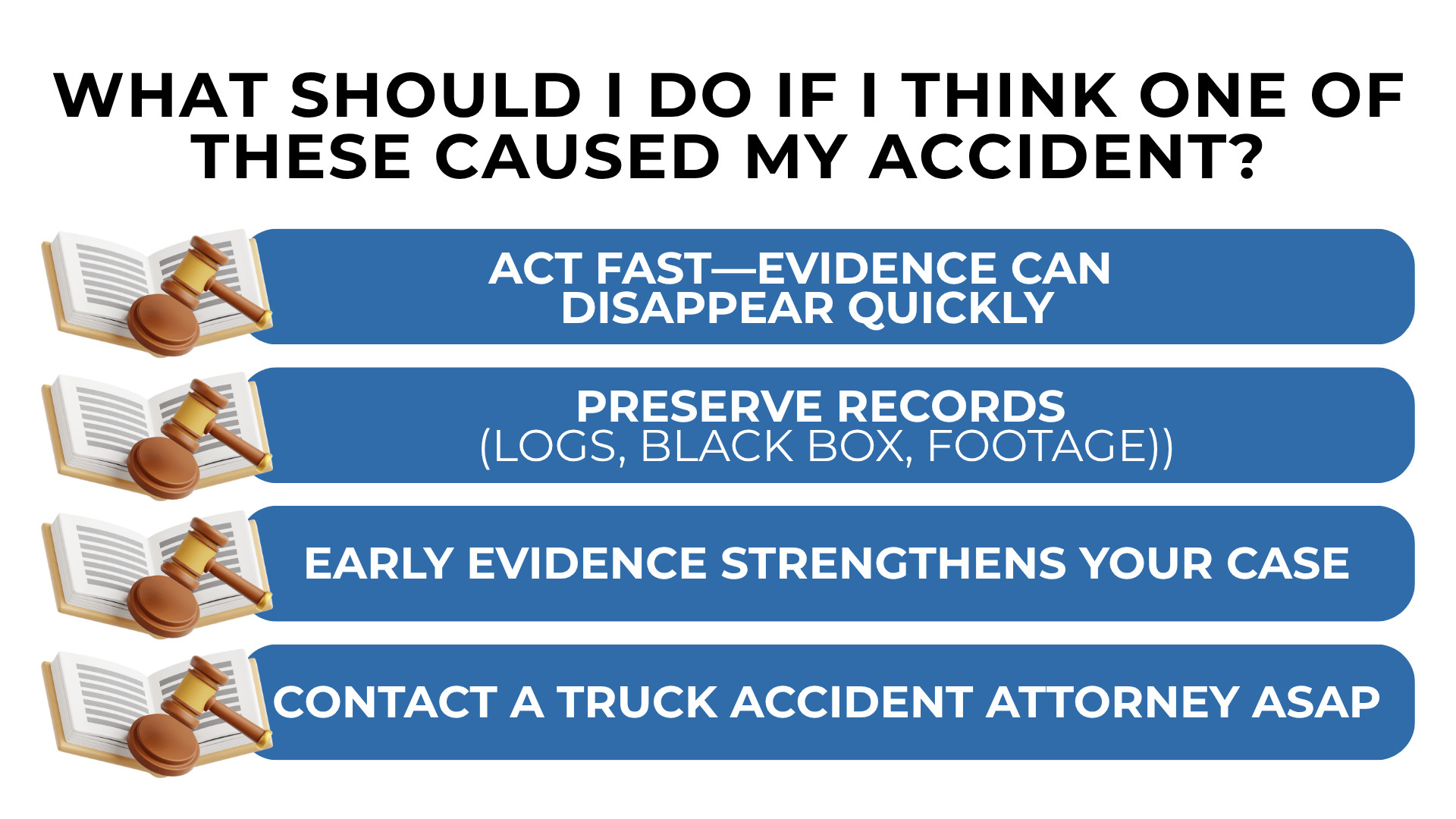
If anything in this article matches what happened in your crash — a driver who seemed exhausted, a truck with brakes that clearly were not maintained, a speed that made no sense for the conditions — here is the most important thing to understand. The evidence connecting the cause to the responsible party does not last forever.
Electronic logging devices that record a driver’s hours are required to be retained for only six months. Event data recorders — the truck’s “black box” — may not be retained indefinitely and can be lost without prompt action to preserve them. Dashcam footage, GPS records, and dispatch communications may be deleted on short retention schedules unless someone steps in to preserve them. The sooner a legal team identifies and secures this evidence, the stronger the connection between what caused the crash and who is accountable for it.
Etemi Law is a personal injury firm based in Waterbury, Connecticut. Lead litigator Ron Etemi has tried over 100 cases to verdict, and the firm’s attorneys have spent decades handling motor vehicle and commercial trucking accident claims in Connecticut courts. If you were hurt in a truck accident and want to understand whether the cause points to a claim, call Etemi Law to talk through what happened.