How Much Compensation Can You Get After a Car Accident in Connecticut?
After a car accident in Connecticut, how much compensation you can recover depends in large part on where the money comes from. The insurance rules for car accidents work differently than most people assume. Connecticut is a fault-based state with a specific set of rules about what coverage is available, what happens when the at-fault driver’s insurance isn’t enough, and how your own policy fills the gap. Understanding that payment chain is the difference between knowing you deserve compensation and knowing how to actually collect it.
Where does the money actually come from?
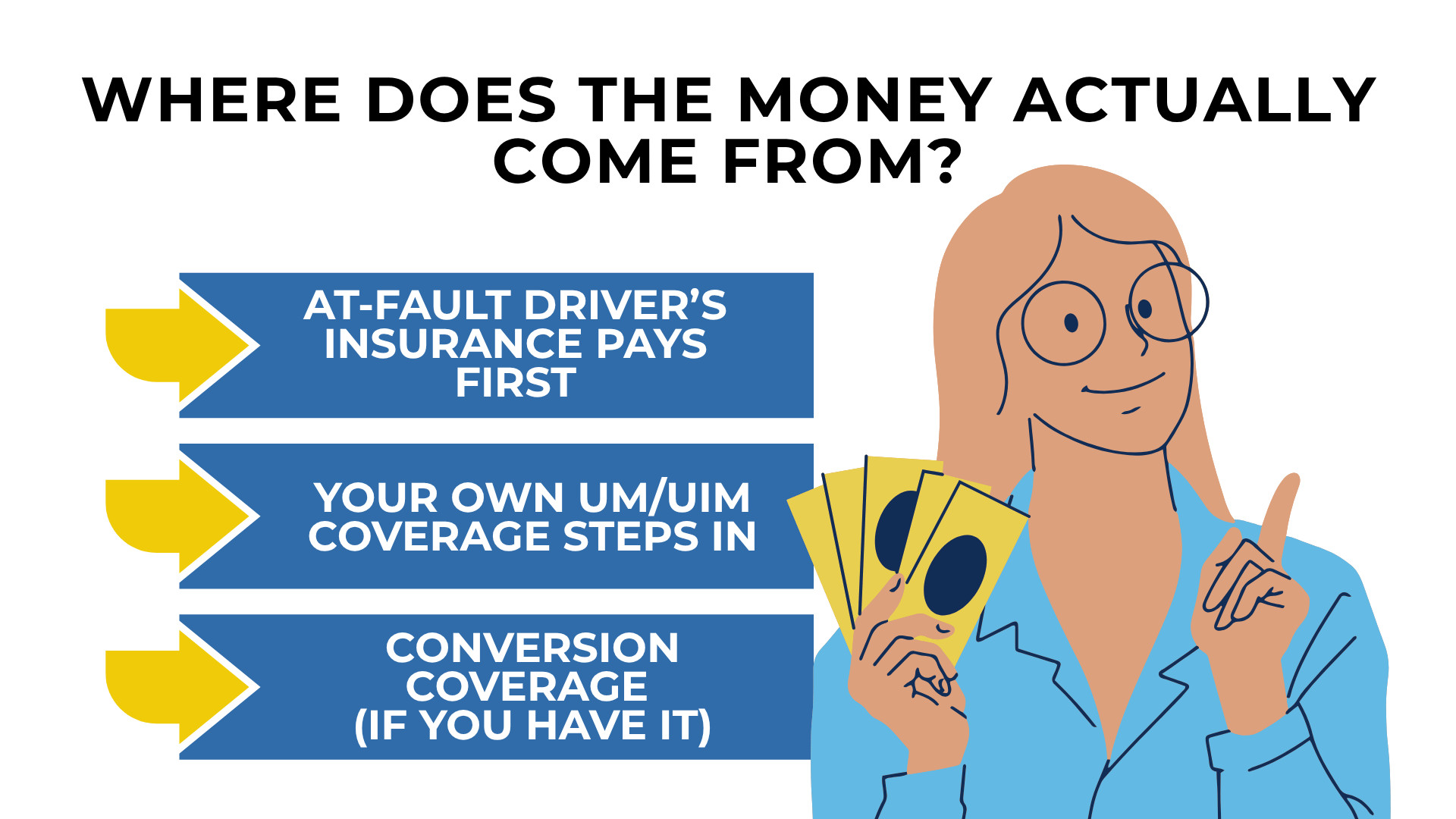
Connecticut is a fault-based state — not a no-fault state. That means the person who caused the accident is responsible for paying for the injuries they caused. That responsibility is typically covered by their auto insurance.
Connecticut requires every registered vehicle owner to carry liability insurance with minimum limits of $25,000 per person for bodily injury, $50,000 per accident for bodily injury to more than one person, and $25,000 for property damage, commonly written as 25/50/25 under Conn. Gen. Stat. § 14-112. In a straightforward case, the at-fault driver’s liability insurer pays compensation up to the policy limits.
But straightforward cases are not the only kind. An estimated 11.8% of Connecticut drivers are uninsured. Many more carry only the state minimum — which can be far too low to cover serious injuries. This is where uninsured and underinsured motorist coverage becomes critical.
Under Conn. Gen. Stat. § 38a-336, every auto insurance policy issued in Connecticut must provide UM/UIM coverage. If the driver who hit you has no insurance, your own UM coverage steps in. If that driver has insurance but not enough to cover your losses, your UIM coverage can make up the difference.
Connecticut law also requires insurers to offer underinsured motorist conversion coverage under Conn. Gen. Stat. § 38a-336a. Conversion coverage prevents the at-fault driver’s payment from reducing your UIM benefits. That means you can collect from both sources.
Understanding your insurance setup matters because it determines the upper limit on what you can recover. The at-fault driver’s policy limits, your own UM/UIM limits, and whether you carry conversion coverage all factor into the total compensation available to you.
Do I need a lawyer to get full compensation?
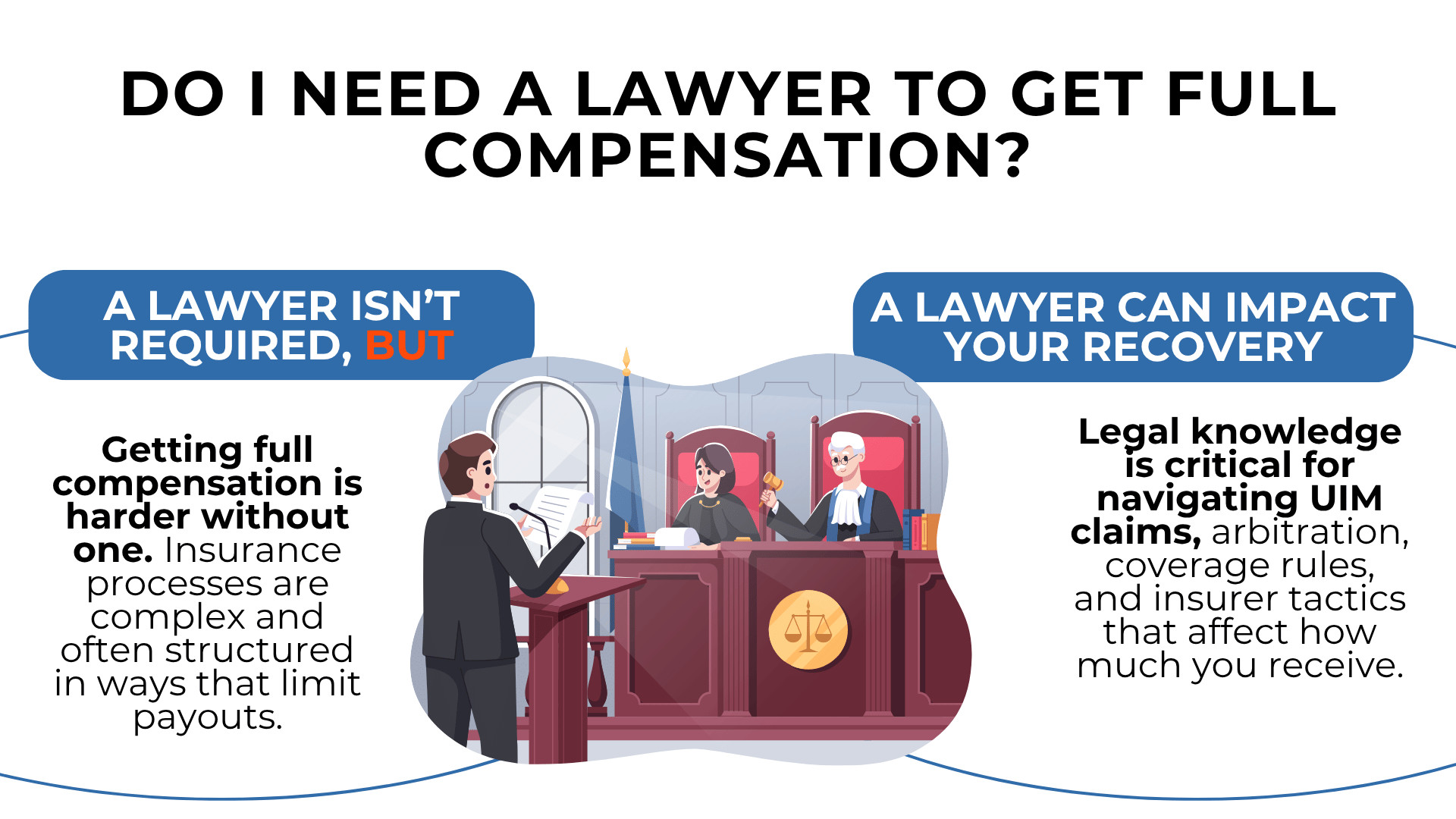
Nothing in Connecticut law requires you to hire an attorney to pursue a car accident claim. But the insurance payment chain described above is where claims often break down. It is built in a way that makes full compensation difficult to get without a lawyer.
Consider what is at stake. When the at-fault driver carries only the $25,000 state minimum and your injuries far exceed that amount, recovering the rest means filing a UIM claim against your own insurer — whose interests at that point are directly opposed to yours. UIM claims may go to arbitration under Conn. Gen. Stat. § 38a-336(c), with a single arbitrator for claims of $40,000 or less and a three-arbitrator panel for larger demands. Whether you carry conversion coverage under § 38a-336a determines whether you can collect from both the at-fault driver’s insurer and your own without offset. And the collateral source rule under Conn. Gen. Stat. § 52-225a governs whether payments from your health insurer reduce your award — with a critical exception: under Marciano v. Jimenez, 324 Conn. 79 (2016), no collateral source reduction applies if the health insurer has any right of subrogation. Each of these is a point where knowledge of the law directly affects how much compensation you receive.
At Etemi Law in Waterbury, Connecticut, attorneys Ron Etemi, Lou Etemi, Semir Dervisi, and Peter Brown handle motor vehicle accident claims with a focus on trial readiness and strategic case development. Ron Etemi has tried over 100 cases to verdict and received the Top Verdict Award. Peter Brown practiced as a civil defense lawyer for his first 15 years — meaning he knows how the other side builds its case. The firm’s approach is built around confronting insurance companies directly rather than waiting for a fair offer to arrive on its own.
If you have been injured in a car accident in Connecticut and want to understand what your claim may be worth, a conversation with an experienced attorney costs nothing. It can clarify what you are entitled to under the law.