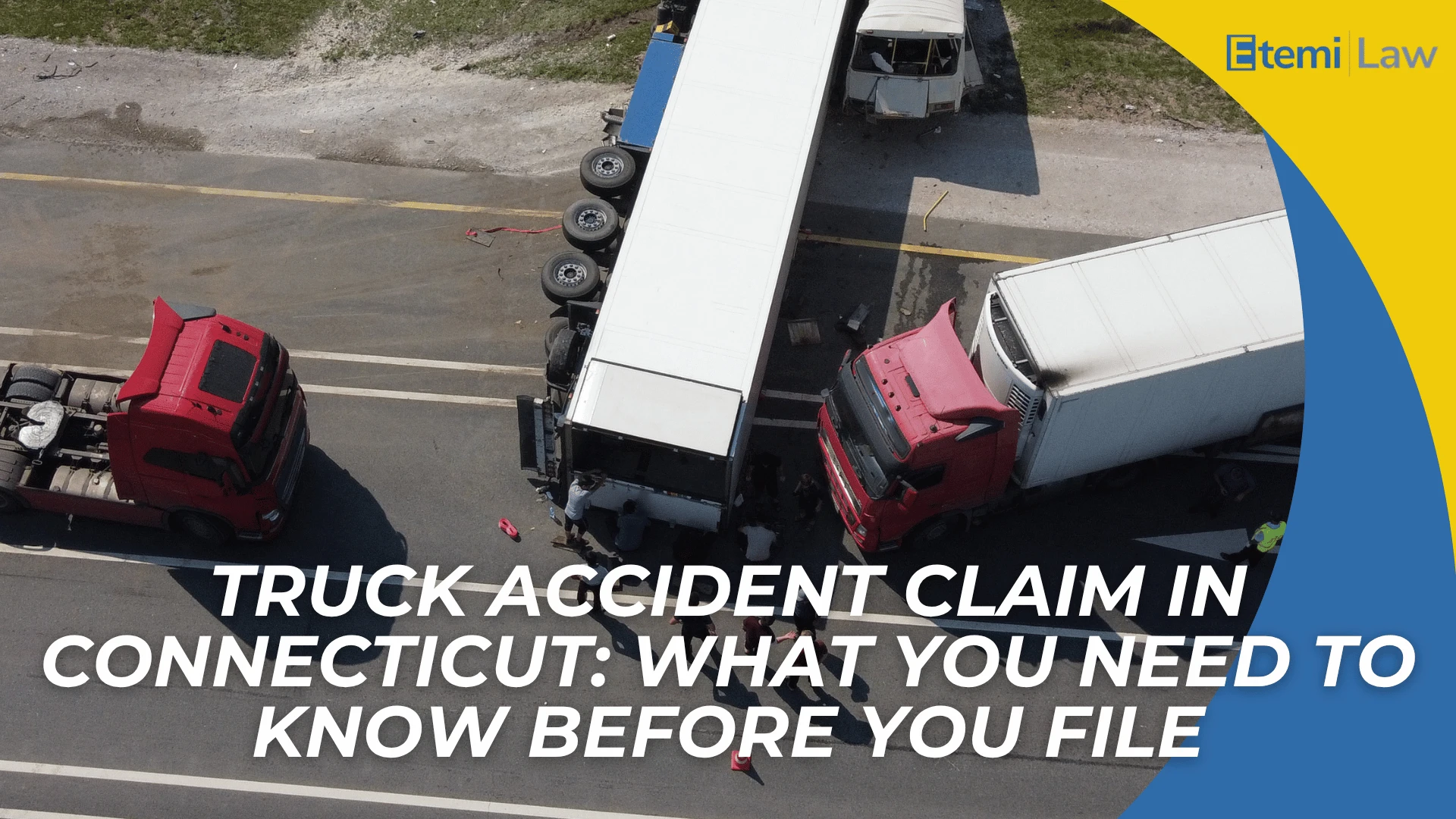
Truck Accident Claim in Connecticut: What You Need to Know Before You File
If you or someone in your family was injured in a crash involving a commercial truck in Connecticut, this article explains the legal rules that apply to your claim. It also explains why those rules differ sharply from an ordinary car accident case. Connecticut has adopted federal motor carrier safety regulations as state law. It recognizes multiple independent theories of liability against trucking companies. And it sets strict filing deadlines that do not pause for anyone, including injured children. Understanding these rules is not optional. They determine who you can hold accountable, what evidence you need to preserve, and how much time you have to act.
At Etemi Law in Waterbury, Connecticut, we handle commercial trucking accident claims because the legal complexity of these cases demands attorneys who understand both federal trucking regulations and Connecticut trial practice. This article walks through what makes these claims different, who can be held liable, what evidence matters most, and the deadlines that apply under Connecticut law.
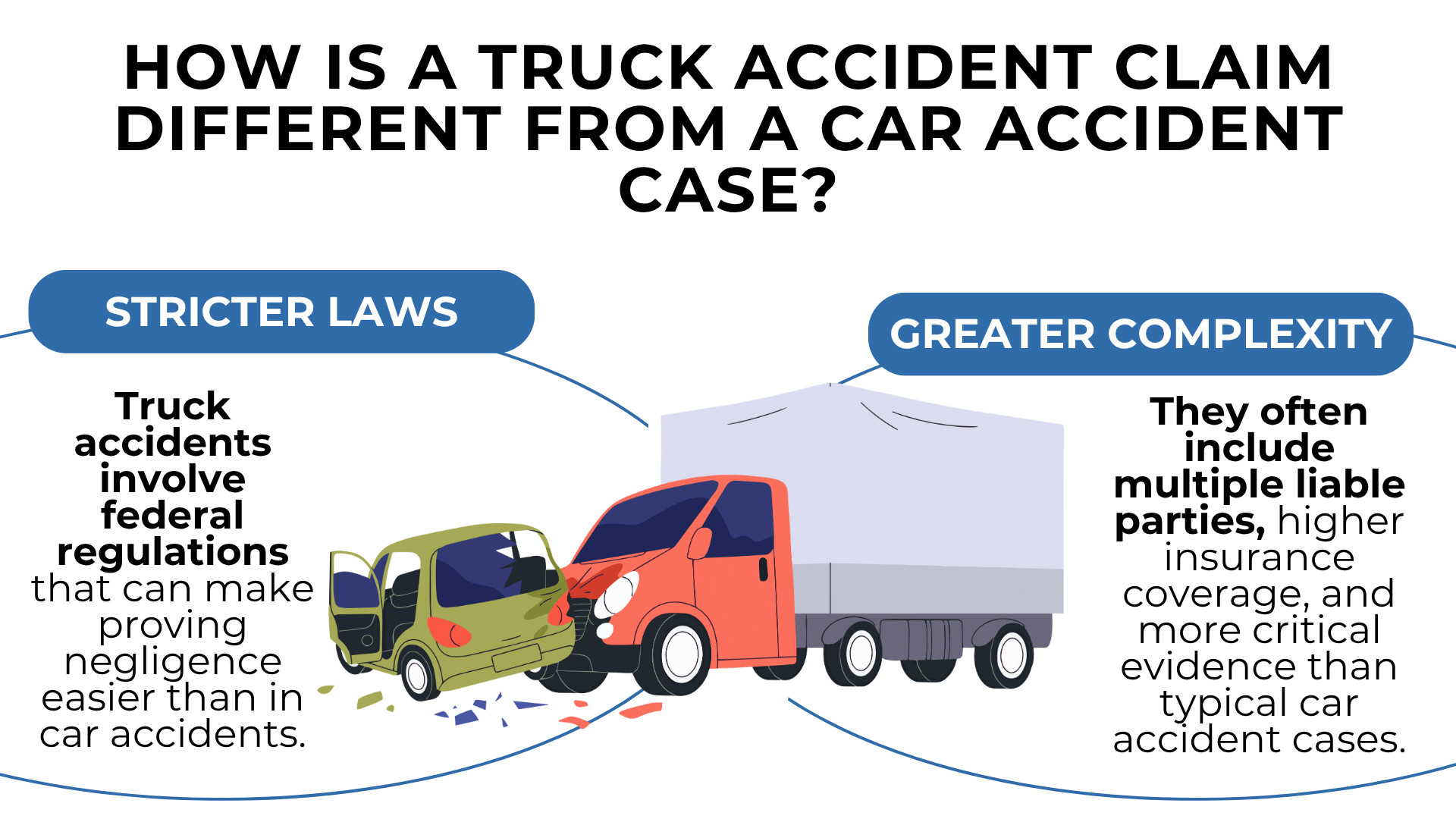
How Is a Truck Accident Claim Different from a Car Accident Case?
The distinction between a truck accident claim and a standard motor vehicle case is not just about the severity of injuries — though that gap is real. In two-vehicle crashes between a passenger vehicle and a large truck in 2023, 97% of the vehicle occupants killed were in the passenger vehicle. A fully loaded tractor-trailer can weigh 20 to 30 times as much as a typical passenger car and requires much more stopping distance. The physics alone make these crashes catastrophic in ways that car-on-car collisions rarely are.
But the legal difference is what most people don’t expect. Three features of Connecticut law set truck accident claims apart from other motor vehicle cases.
Federal regulations carry the force of state law. Under Conn. Gen. Stat. § 14-163c, Connecticut has adopted the Federal Motor Carrier Safety Regulations — 49 CFR Parts 382 through 397 — for commercial vehicles operating within the state. These regulations govern hours of service, vehicle maintenance, driver qualifications, drug and alcohol testing, and electronic logging requirements. Once adopted, a violation of these federal rules can establish negligence as a matter of law under Connecticut’s negligence per se doctrine. As the Connecticut Supreme Court held in Gore v. People’s Savings Bank, 235 Conn. 360 (1995), in a negligence per se case the jury need only decide whether the regulation was violated. If it was, the defendant was negligent as a matter of law. That is a fundamentally different burden than proving a driver simply failed to act as a reasonable person would.
Multiple parties can be liable. A typical car accident involves one other driver and one insurance policy. A truck accident claim can involve the driver, the motor carrier, the company that maintained the vehicle, the manufacturer of a defective component, and the entity that loaded the cargo. Each operates under different legal theories and is potentially covered by different insurance. Federal law requires general freight carriers to maintain minimum insurance of $750,000, with minimums reaching $1 million to $5 million for carriers transporting hazardous materials. These are not the $25,000 per-person minimums that apply to passenger vehicles under Conn. Gen. Stat. § 14-112.
Critical evidence has a short shelf life. Electronic logging device records, event data recorder information, dashcam footage, GPS data, and dispatch communications are all subject to retention schedules that can result in their destruction within months of a crash. The legal tools available to preserve this evidence only work if they are deployed quickly.
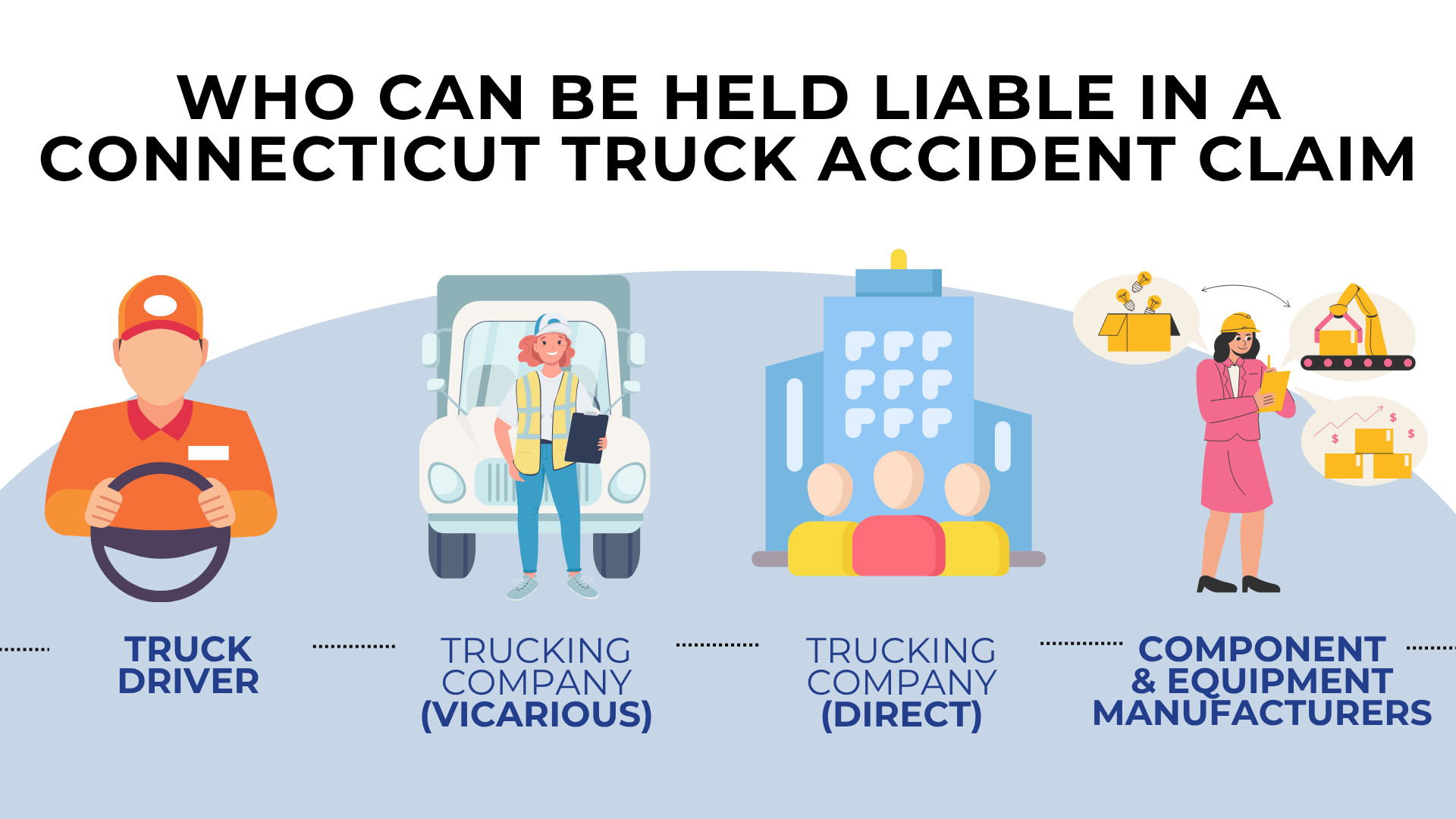
Who Can Be Held Liable in a Connecticut Truck Accident Claim
Connecticut law provides several independent paths to hold parties accountable after a trucking accident. These theories are not mutually exclusive — they can be pursued simultaneously against different defendants or even against the same defendant.
The truck driver
The foundation of most truck accident claims is a negligence action against the driver. Under Connecticut law, a plaintiff must establish four elements: a duty of care, a breach of that duty, causation linking the breach to the harm, and actual damages. The Connecticut Supreme Court in Jaworski v. Kiernan, 241 Conn. 399 (1997), held that the threshold inquiry is whether the specific harm alleged was foreseeable to the defendant.
While Connecticut does not impose a heightened common-law duty of care on freight carriers (that standard applies only to common carriers of passengers), the standard of reasonable care is shaped heavily by federal regulatory obligations. When a driver violates hours-of-service limits under 49 CFR § 395.3, operates while impaired by fatigue in violation of 49 CFR § 392.3, or exceeds safe speeds, those violations can constitute negligence per se. That means the only factual question is whether the violation occurred and whether it caused the plaintiff’s injuries.
The data on driver-related factors shows how frequently these violations contribute to crashes. In the federal Large Truck Crash Causation Study, 87.2% of crashes where the truck was assigned the critical reason involved driver-related factors, including decision errors, recognition errors, and non-performance factors such as falling asleep. Nearly 23% of large trucks in those crashes were traveling too fast for conditions. And 13% of drivers were coded as fatigued at the time of the crash.
The trucking company — vicarious liability
Connecticut follows the common-law doctrine of respondeat superior: employers are vicariously liable for the negligent acts of their employees committed within the course and scope of employment. The Connecticut Supreme Court affirmed this in Jagger v. Mohawk Mountain Ski Area, Inc., 269 Conn. 672 (2004). Additionally, Conn. Gen. Stat. § 52-183 creates a rebuttable presumption that the operator of an owner’s motor vehicle is the owner’s agent operating in the course of employment. The trucking company bears the burden of rebutting that presumption.
Even when a carrier classifies its drivers as independent contractors, that label is not decisive. Connecticut applies the ABC Test under Conn. Gen. Stat. § 31-222(a)(1)(B), which presumes employment status unless the company proves all three requirements: freedom from direction and control, services outside the employer’s usual course of business, and that the worker is engaged in an independently established trade. Federal regulations add another layer — under 49 CFR § 390.5, the definition of “employee” includes drivers operating under a carrier’s authority even when classified as independent contractors.
The trucking company — direct negligence
Separate from vicarious liability, Connecticut recognizes direct negligence claims against trucking companies for negligent hiring, supervision, retention, and entrustment. These theories impose liability for the company’s own failures, not derivatively through the driver’s conduct. As the Connecticut Appellate Court held in Seguro v. Cummiskey, 82 Conn. App. 186 (2004), these claims exist independently of respondeat superior.
The central element is foreseeability. The Connecticut Supreme Court established in Shore v. Stonington, 187 Conn. 147 (1982), that negligent hiring applies when an employer fails to select an employee fit to perform the services of employment. Without evidence that the employer knew or should have known of the employee’s dangerous propensities, the claim fails. For trucking companies, federal regulations under 49 CFR Part 391 (driver qualifications) and 49 CFR Part 382 (drug and alcohol testing) define what constitutes reasonable hiring and supervision practices. A carrier that fails to verify a driver’s qualifications, ignores a history of violations, or skips mandatory drug testing has potentially created its own independent basis for liability.
For negligent entrustment, the Connecticut Supreme Court of Errors recognized in Greeley v. Cunningham, 116 Conn. 515 (1933), that an owner who entrusts a vehicle to someone the owner knows or should know is incompetent to operate it is liable for resulting injuries. Separately, Shea v. Brown, 146 Conn. 631 (1959), held that merely being a suspended driver is insufficient as a matter of law to establish incompetence as an operator of a motor vehicle.
Component and equipment manufacturers
When a crash results from a mechanical failure — defective brakes, a tire blowout, a faulty coupling device — the Connecticut Product Liability Act (Conn. Gen. Stat. §§ 52-572m through 52-572q) provides the exclusive remedy against product sellers. “Product seller” is defined broadly to include manufacturers, wholesalers, distributors, retailers, bailors, and lessors engaged in the business of selling, leasing, or bailment of a product. No privity of contract is required.
Connecticut applies a modified consumer expectation test for design defect claims, evaluating consumer expectations in light of risk-utility factors. The Connecticut Supreme Court adopted this test in Potter v. Chicago Pneumatic Tool Co., 241 Conn. 199 (1997). And where physical evidence of the defect has been lost, the court in Metropolitan Property & Casualty Insurance Co. v. Deere & Co., 302 Conn. 123 (2011), adopted the malfunction theory. That doctrine permits a jury to infer a product defect from circumstantial evidence if three conditions are met: the incident ordinarily does not occur without a defect, the defect most likely existed when the product left the manufacturer’s control, and the incident was not the result of other reasonably possible causes not attributable to the manufacturer.
The frequency of equipment failures makes this theory more relevant than many people assume. In the Large Truck Crash Causation Study, 29.4% of large trucks involved in crashes had brake problems coded as an associated factor. During the 2024 CVSA International Roadcheck, brake defects accounted for 25% of all vehicle violations. And the national vehicle out-of-service rate was 22.6% — meaning more than one in five commercial vehicles inspected had safety violations serious enough that the vehicle was taken off the road.
What Evidence Can Make or Break Your Truck Accident Claim?
Truck accident claims generate a category of evidence that simply does not exist in car accident cases — and much of it is perishable by design.
Electronic logging devices record hours of service, driving time, and duty status. Under 49 CFR § 395.8(k) and § 395.22(j), motor carriers are required to retain ELD records for only six months from the date of receipt. Event data recorders — the truck’s “black box” — capture speed, braking, and other operational data in the moments before a crash. But this data can be overwritten if the vehicle is returned to service. Dashcam footage, GPS tracking data, and dispatch communications are all subject to the carrier’s internal retention policies, which may be even shorter than the federal minimums.
Federal law prohibits the alteration or erasure of original ELD data under 49 CFR § 395.30(f). But the common-law duty to preserve evidence arises only when litigation is pending or reasonably anticipated. And it overrides routine retention schedules only if the carrier has been placed on notice.
Connecticut provides unusually strong tools for addressing evidence destruction. Under Beers v. Bayliner Marine Corp., 236 Conn. 769 (1996), a jury may draw a permissive adverse inference from intentional spoliation — meaning the jury can infer that the destroyed evidence would have been unfavorable to the party that destroyed it. More significantly, Connecticut is one of a small number of states that recognizes an independent tort of intentional spoliation. In Rizzuto v. Davidson Ladders, Inc., 280 Conn. 225 (2006), the Connecticut Supreme Court held that a plaintiff can recover compensatory damages lost due to the intentional destruction of evidence. This is a powerful deterrent, but it only helps if the spoliation is documented. That requires sending a preservation demand to the carrier, its insurer, and any involved maintenance providers as quickly as possible after the crash.
The evidence that matters in these cases includes driver qualification files, drug and alcohol testing records, vehicle inspection and maintenance logs, the carrier’s safety rating and inspection history, freight and dispatch records, and any post-crash communications between the driver and the company. An attorney experienced in trucking litigation will know what to request, where it is stored, and how to compel its preservation before routine deletion policies erase it.

How Much Could a Connecticut Truck Accident Claim Be Worth?
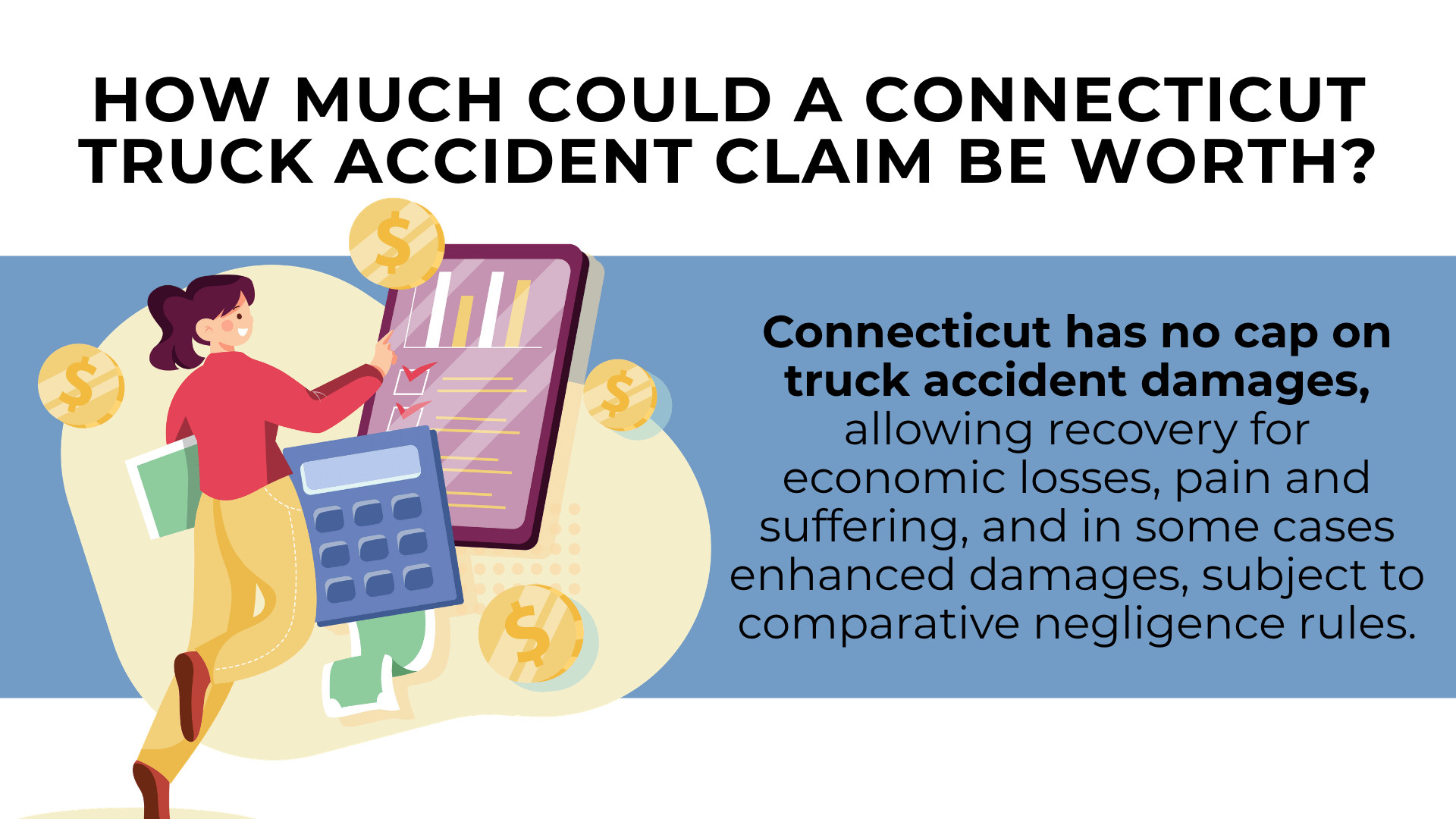
Connecticut sets no statutory limit on either economic or noneconomic damages in personal injury or wrongful death cases. What a truck accident claim is worth depends on the specific injuries sustained, but the categories of recoverable damages are well defined under Connecticut law.
Economic damages include medical expenses, rehabilitative services, custodial care, and loss of earnings or earning capacity. In truck accident cases, these figures can be substantial. The injuries most commonly associated with commercial truck collisions — traumatic brain injuries and spinal cord injuries — carry costs that extend over a lifetime. Motor vehicle crashes are the leading cause of traumatic spinal cord injuries, accounting for 38% of all new cases. First-year healthcare and living expenses for a survivor with high tetraplegia average $1,446,827, with $251,246 each subsequent year. Motor vehicle crashes also account for roughly 17% of all TBI-related deaths and 24.5% of all TBI-related hospitalizations nationally.
Noneconomic damages cover physical pain, suffering, and mental and emotional distress. Connecticut also recognizes loss of consortium claims for spouses — defined in Hopson v. St. Mary’s Hospital, 176 Conn. 485 (1979), as the constellation of companionship, dependence, reliance, affection, sharing, and aid arising from the civil contract of marriage. The Connecticut Supreme Court in Campos v. Coleman, 319 Conn. 36 (2015), extended a derivative consortium claim to minor children for the period between a parent’s injury and the child reaching age 18. These claims are derivative, meaning they depend on the success of the injured person’s underlying claim.
Enhanced damages may be available under Conn. Gen. Stat. § 14-295, which authorizes double or treble damages when a party deliberately or with reckless disregard violated listed traffic statutes and the violation was a substantial factor in causing the injury. This must be specifically pleaded in the complaint. For claims involving defective truck components, Conn. Gen. Stat. § 52-240b permits punitive damages up to twice compensatory damages for reckless disregard of product safety.
Comparative negligence is a factor the defense will raise. Connecticut follows a modified comparative negligence system under Conn. Gen. Stat. § 52-572h. If the plaintiff’s negligence is 50% or greater, recovery is completely barred. If the plaintiff is less than 50% at fault, damages are reduced by their percentage of fault. And each defendant is liable only for their proportionate share. Critically, under § 52-572h(o), apportionment does not apply when liability rests on a basis other than negligence — including strict product liability or recklessness. If a truck driver’s conduct is found to be reckless, the comparative fault system does not protect the defendants.
The Filing Deadlines You Cannot Miss
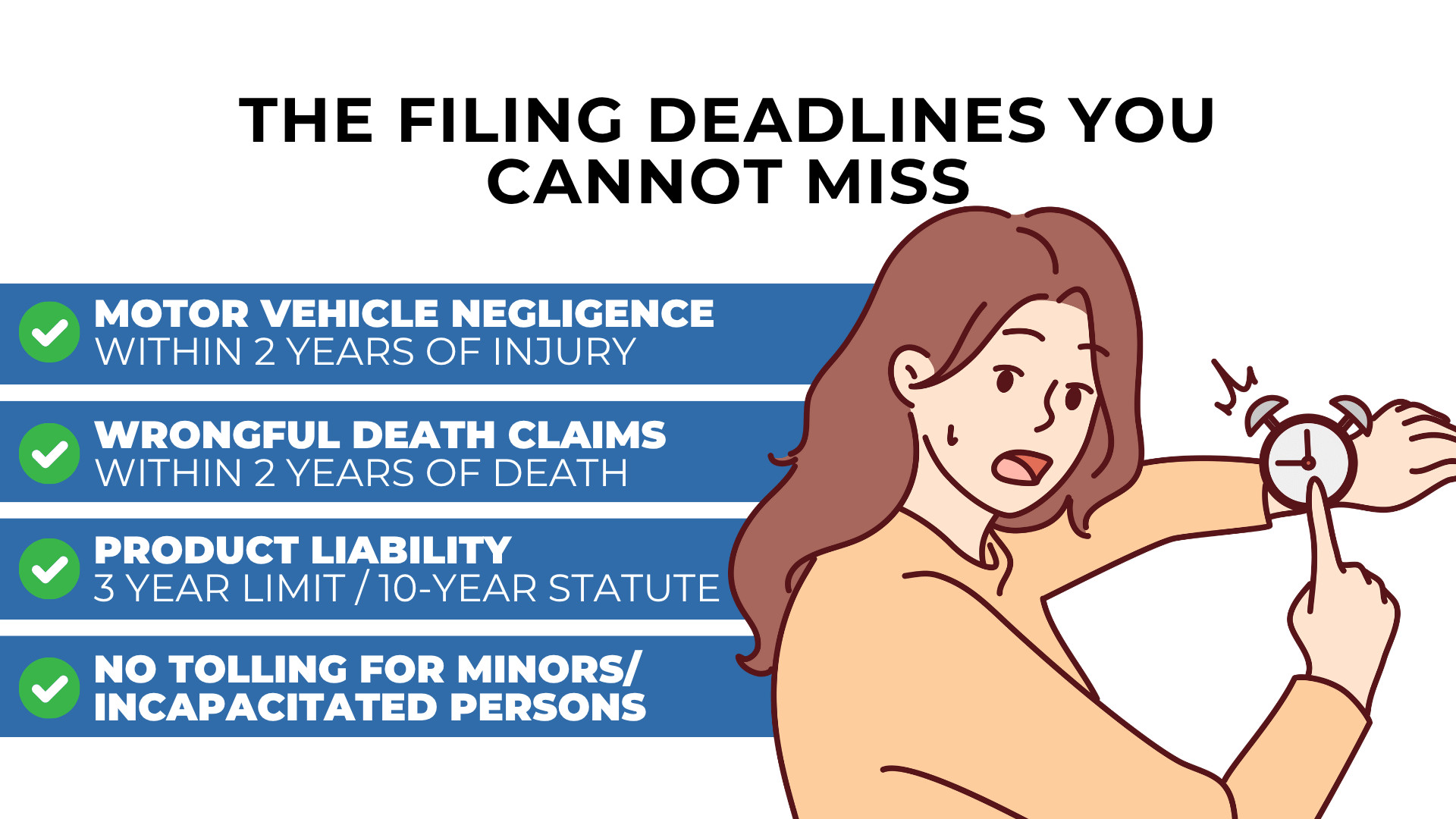
Connecticut’s statute of limitations for motor vehicle negligence claims is two years from the date the injury is first sustained, discovered, or should have been discovered, under Conn. Gen. Stat. § 52-584. There is also a three-year statute of repose measured from the date of the act or omission. The Connecticut Supreme Court in McDonald v. Haynes Medical Laboratory, Inc., 192 Conn. 327 (1984), confirmed that this repose period is absolute and cannot be extended even if the injury has not yet been discovered.
Wrongful death actions under Conn. Gen. Stat. § 52-555 must be brought within two years from the date of death and no more than five years from the date of the act or omission. These actions must be filed by the executor or administrator of the estate.
Product liability claims against component manufacturers are subject to a separate three-year limitation with a ten-year statute of repose under Conn. Gen. Stat. § 52-577a, measured from the date the product seller last parted with possession or control. For older trucks with aging components, that repose period can become a barrier.
There is one deadline rule that catches many families off guard. Connecticut is the only state in the country that does not toll the negligence statute of limitations for minors or incapacitated persons. Under Conn. Gen. Stat. § 52-584, there is no pause or extension for children or individuals who lack the capacity to act on their own behalf. If a child was injured in a truck accident, the parent or guardian must bring the claim within the same two-year window that applies to every other plaintiff. Missing this deadline means the claim is gone — regardless of the child’s age or the severity of their injuries.
The savings statute under Conn. Gen. Stat. § 52-592 may allow a new action within one year if a prior suit fails for reasons unrelated to the merits. Separately, Conn. Gen. Stat. § 52-595 provides tolling for fraudulent concealment. But these are narrow exceptions, not safety nets to rely on.
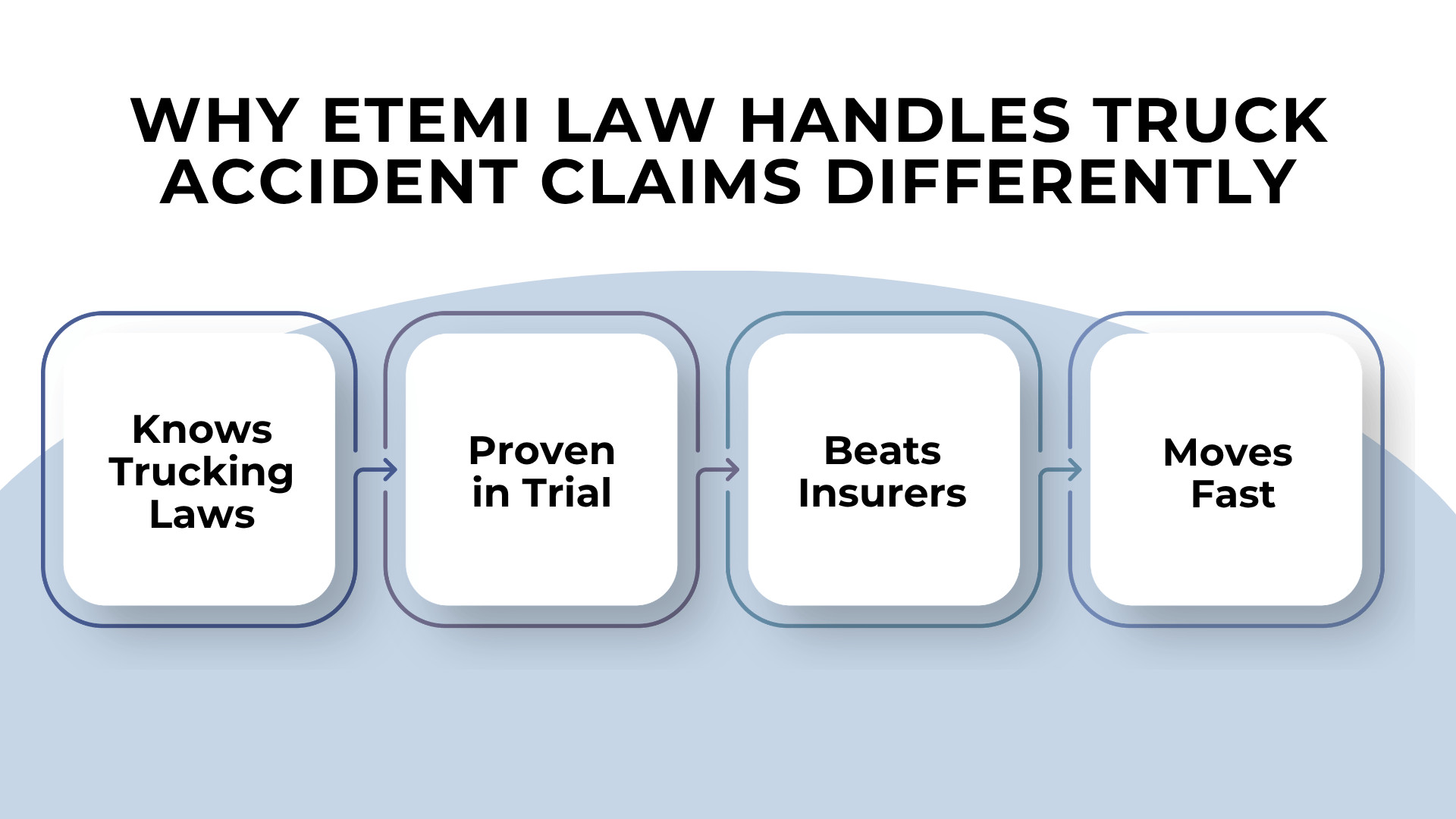
Why Etemi Law Handles Truck Accident Claims Differently
The legal rules described in this article are not academic. They determine the outcome of real cases — who is held accountable, what evidence survives, and whether a family recovers what they need to move forward. Truck accident claims require attorneys who understand federal motor carrier safety regulations, know how to identify every liable party in a multi-defendant case, and can move fast enough to preserve evidence before it disappears.
At Etemi Law in Waterbury, that is what we do. Ron Etemi has tried over 100 cases to verdict and received the Top Verdict Award. He is known for trial readiness, strategic case development, and the ability to confront insurance companies and corporate defendants without hesitation. Peter Brown has 175 jury verdicts to his name and spent his first 15 years practicing as one of the most respected civil defense lawyers in Connecticut — which means he knows exactly how the other side builds its case. Lou Etemi has helped hundreds of clients through strategic negotiation and persistence, and Semir Dervisi brings aggressive negotiation skills and a detail-oriented approach to case strategy shaped by extensive experience in depositions, arbitration, and trial preparation.
Connecticut had 1,607 large truck crashes in 2024, resulting in 28 fatalities and 723 injuries. Over the four years from 2022 through 2025, the state recorded 8,599 total large truck crashes and 119 fatalities. These are not abstract numbers. Each one represents a person or a family navigating the same legal system described in this article.
If you were injured in a truck accident in Connecticut, or if you lost a family member in one, contact Etemi Law for a consultation. The filing deadlines are firm, the evidence is already aging, and the trucking company’s legal team is already working. The sooner you act, the stronger your claim will be.