Truck Driver Fatigue and Connecticut Truck Accident Claims

Truck driver fatigue — exhaustion severe enough to impair a commercial driver’s reaction time, judgment, or ability to stay awake behind the wheel — is one of the most frequently cited driver factors in serious large truck crashes. Federal law expressly prohibits a commercial driver from operating a truck while impaired by fatigue. If you’re searching this term because something about a recent crash doesn’t fit the story the trucking company is telling, you’re following an instinct that federal crash data, Connecticut statutes, and decades of trucking litigation all take seriously.
This page walks through what fatigue crashes actually look like, the federal Hours of Service rules that are supposed to prevent them, how lawyers prove a driver was too tired to drive after the fact, why waiting can destroy the evidence you’d need to win, and why the trucking company — not just the driver — is usually the party with real financial responsibility.
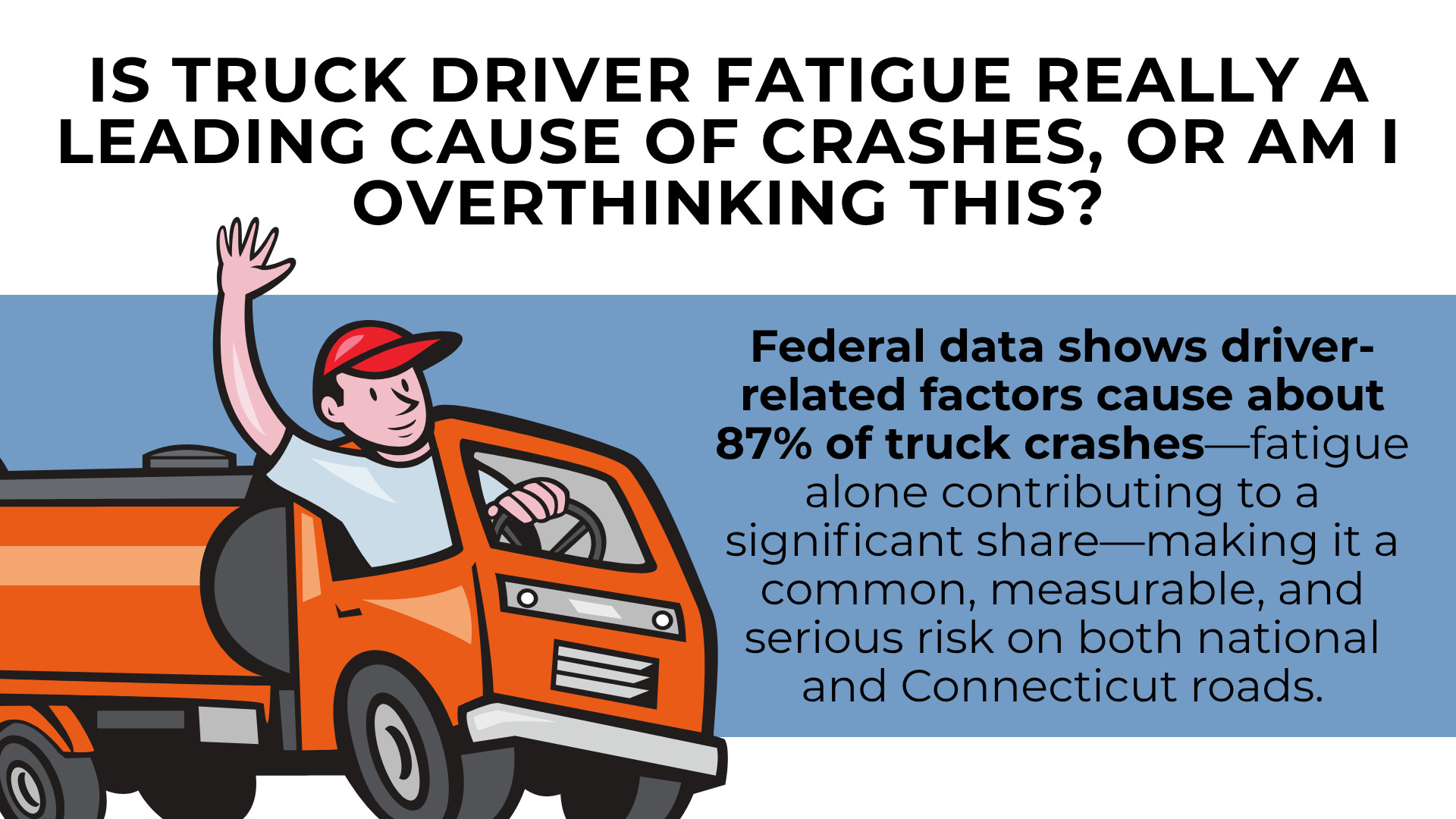
Is truck driver fatigue really a leading cause of crashes, or am I overthinking this?
You are not overthinking it. The most comprehensive federal study ever conducted on the causes of large truck crashes is the Large Truck Crash Causation Study, jointly run by FMCSA and NHTSA. When the critical reason for a crash was assigned to the truck, a category capturing non-performance — including falling asleep at the wheel — accounted for 11.6% of the truck drivers in those crashes.
That number matters because it tells you two things. First, fatigue is not a fringe theory — it is a named, tracked, measurable cause that federal investigators look for. Second, truck drivers losing the ability to drive at the wheel is common enough to have its own category in the federal data.
Connecticut sees this play out on its own roads. FMCSA data shows 1,607 large truck crashes in Connecticut in 2024, producing 28 fatalities and 723 injuries. Nationally, 5,472 people died in crashes involving large trucks in 2023. Roughly 70% of them were occupants of other vehicles — the cars, pickups, and SUVs that were hit.
What does a fatigue-caused truck crash look like — and does mine fit the pattern?
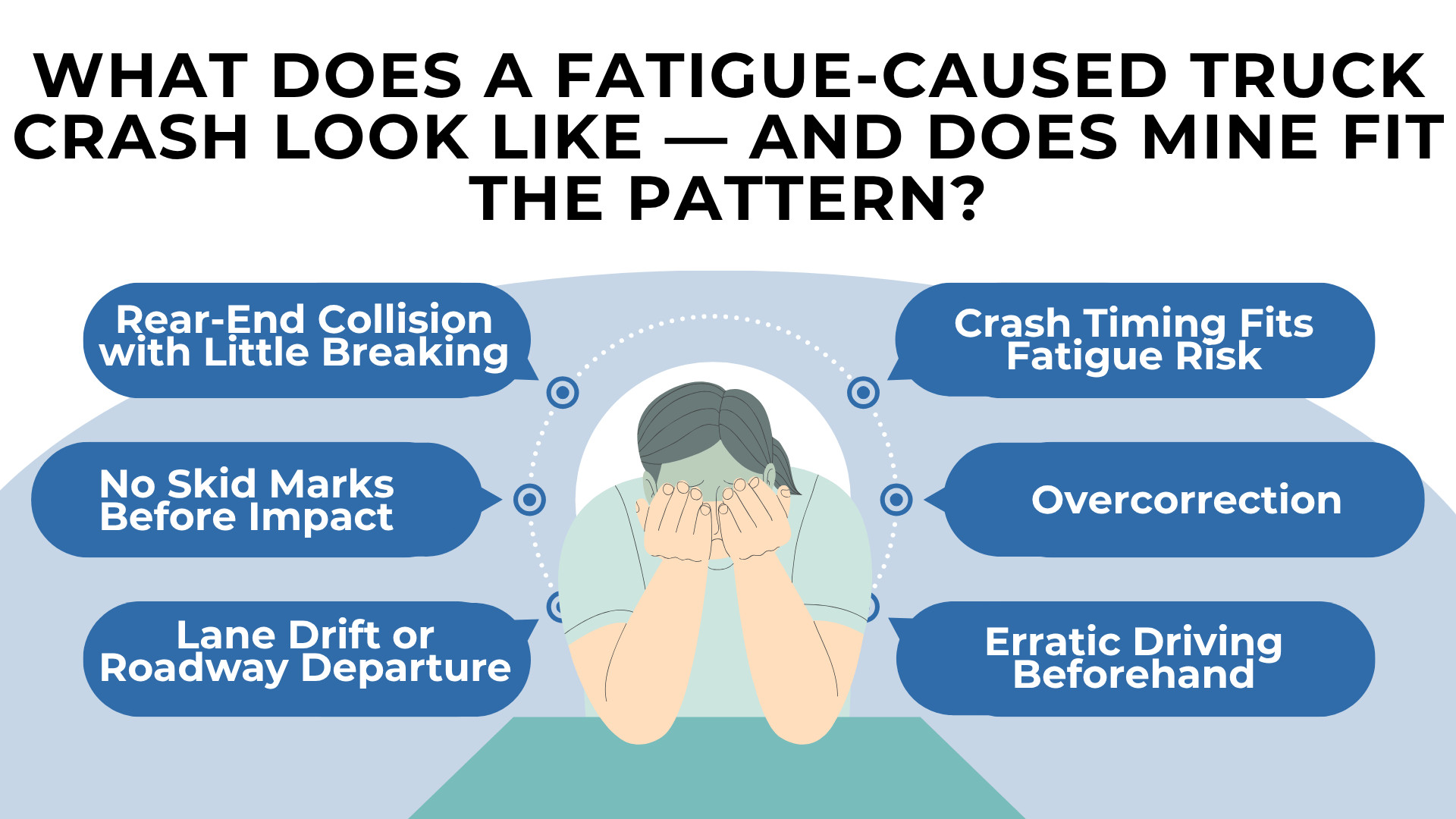
Fatigue crashes tend to share a set of physical signatures that accident reconstructionists, safety investigators, and experienced trucking lawyers recognize on sight:
- The truck rear-ended a vehicle or line of vehicles that had been stopped or visibly slowing, with little or no pre-impact braking.
- There are no skid marks, or skid marks begin only at the moment of impact, suggesting the driver never saw what was in front of him.
- The truck drifted out of its lane, crossed the centerline, or ran off the road on a straight stretch where no evasive maneuver was required.
- The crash happened late at night, in the early-morning hours, at the end of a long shift, or on a monotonous stretch of highway — the conditions most strongly associated with drowsy driving.
- The driver overcorrected after drifting, producing a jackknife or rollover out of proportion to what traffic conditions would suggest.
- Witnesses describe the truck weaving, speeding up and slowing down erratically, or failing to respond to obvious hazards like brake lights, construction zones, or emergency vehicles.
If any of these describe what happened to you or your family member, your suspicion is consistent with the pattern typically seen in fatigue cases. The next question is whether the law gives you something to work with — and it does.
Aren’t there federal rules that are supposed to stop truckers from driving tired?
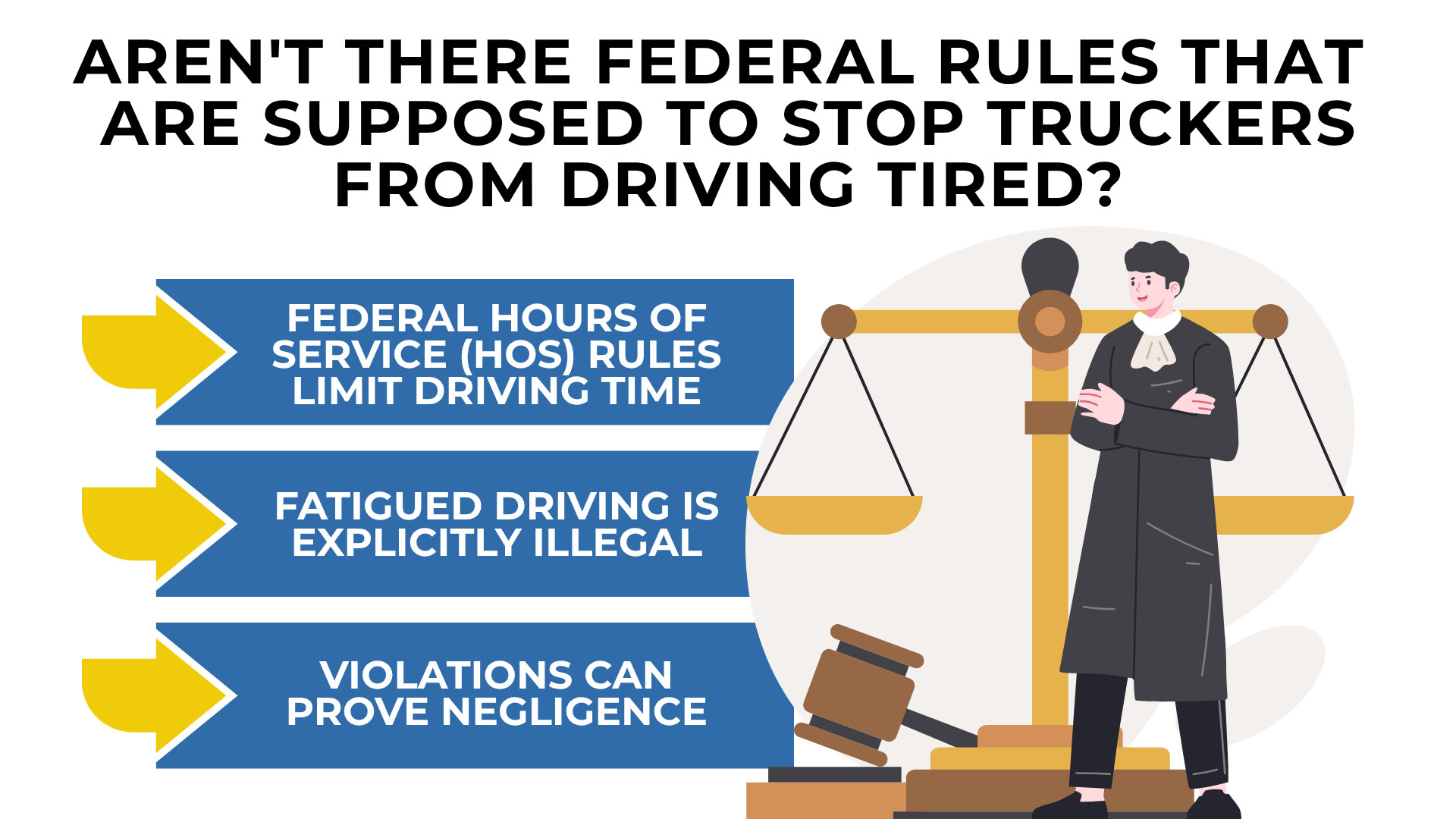
There are, and they are the backbone of a fatigue case.
The federal Hours of Service rules, set out in 49 CFR § 395.3, govern how long a commercial truck driver can operate before stopping to rest:
- A driver cannot drive for more than 11 hours following 10 consecutive hours off duty.
- All driving must occur within a 14-hour on-duty window that begins when the driver comes on duty.
- A driver cannot drive if more than 8 hours of driving time have passed without at least a consecutive 30-minute interruption in driving status.
- Drivers are subject to 60/70-hour weekly limits on total on-duty time.
Federal regulations go further than the hour limits. Under 49 CFR § 392.3, the regulation prohibits driving a commercial motor vehicle while the driver’s ability is impaired by fatigue, illness, or any other cause. It also prohibits a motor carrier from allowing that kind of driving.
Connecticut has adopted these federal rules as state law. Under Conn. Gen. Stat. § 14-163c, the Commissioner of Motor Vehicles is authorized to incorporate the Federal Motor Carrier Safety Regulations — including the HOS rules and the prohibition on fatigued driving — into Connecticut law. That adoption has real force. Under Connecticut’s negligence per se doctrine, when a defendant violates an applicable statute or regulation, the violation can establish negligence as a matter of law if two conditions are met. First, the plaintiff was within the class of people the regulation was designed to protect. Second, the harm suffered was of the type the regulation was designed to prevent. Whether a given plaintiff and injury satisfy those conditions is a question for the court and jury on the facts of the case. Causation must still be proven.
That changes the nature of the case. It shifts the argument from “the driver was too tired” — a judgment call — to “the driver broke a federal safety regulation adopted into Connecticut law,” which is a question of records.
How do you prove a truck driver was fatigued after the crash?
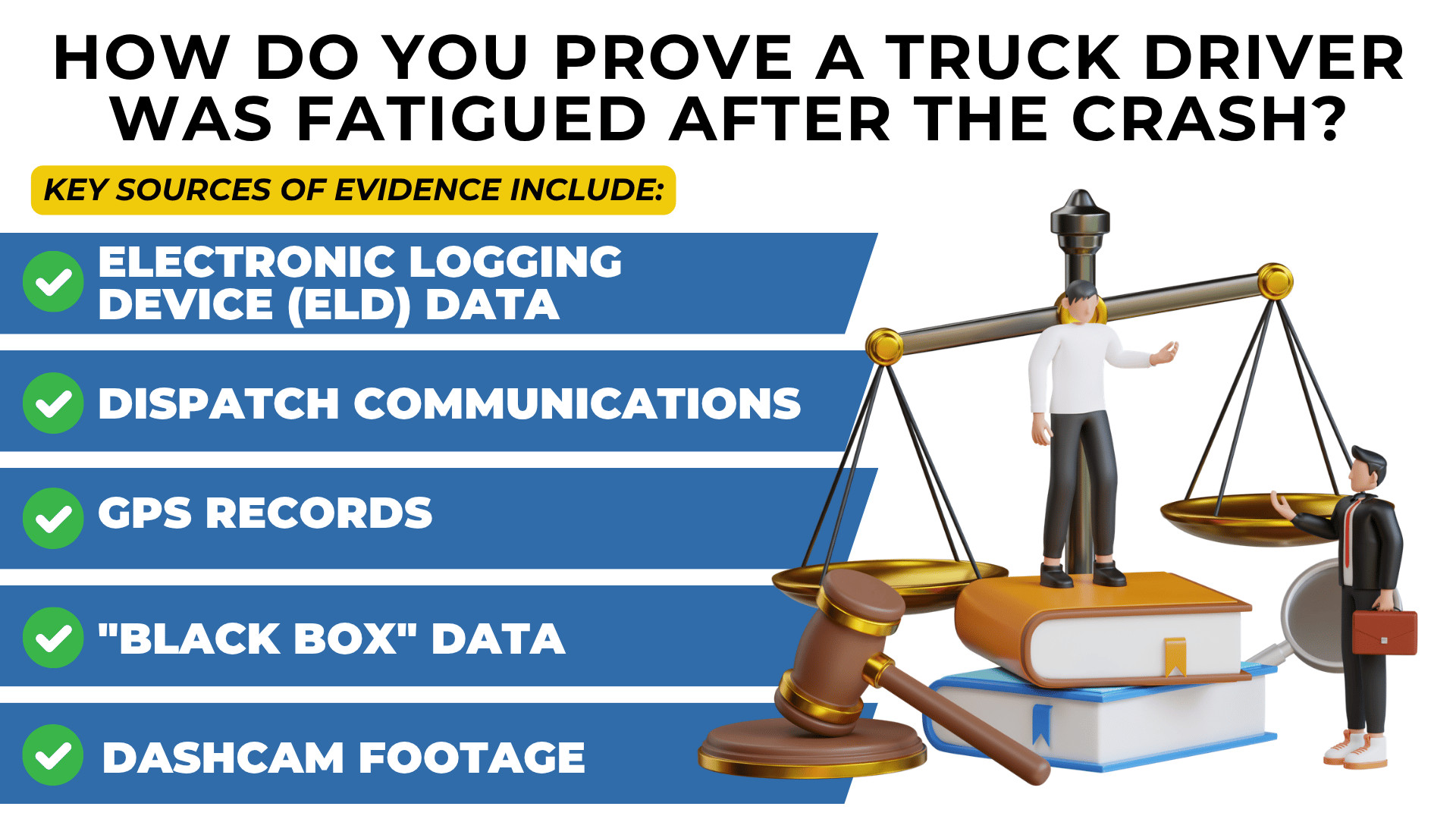
Fatigue cases are built on records, not memory. The central sources of evidence lawyers look to include:
Electronic Logging Device (ELD) data. Most interstate commercial trucks are required to use an ELD that records the driver’s duty status. ELD records are governed by 49 CFR § 395.8, and the ELD is the single most important piece of evidence in most fatigue cases.
Dispatch communications. Communications between driver and dispatcher can reveal pressure to keep driving, unrealistic delivery windows, or instructions that effectively required a log violation.
GPS records. GPS data provides time-and-location information that can be cross-referenced against the driver’s logbook. A location recorded in one place while the logbook says the driver was on rest somewhere else is often the thread that unravels an entire case.
Event data recorder (“black box”) data. Most modern tractors record data in the seconds before a crash. The absence of braking before a rear-end impact can be powerful evidence that the driver never saw the collision coming.
Dashcam footage. Many fleets run forward-facing and driver-facing cameras.
These records exist. The question is whether they will still exist by the time anyone asks for them.
Why am I being told to act fast — what evidence is actually disappearing?
This is the part most people underestimate, and it is the single most urgent reason to talk to a lawyer quickly.
Federal regulations only require motor carriers to retain ELD records of duty status for six months from the date of receipt under 49 CFR § 395.8(k). Dashcam systems typically run on a rolling loop that overwrites itself unless someone actively flags and saves the footage. Communications and other records get deleted, archived, or lost in normal business operations.
Connecticut law does provide some protection — but only once the carrier knows, or reasonably should know, that litigation is coming. Connecticut imposes a common-law duty to preserve evidence when litigation is pending or reasonably anticipated. If the evidence was intentionally destroyed, the jury in a later lawsuit may be permitted to draw an adverse inference — that the destroyed evidence would have been unfavorable to the carrier. Connecticut is also one of the few states that recognizes an independent tort of intentional spoliation under Rizzuto v. Davidson Ladders, Inc., 280 Conn. 225 (2006).
These protections only work if the carrier was on notice. A lawyer triggers that notice by sending a preservation-of-evidence letter — sometimes called a litigation hold or spoliation letter — identifying the ELD data, dispatch records, dashcam footage, GPS records, event data recorder data, and related materials that must be preserved. Once that letter is delivered, destroying those records becomes legally dangerous for the carrier. Without it, a carrier can point to its routine document-retention schedule and wipe the evidence clean.
The separate filing deadline — the Connecticut statute of limitations under Conn. Gen. Stat. § 52-584 — gives you two years from the date of injury to file a negligence lawsuit. That deadline is subject to an absolute three-year statute of repose from the date of the act or omission. But the evidence clock runs much faster than the filing clock. A lawsuit filed two years in with no ELD records, no dashcam footage, and no dispatch communications is a harder lawsuit to win.
Is it just the driver who’s responsible, or is the trucking company liable too?
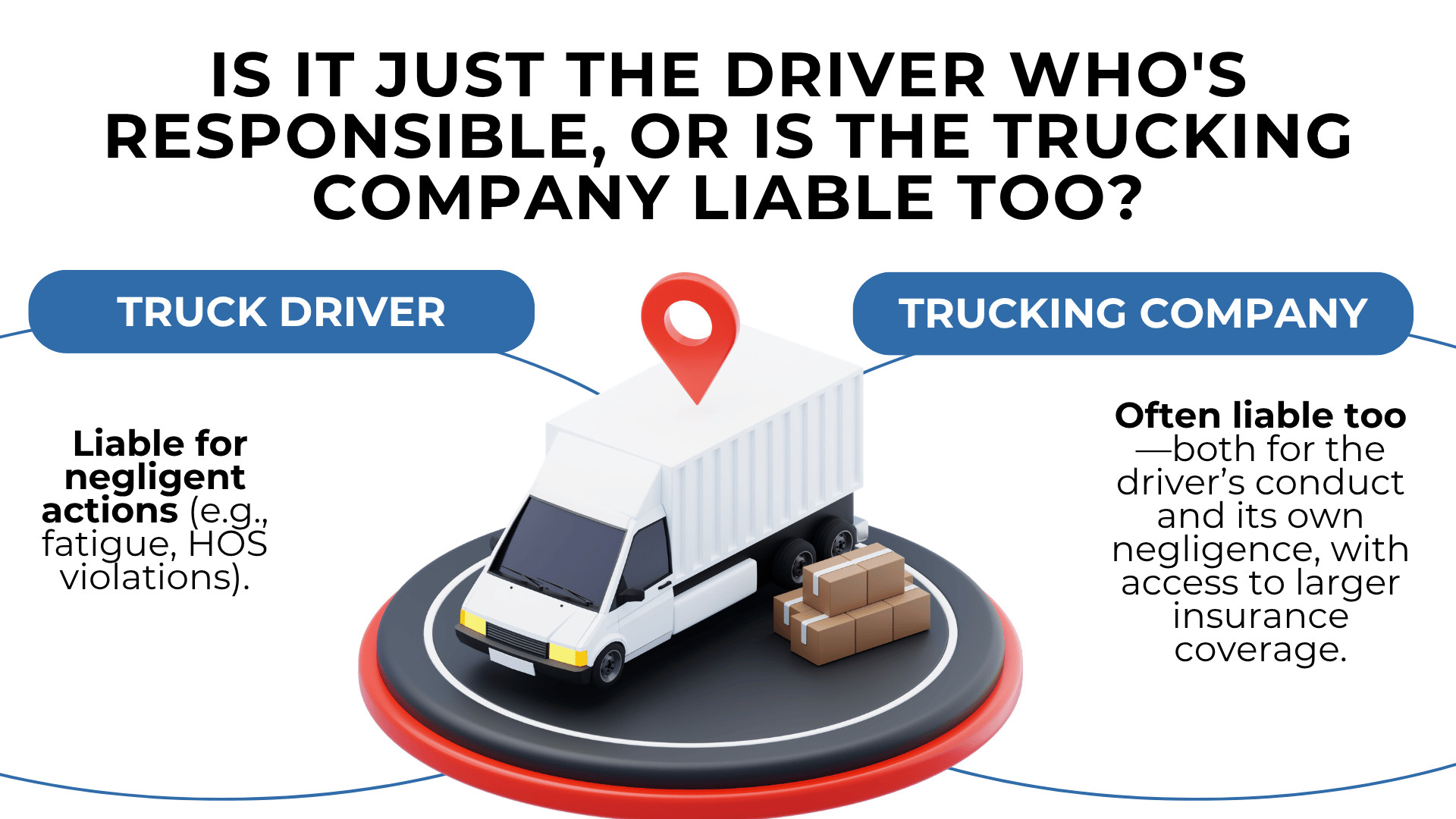
In most fatigue cases, the trucking company is the real defendant. Understanding why is the single most important thing to know about the value of your case.
Under Connecticut common law, an employer is vicariously liable for the negligent acts or omissions of an employee committed within the course and scope of employment. This is the doctrine of respondeat superior. When a driver violates HOS rules while hauling a load for his carrier, the carrier is on the hook for the driver’s negligence. Connecticut reinforces this with Conn. Gen. Stat. § 52-183. The statute creates a rebuttable presumption that the operator of an owner’s motor vehicle is the owner’s agent and servant operating in the course of employment, forcing the carrier to rebut that presumption.
Vicarious liability is only the starting point. Connecticut also recognizes direct negligence claims against the carrier itself, independent of vicarious liability, including:
- Negligent hiring — the carrier hired a driver it knew or should have known posed a risk.
- Negligent supervision and retention — the carrier failed to supervise or retained a driver despite knowledge of dangerous conduct.
- Negligent entrustment — the carrier entrusted a commercial truck to a driver it knew or should have known posed a risk, and injury resulted from that risk.
The key question across these claims is foreseeability — whether an ordinary person in the carrier’s position, knowing what the carrier knew or should have known, would anticipate that harm of the kind suffered was likely to result. In fatigue cases, the foreseeability question often turns on what dispatch records, driver qualification files, and prior inspection history reveal about what the carrier knew.
Enforcement data makes the broader pattern across the industry. During the 2024 International Roadcheck — the annual three-day commercial vehicle enforcement blitz — 32.1% of all driver violations were Hours of Service violations, nearly one in three.
There is also a financial reason the carrier’s exposure matters. Federally regulated interstate carriers are required under 49 CFR § 387.9 to carry a minimum of $750,000 in liability coverage for general non-hazardous freight. Higher minimums apply to hazardous materials. That coverage — not the individual driver’s personal assets — is typically what funds a serious truck crash recovery. It is only accessible if the case is built against the carrier as well as the driver.
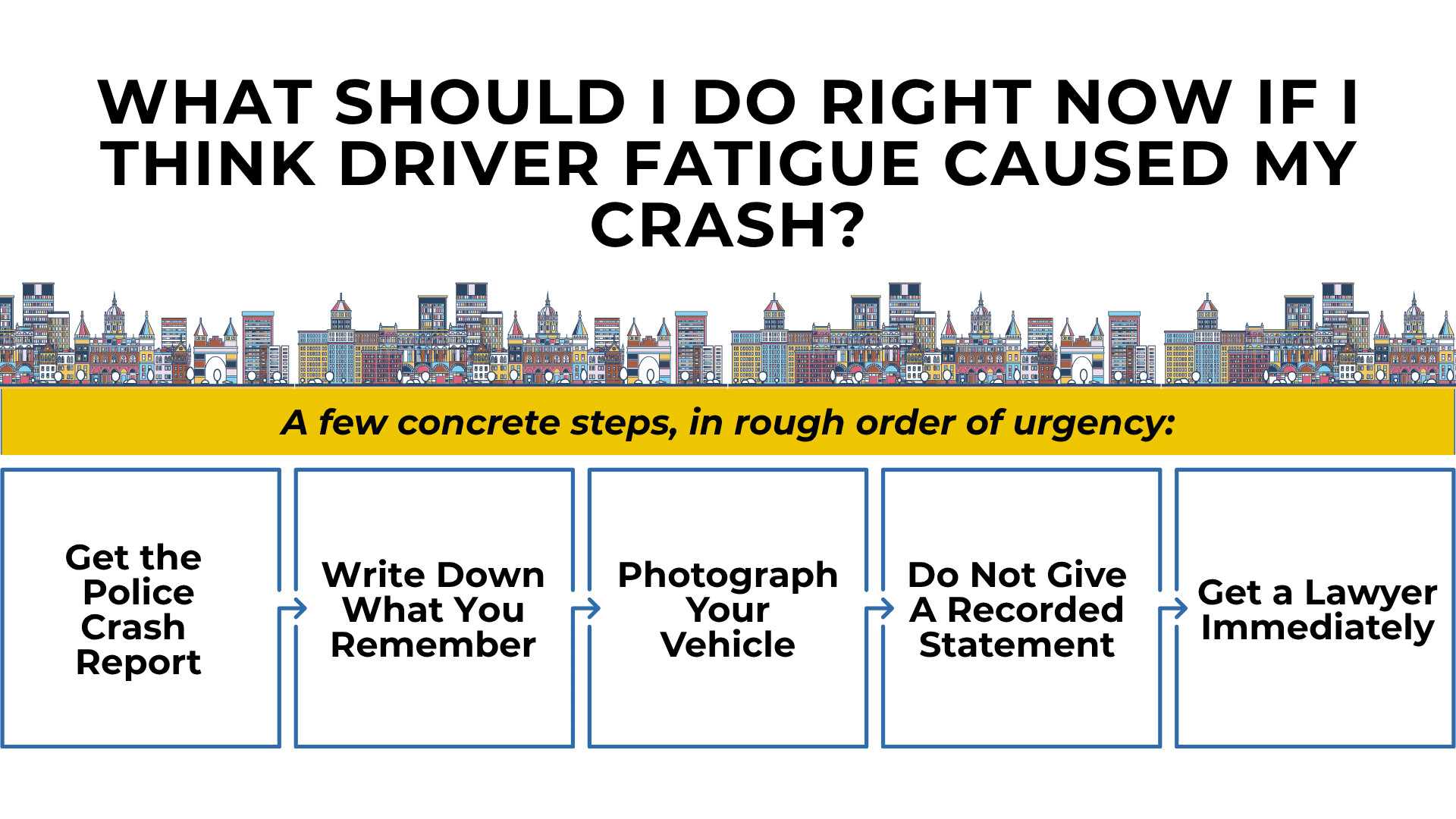
What should I do right now if I think driver fatigue caused my crash?
A few concrete steps, in rough order of urgency:
Get the police crash report. Connecticut crash reports can be requested from the investigating state or local police department. The report identifies the driver, the carrier, and the insurance information you or your lawyer will need to move quickly.
Write down what you remember — today. The driver’s demeanor, anything he said at the scene, how long the truck had been parked before first responders arrived, whether you saw him on a phone or rubbing his eyes, what other witnesses said. Memory degrades fast, and these details can matter enormously later.
Photograph your vehicle before it is repaired or salvaged. Damage patterns can be reconstructed from photographs long after the vehicle itself is gone.
Do not give a recorded statement to the trucking company’s insurer. Adjusters often call within days. You are not required to speak with them. Early statements made while you are still in pain, on medication, or missing medical information are routinely used later to minimize claims.
Get a lawyer to send a preservation-of-evidence letter immediately. This is the single most time-sensitive step. A preservation letter directed to the carrier, the driver, and their insurers identifies the ELD data, dispatch records, dashcam footage, GPS records, event data recorder data, and related records that must be preserved. It also puts the carrier on notice for purposes of Connecticut’s spoliation framework if any of those materials are destroyed afterward. Every day of delay is another day the carrier can continue operating under routine document-retention schedules.
If you’re in Connecticut and want to talk through what happened, Etemi Law handles commercial trucking cases out of Waterbury. The first conversation is usually about understanding what evidence still exists and getting a preservation letter out the door before anything else disappears.