What to Do After a Truck Accident

The short answer: get medical attention, file a police report, document what you can, be careful about what you say to the trucking company’s insurer, and move quickly on preserving evidence — because commercial truck cases have ticking clocks that regular car accidents don’t. Below is that answer in order, starting from the scene itself and ending with the honest question of whether you need a lawyer. If you’ve just been in a crash, you can skip ahead to whichever section matches where you are right now.
What should I do right at the scene?
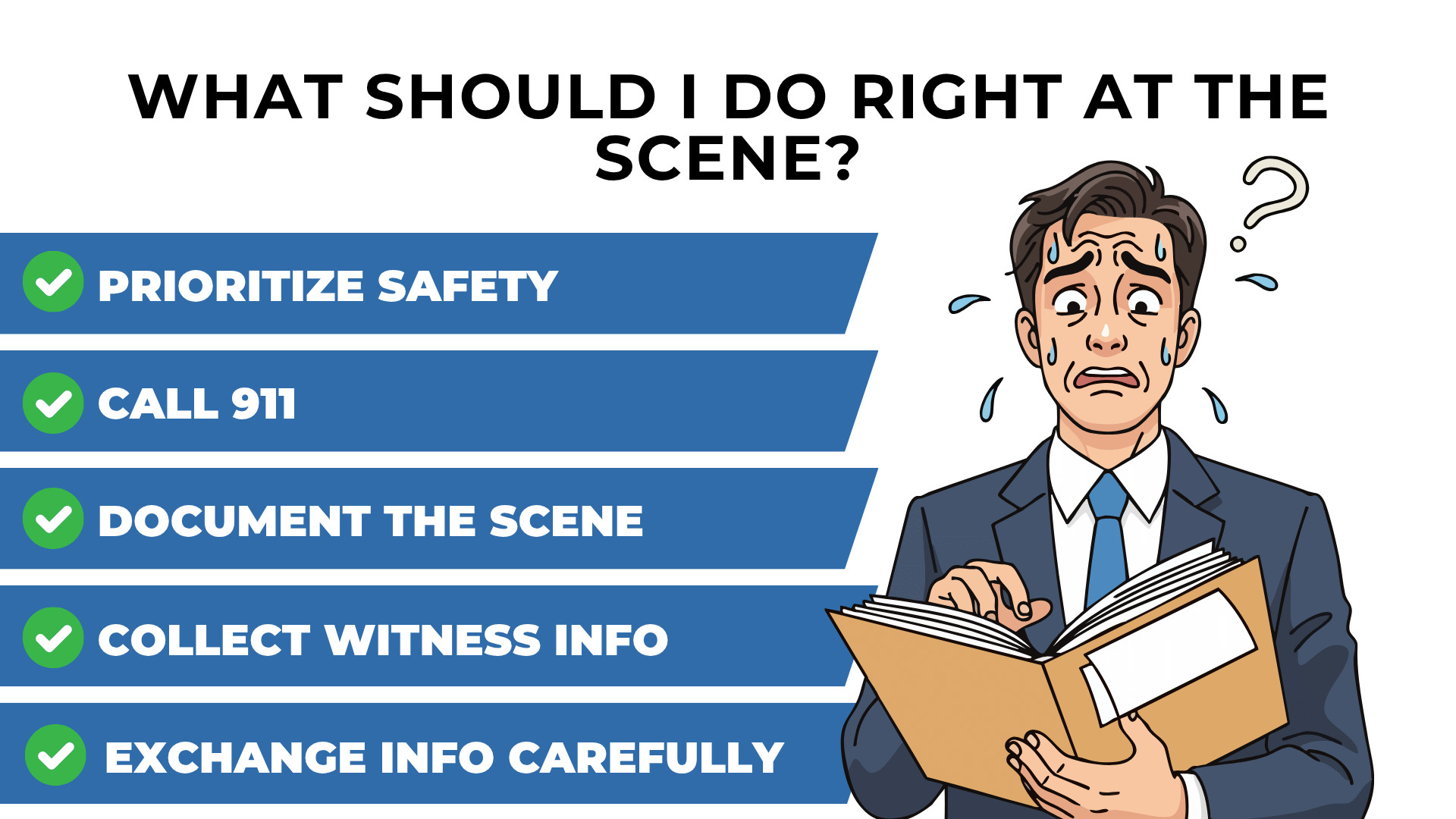
The first priority is safety. If vehicles can be moved out of traffic without making injuries worse, move them. If they can’t, stay where you are with hazards on and wait.
Call 911 even if the damage looks minor. A police report creates the first official, timestamped record of the crash, and in a commercial trucking case that document becomes a foundation piece of evidence. The responding officer will note the position of vehicles, statements, visible damage, and often road and weather conditions. These details get harder to reconstruct the longer you wait.
If you can do so safely, take photos. Get wide shots of the scene and close-ups of damage to every vehicle involved. Photograph the truck’s U.S. DOT number and license plate, along with the truck company’s name on the cab and trailer. Capture road conditions, skid marks, debris, traffic signals, and any visible injuries. Photograph the driver’s commercial driver’s license and insurance card if they provide them.
Get contact information from every witness — not just their name, but a phone number and, if possible, a short note about what they saw. Witnesses scatter quickly and memories fade.
Exchange information with the truck driver, but keep the exchange factual. Do not apologize, do not speculate about fault, and do not say “I’m fine” or “I’m not hurt.” Adrenaline hides injury; more on that in a moment. Anything you say at the scene can be quoted back to you later.
Do I need to see a doctor if I feel okay?
Yes. This is the single most important decision people get wrong in the first 24 hours.
High-impact crashes involving a large truck deliver forces that passenger vehicles aren’t built to absorb. A fully loaded tractor-trailer can weigh approximately 20 to 30 times the weight of a typical passenger car. It also needs 20 to 40 percent more stopping distance. That size difference means more serious injuries: in two-vehicle crashes between a passenger vehicle and a large truck in 2023, 97% of the occupants killed were in the passenger vehicle. Occupants of other vehicles also made up 70% of the 5,472 people killed in large truck crashes nationally that year.
Adrenaline masks pain, sometimes for hours, sometimes for days. Concussions and other traumatic brain injuries frequently show up with delayed symptoms — headaches, confusion, sensitivity to light, memory gaps, trouble concentrating — and motor vehicle crashes account for roughly 24.5% of all TBI-related hospitalizations in the United States. Soft-tissue injuries, internal bleeding, and spinal injuries can all feel minor at first. Motor vehicle crashes are the number one cause of traumatic spinal cord injuries, responsible for 38% of new cases since 2015.
There is also a legal side to this: medical records created at the time of the crash connect your injuries to the crash. Gaps between the accident and the first medical visit are the single most common argument an insurance adjuster uses against you. They will say your injuries “must have happened later” or “aren’t that serious.” Getting examined promptly protects your health and your case at the same time.

The trucking company’s insurance is already calling me — what do I say?
Probably very little, and not before you understand what the call is actually for.
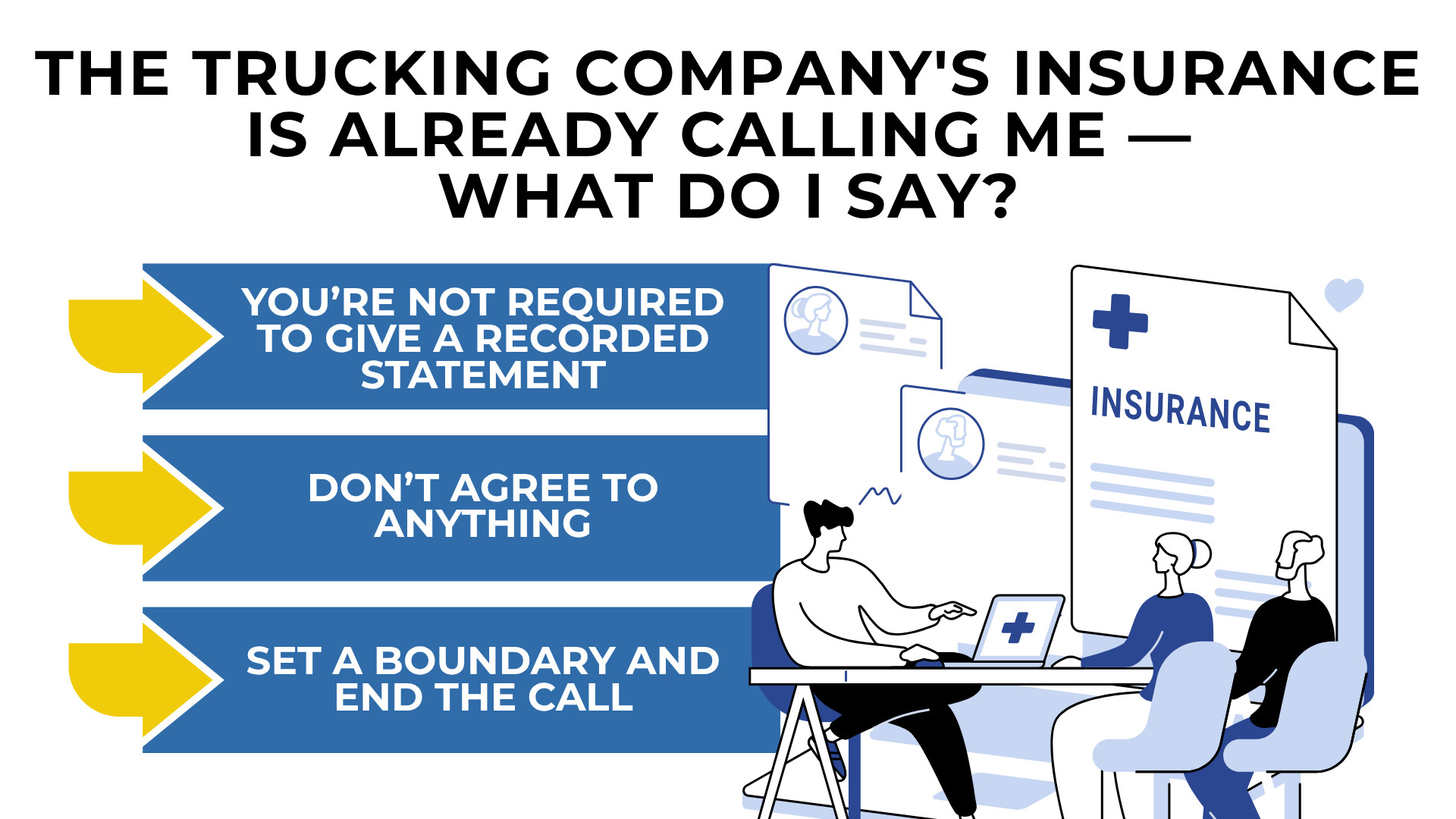
The trucking company’s insurer is not your insurer. Their job is to minimize what the company pays. An adjuster calling within days of a crash is typically trying to do one or more of three things. They want to get a recorded statement, get you to accept a quick settlement, or get a signed medical authorization that gives them broad access to your records.
Anything you say in a recorded statement can be replayed later and picked apart for inconsistencies — including innocent ones, like saying “I’m feeling better” on a good pain day. You are not required to give a recorded statement to the other party’s insurance company. A quick settlement offered in the first days or weeks is almost always priced before anyone knows the full extent of the injuries. Once signed, it ends your claim permanently, even if you need surgery six months later.
It is safe to confirm basic facts — your name, that you were involved, the date and location of the crash. It is not safe to describe your injuries, explain how the crash happened in detail, say who was at fault, or agree to anything. You can say, “I’m not prepared to give a statement or discuss settlement right now,” and end the call. That is not rude; it is standard.
If it helps to have a number to compare against, commercial trucks are required to carry much more insurance than passenger vehicles. Connecticut’s minimum liability coverage for a private vehicle is $25,000 per person / $50,000 per accident / $25,000 property damage under Conn. Gen. Stat. § 14-112. Under 49 CFR § 387.9, federally regulated interstate carriers generally must carry at least $750,000 for general non-hazardous freight, $1,000,000 for certain hazardous materials, and $5,000,000 for the most dangerous hazmat categories. The numbers on the other side of the table are big, which is part of why the defense is aggressive from day one.
Why is a truck accident different from a regular car accident?
This is the turning point, and understanding it changes how you approach every decision that follows.
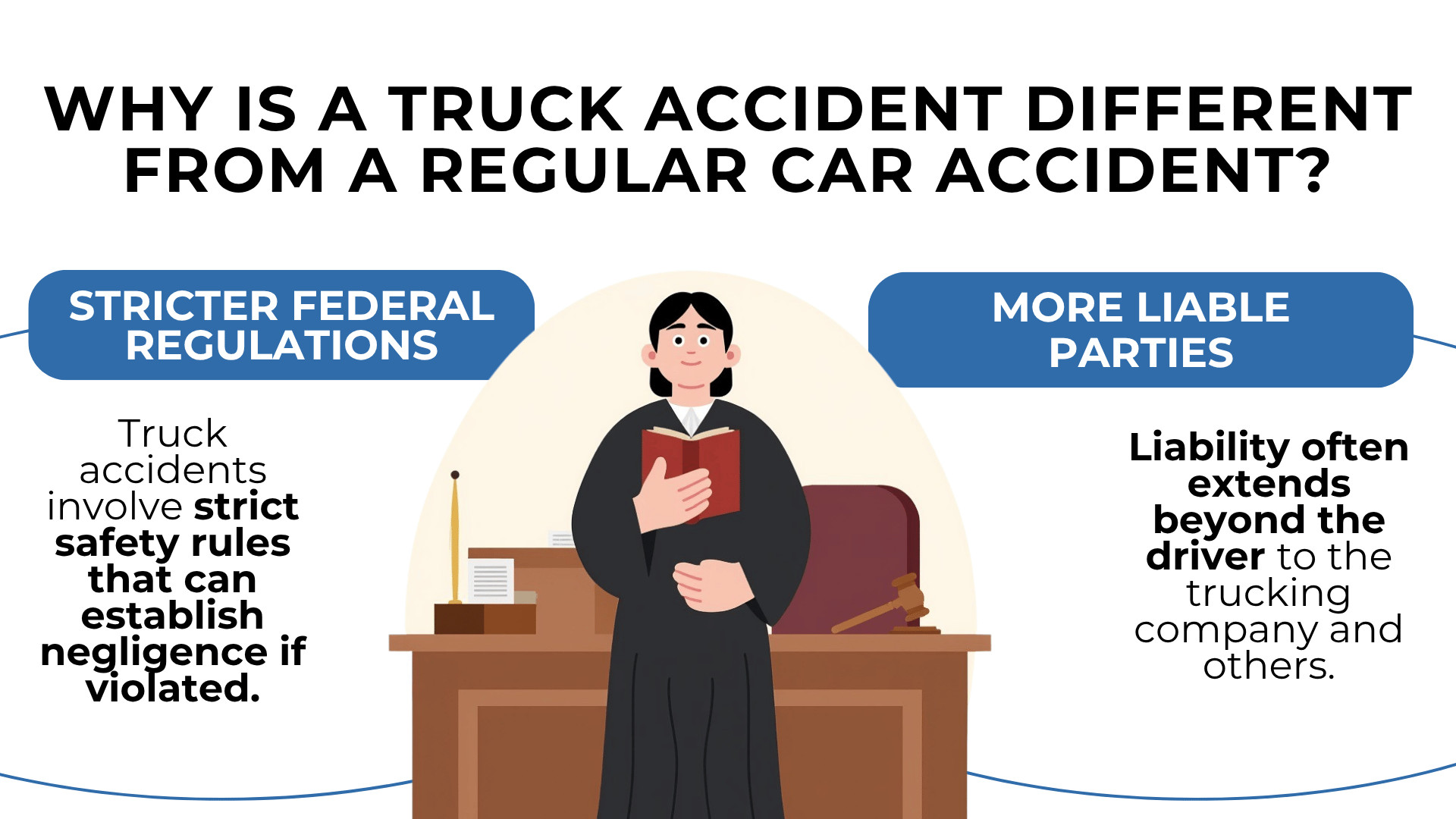
Commercial trucks operate inside a thick web of federal safety rules that passenger cars do not. Connecticut has adopted the Federal Motor Carrier Safety Regulations — 49 CFR Parts 382 through 397 — by statute under Conn. Gen. Stat. § 14-163c. That means the federal rules governing driver hours, logbooks, drug and alcohol testing, driver qualification, vehicle maintenance, and dozens of other requirements apply directly in a Connecticut state court case. Under Connecticut’s negligence per se doctrine, a violation of such a regulation can constitute negligence as a matter of law if (1) the plaintiff was within the class of persons the regulation was designed to protect, and (2) the harm suffered was of the type the regulation was designed to prevent. Where that threshold is met, the jury need only determine whether the violation occurred.
There are also more potentially responsible parties than in a typical car crash. Beyond the driver, the motor carrier that employs the driver can be liable under several separate legal theories. One is respondeat superior for the driver’s conduct within the course and scope of employment. The other is direct claims against the company itself for negligent hiring, training, supervision, or entrustment. Those claims turn on whether the carrier knew or should have known the employee or driver posed a risk. Connecticut also provides a rebuttable presumption under Conn. Gen. Stat. § 52-183 that when someone other than the owner is operating a vehicle, the operator is the owner’s agent and servant operating in the course of employment. The defendant bears the burden of rebutting the presumption.
And the numbers are not small. Connecticut recorded 1,607 large truck crashes in 2024, including 28 fatal crashes, 28 fatalities, and 723 injuries. Between 2022 and 2025, the state experienced 8,599 total large truck crashes resulting in 119 fatalities combined. Federal researchers have identified contributing factors in large truck crashes — brake defects in 29.4% of trucks studied, trucks traveling too fast for conditions in 22.9%, driver fatigue in 13%. All of these leave traces in the evidence, but only if someone goes and gets them.
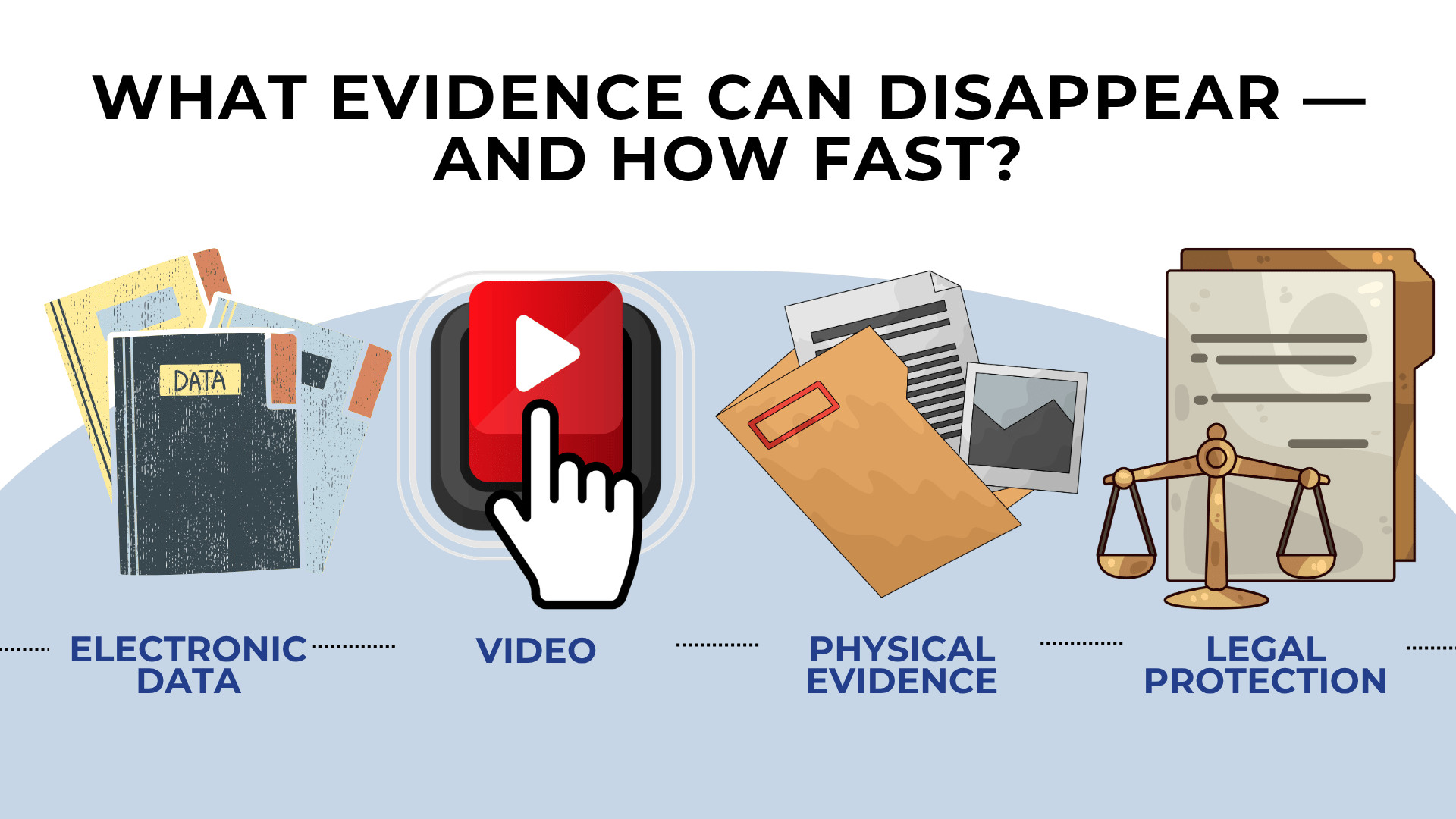
What evidence can disappear — and how fast?
Faster than most people think.
Commercial trucks generate a type of evidence that passenger cars don’t: electronic records. The engine control module (often called the “black box”) logs speed, braking, throttle position, and other data in the seconds before impact. Electronic logging devices (ELDs) required under 49 CFR § 395.8 record the driver’s hours of service. Dashcams, if installed, capture the moments before the crash. Dispatch records, GPS pings, maintenance logs, inspection reports, and driver qualification files all sit on company servers.
Federal rules require motor carriers to retain ELD records of duty status for six months under 49 CFR § 395.8(k). Dashcam loops can overwrite in days. The truck itself typically goes back on the road within weeks, often repaired, sometimes sold. Skid marks and debris on the roadway are gone after the next rain.
Connecticut does impose a common-law duty to preserve evidence once litigation is pending or reasonably anticipated, and that duty overrides the routine six-month retention window. Connecticut goes further than most states. In Rizzuto v. Davidson Ladders, Inc., 280 Conn. 225 (2006), the state’s Supreme Court recognized an independent tort of intentional spoliation. The trier of fact may also draw a permissive adverse inference from intentional spoliation that the destroyed evidence would have been unfavorable to the destroying party. But none of those protections kick in automatically. Someone — typically an attorney — has to send a formal preservation letter putting the carrier and its insurer on notice that specific categories of evidence must be held. The sooner that letter goes out, the more of the record survives.
This is the real reason the clock in a trucking case runs faster than the legal deadline suggests.
What should I be keeping track of myself?
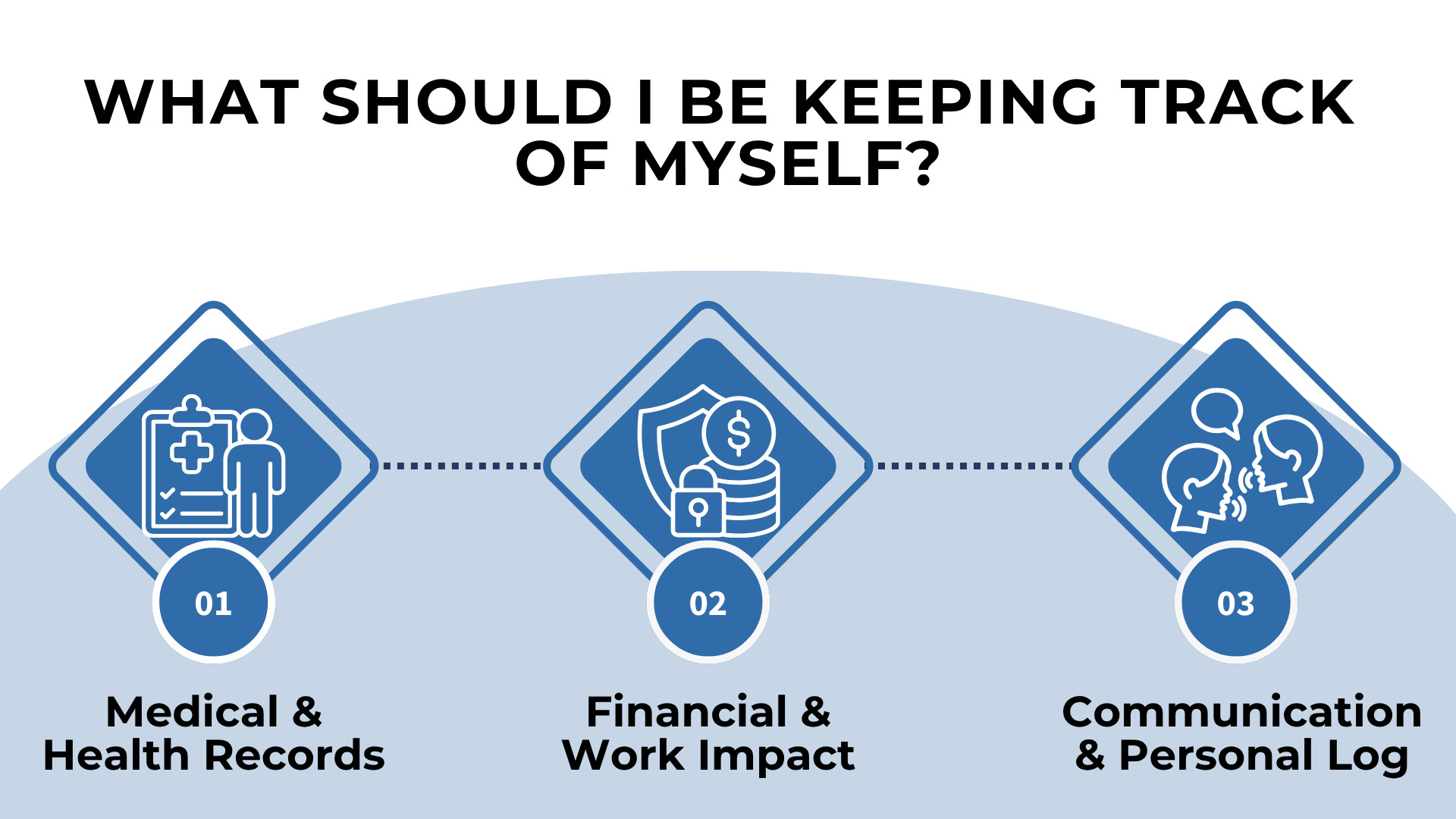
A simple file, paper or digital, that grows over time. You don’t need to organize it perfectly; you just need to not throw anything away.
Useful things to save or record:
- Every medical visit, every provider, every diagnosis, every prescription
- Symptoms as they develop or change, with dates — especially headaches, changes in thinking or focus, sleep problems, pain that moves or worsens
- All bills and insurance correspondence, including explanation-of-benefits statements
- Time missed from work, pay stubs before and after, any written note from your employer about lost hours or duties
- Mileage to and from medical appointments
- Out-of-pocket expenses: prescriptions, medical devices, parking, home help you had to hire
- Photographs of visible injuries over time, so the trajectory of healing is documented
- Every letter, email, voicemail, and business card from any insurance representative, whether yours or the trucking company’s
If you keep a phone-based journal of how you feel day to day, do it without exaggerating and without minimizing. The most credible record is the plain one.
How long do I have to take legal action in Connecticut?
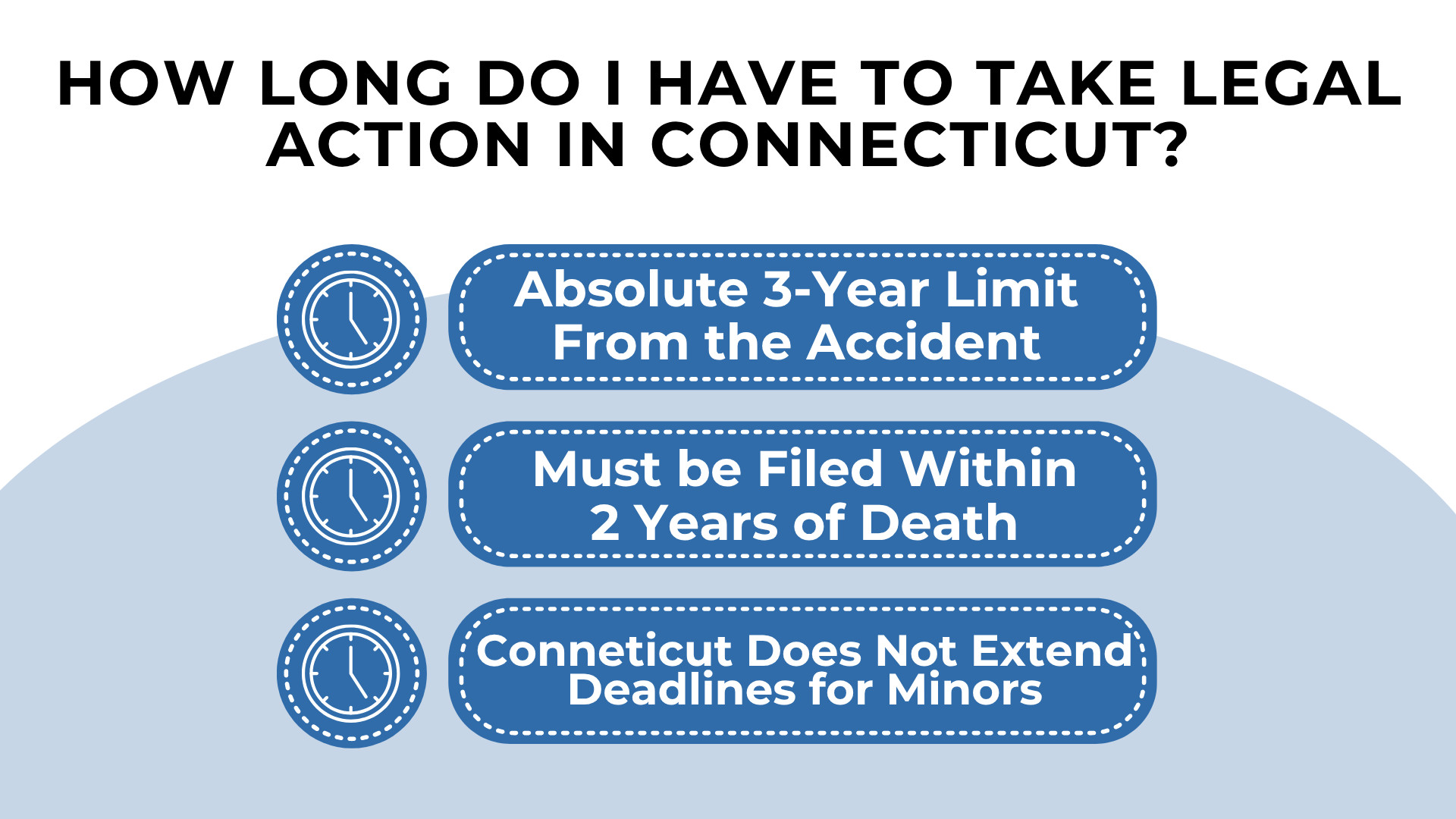
For most Connecticut personal injury claims arising from a motor vehicle crash, Conn. Gen. Stat. § 52-584 sets a two-year statute of limitations from the date the injury is first sustained, discovered, or in the exercise of reasonable care should have been discovered. That rule is subject to an absolute three-year statute of repose from the date of the act or omission. Wrongful death claims under Conn. Gen. Stat. § 52-555 must be brought within two years from the date of death and no more than five years from the date of the act or omission complained of.
Two points are worth flagging. First, Connecticut is notably the only state that does not toll the negligence statute of limitations for minors or incapacitated persons. Parents or guardians must bring claims on behalf of minors within the standard limitations period. Second, “two years” is misleading as a planning timeline. Long before the statute runs, ELD records may be gone, dashcams may have overwritten, witnesses may be unreachable, and the truck may be repaired and back in service. The meaningful deadline — the one that decides how strong a case can be built — is evidence preservation, which is measured in weeks and months, not years.
Do I actually need a lawyer for this?
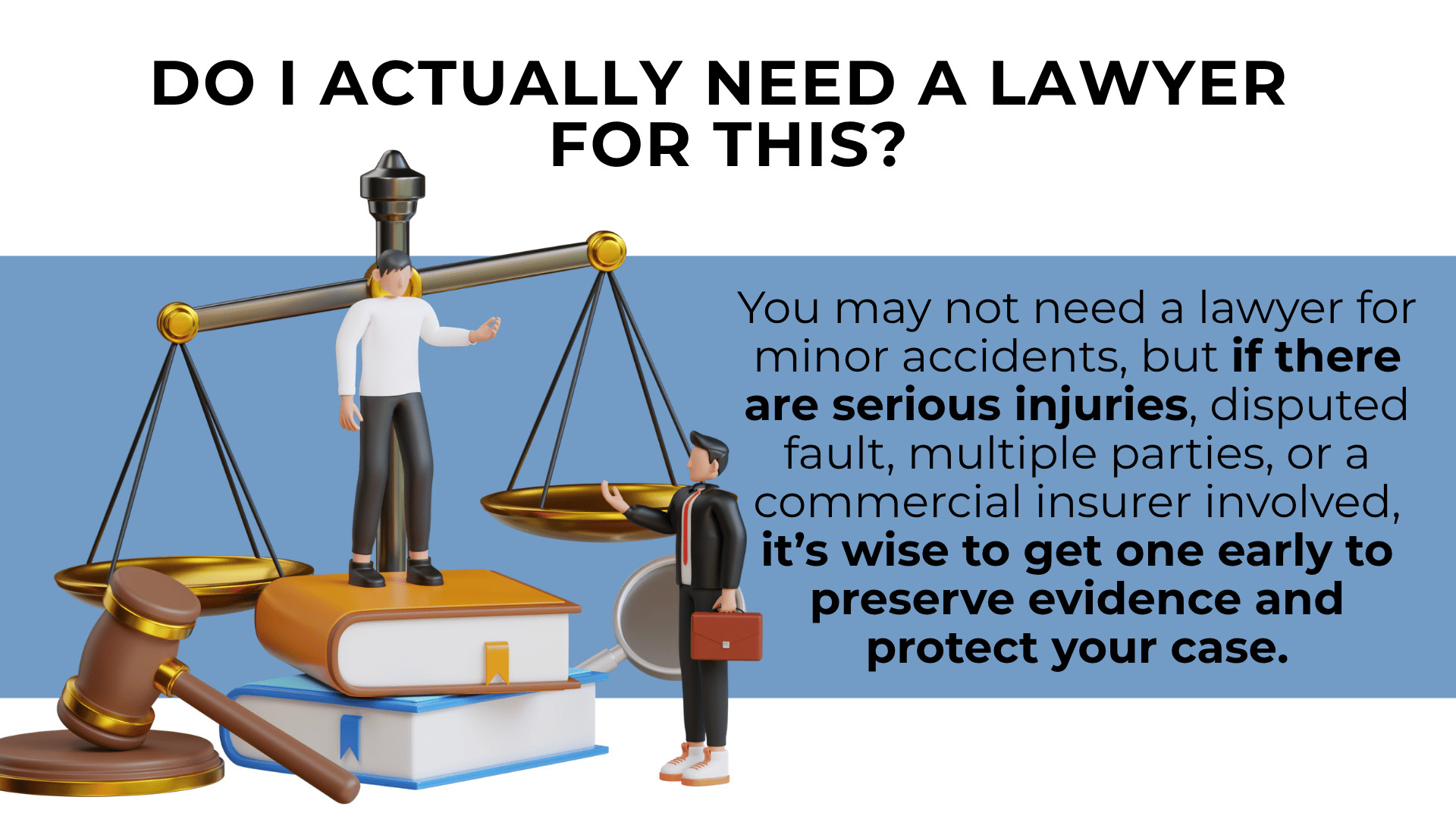
Not every collision requires one. A minor impact with minor injury and a cooperative insurer can sometimes be resolved without an attorney. The following factors, in combination or individually, are the honest signals that the situation has crossed that line:
- Any injury serious enough to require hospitalization, imaging beyond an initial ER visit, ongoing treatment, or missed work beyond a few days
- Any head injury, no matter how mild it seemed at first
- Disputed fault, or a police report that doesn’t match what you remember
- More than one potentially responsible party (driver, motor carrier, maintenance provider, cargo loader, another motorist)
- A commercial insurance policy on the other side — which is true in virtually every case involving a large truck
- The trucking company’s insurer pushing for a recorded statement, a quick settlement, or a broad medical authorization
- Any sign that records, the truck itself, or witnesses are becoming harder to access
What a lawyer does in the first days and weeks is not something you can do from a hospital bed or a couch. It includes sending formal preservation letters to the carrier and its insurer that put them on notice to hold specific evidence. It includes arranging for an investigator to photograph and measure the scene before it changes. It includes securing the truck for inspection before it is repaired or sold. It includes requesting driver qualification files, maintenance records, and ELD data under federal rules. And it includes handling all communication with insurers so nothing you say can be used against you later.
In a commercial trucking case, the evidence that determines what the case is worth starts disappearing almost immediately, and waiting has a real cost you can measure. If the situation feels bigger than a typical fender-bender, that intuition is usually correct — and the right time to get a professional opinion is earlier, not later. Etemi Law, a personal injury firm in Waterbury, Connecticut, handles commercial trucking accident cases; whichever firm you consider, ask about fees, consultation policy, and experience with trucking-specific evidence preservation before you commit.