What to Do After a Jackknife Truck Accident in Connecticut
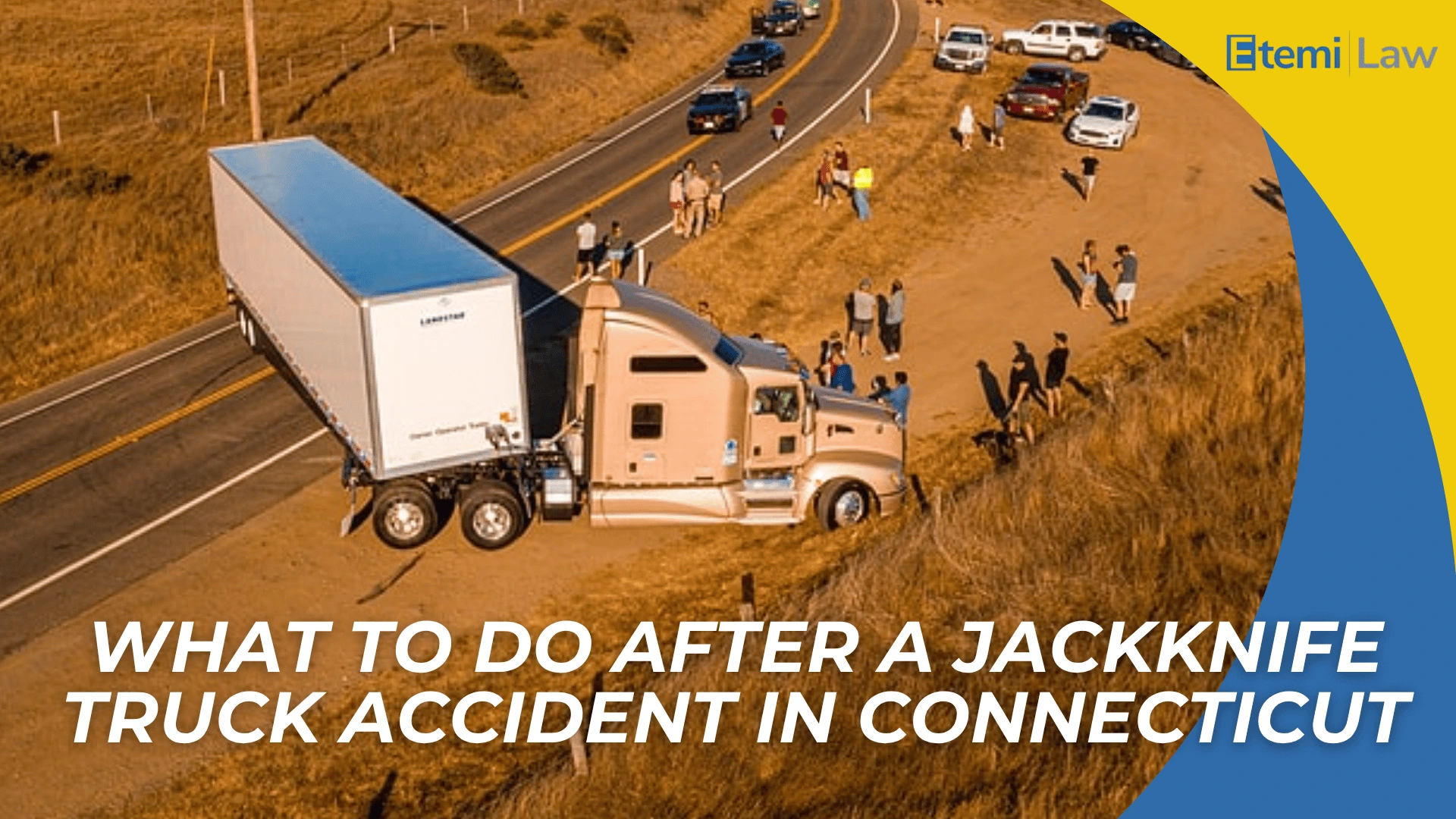
A jackknife truck accident happens when a semi-truck’s trailer swings out of alignment with the cab, folding the rig at its pivot point and sweeping across one or more lanes of traffic. If you or someone you care about was hit in one of these crashes, the driver or the trucking company likely did something wrong. You may have a claim worth significantly more than a typical car accident case.
This page walks through how jackknife accidents happen, what causes them, who can be held liable under Connecticut law, what kind of damages you can recover, and why acting quickly matters more in trucking cases than almost any other type of personal injury claim.
What actually happens when a truck jackknifes?
A tractor-trailer is two connected vehicles — the cab and the trailer — joined at a hitch point called the fifth wheel. When the drive wheels lose traction or the brakes lock unevenly, the trailer keeps moving forward while the cab slows or turns. The trailer swings outward like a closing pocket knife, and the rig folds in on itself, often sweeping across multiple lanes before it stops.
What makes this so dangerous is the sheer size difference. A fully loaded tractor-trailer can weigh 20 to 30 times as much as a passenger car. It also requires 20 to 40 percent more stopping distance. When 80,000 pounds of truck swings sideways across a highway, the people in surrounding cars absorb almost all of the force. Of the 5,472 people killed in large truck crashes nationally in 2023, 70% were occupants of other vehicles — not the truck.
These collisions are not fender-benders. They are high-force, multi-vehicle events that produce catastrophic injuries — and in most cases, someone’s negligence caused them.
Why do trucks jackknife, and why does the cause matter for your case?
Trucks don’t jackknife randomly. Nearly every jackknife accident traces back to a specific human decision or maintenance failure. Under Connecticut law, that distinction is what separates a bad day from a viable legal claim.
The most common causes include speeding for conditions, defective or poorly maintained brakes, driver fatigue, and improper braking technique. The federal data on each of these is striking.
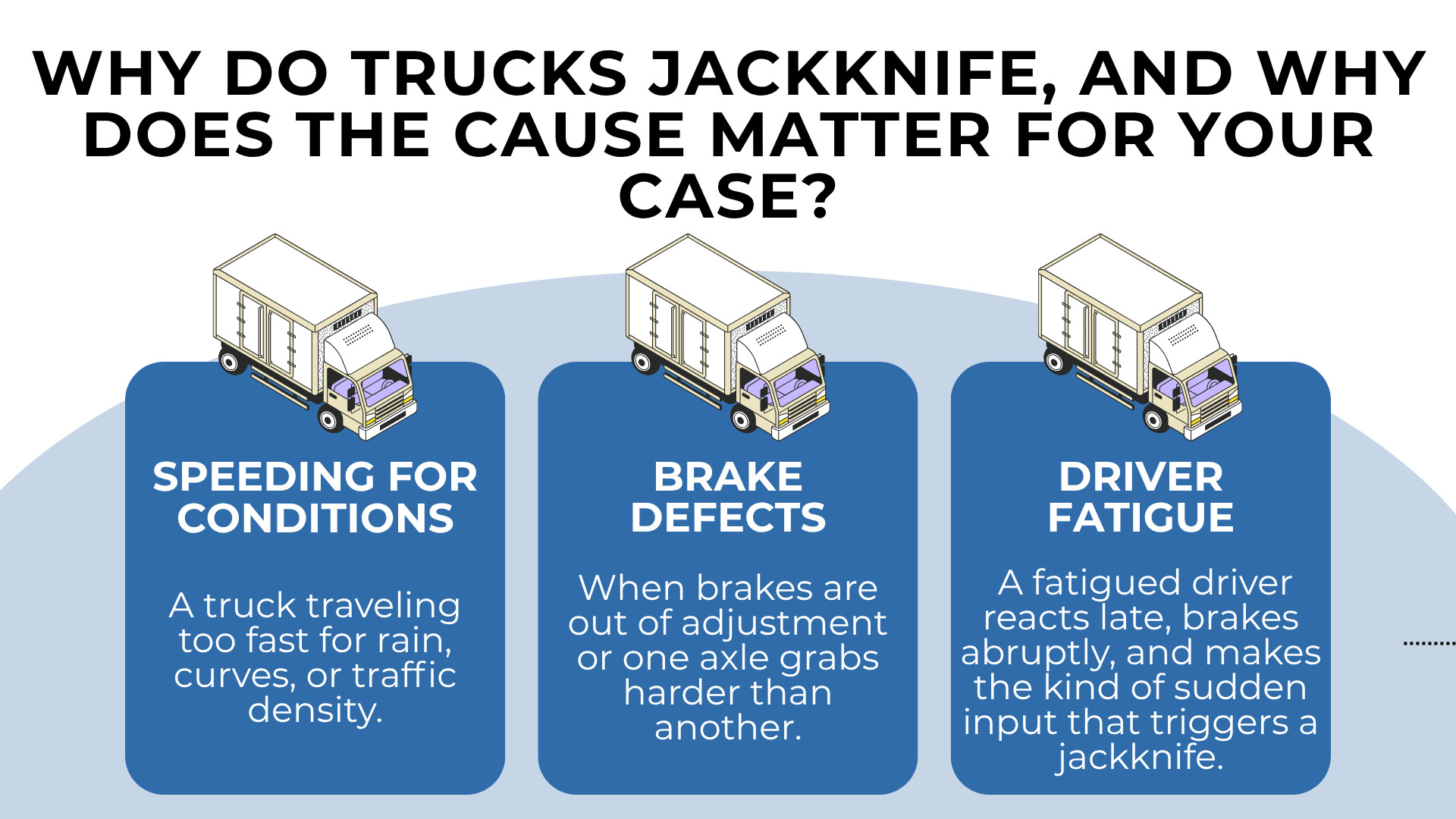
Speeding for conditions was coded as a factor in 22.9 percent of large trucks involved in crashes studied in the federal Large Truck Crash Causation Study — nearly one in four. A truck traveling too fast for rain, curves, or traffic density is far more likely to lose traction and jackknife when the driver brakes hard.
Brake defects appeared in 29.4 percent of crash-involved trucks in that same study — the single most common vehicle problem. And the issue persists today: during the 2024 CVSA International Roadcheck, brake defects accounted for 25 percent of all vehicle violations across North America. When brakes are out of adjustment or one axle grabs harder than another, uneven stopping force is exactly what causes a trailer to swing.
Driver fatigue was identified in 13 percent of crash-involved truck drivers. Federal hours-of-service rules exist specifically to prevent this. Under 49 CFR § 395.3, a driver cannot drive more than 11 hours within a 14-hour on-duty window after 10 consecutive hours off duty. A fatigued driver reacts late, brakes abruptly, and makes the kind of sudden input that triggers a jackknife.
Here is why these causes matter legally. Connecticut has adopted the Federal Motor Carrier Safety Regulations as state law through Conn. Gen. Stat. § 14-163c. That means a trucking company or driver who violates federal rules on braking, speed, hours of service, or vehicle maintenance has violated Connecticut law. Under Connecticut’s negligence per se doctrine, a regulatory violation counts as negligence as a matter of law when two conditions are met. The injured person must be within the class the regulation was designed to protect. And the harm must be the type the regulation was designed to prevent. As the Connecticut Supreme Court held in Gore v. People’s Savings Bank, 235 Conn. 360 (1995), the jury in a negligence per se case does not need to decide whether the defendant acted reasonably — only whether the violation occurred. If it did, the defendant was negligent as a matter of law.
In practical terms, this means that if a truck driver violated hours-of-service limits before jackknifing into your vehicle, that violation alone can establish negligence. Your attorney does not need to prove the driver was subjectively careless — just that the rule was broken and the crash followed.
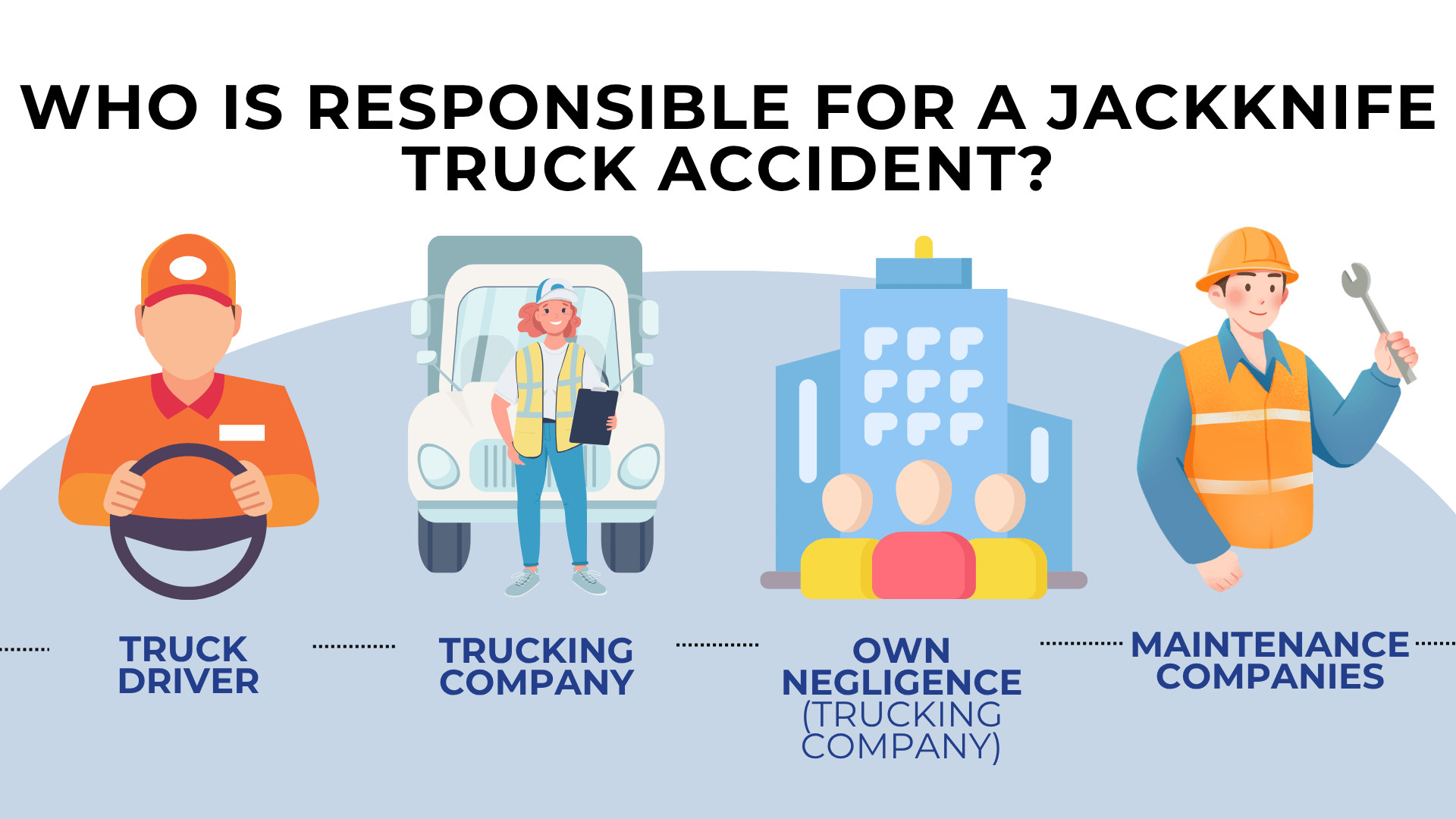
Who is responsible for a jackknife truck accident?
One of the most important things to understand about a jackknife truck accident claim is that liability rarely stops with the driver. Multiple parties may share legal responsibility, and identifying all of them is critical because it expands both accountability and available insurance coverage.
The truck driver. If the driver was speeding, fatigued, violating hours-of-service rules, or failed to brake properly for conditions, they are directly liable for negligence. A violation of any adopted federal regulation can establish that negligence as a matter of law under the rule described above.
The trucking company. Under Connecticut’s respondeat superior doctrine, employers are vicariously liable for the negligent acts of employees committed within the course and scope of employment. The Connecticut Supreme Court affirmed this principle in Jagger v. Mohawk Mountain Ski Area, Inc., 269 Conn. 672 (2004). Connecticut law goes a step further. Conn. Gen. Stat. § 52-183 creates a rebuttable presumption that the operator of an owner’s vehicle is the owner’s agent acting in the course of employment. The trucking company bears the burden of proving otherwise.
Even when a trucking company classifies its driver as an independent contractor, that label is not necessarily the final word. Under the federal definition in 49 CFR § 390.5, a driver operating under a carrier’s authority can be treated as the carrier’s employee for liability purposes regardless of the contractual label.
The trucking company’s own negligence. Connecticut also recognizes direct claims against the carrier for negligent hiring, training, supervision, and entrustment — independent of vicarious liability. Seguro v. Cummiskey, 82 Conn. App. 186 (2004). In a jackknife case, this means asking whether the company hired a driver with a known history of violations, failed to train drivers on proper braking technique for loaded trailers, or neglected to maintain its fleet’s brake systems. Each of those failures is the company’s own negligence, separate from whatever the driver did on the road.
Maintenance companies. If a third-party shop serviced the truck’s brakes or inspected the rig and missed a defect that contributed to the jackknife, that company may also bear a share of responsibility.
Federal law requires interstate carriers to maintain at least $750,000 in liability insurance under 49 CFR § 387.9, with higher minimums for hazardous materials. Identifying every responsible party means accessing every applicable policy.
What injuries do jackknife accidents cause?
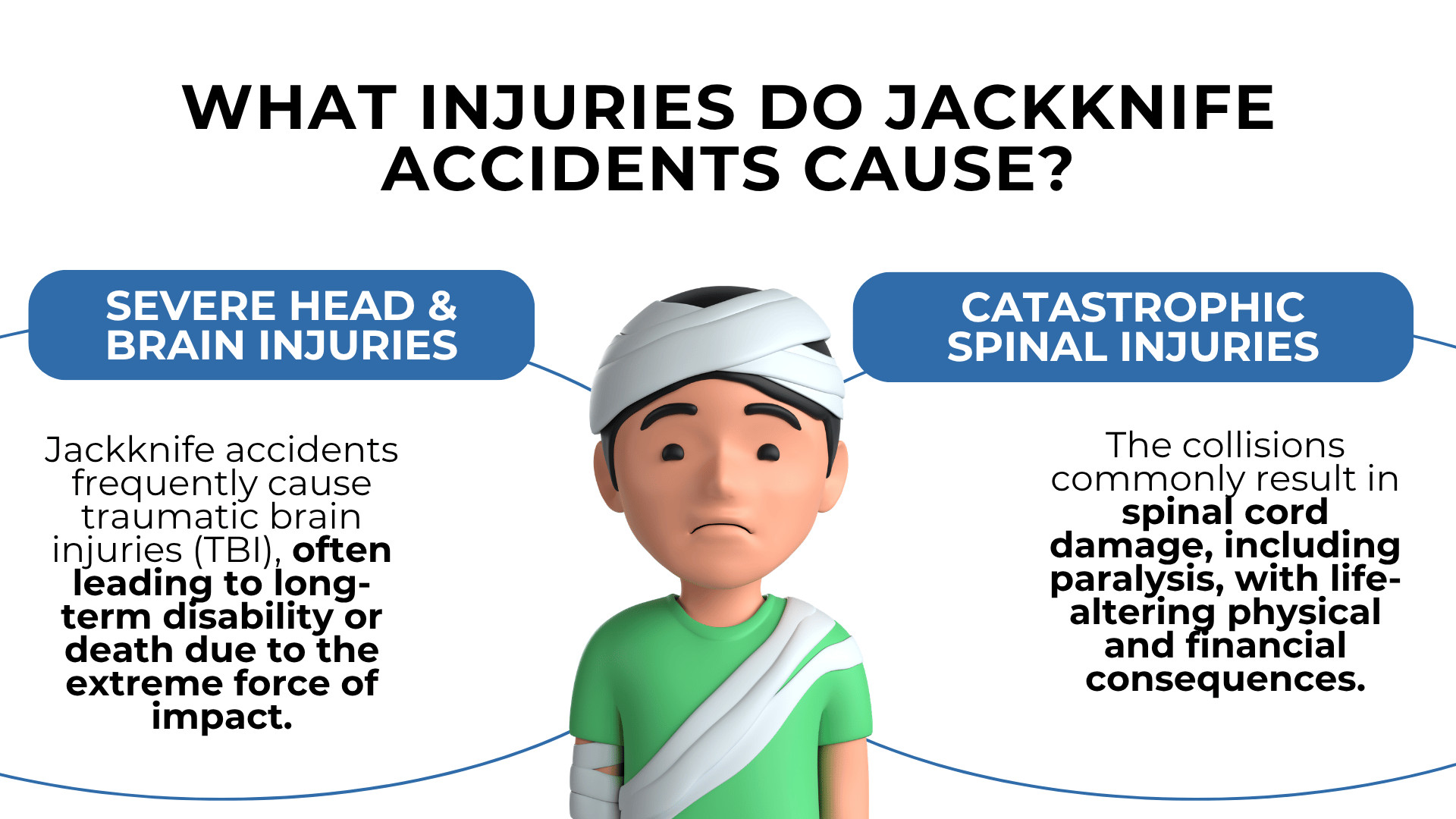
The force involved in a jackknife collision — tens of thousands of pounds of truck and trailer sweeping across traffic lanes — produces injuries that are far more severe than a typical car accident.
Traumatic brain injury is among the most common and most devastating. Motor vehicle crashes account for approximately 17 percent of all TBI-related deaths in the United States. They also cause roughly 24.5 percent of all TBI-related hospitalizations. An estimated 5.3 million Americans live with permanent TBI-related disability, and the total economic cost of TBI has been estimated at $76.5 billion.
Spinal cord injuries are equally catastrophic. Motor vehicle crashes are the number one cause of traumatic spinal cord injuries, accounting for 38 percent of all new cases. The financial toll is staggering: first-year healthcare costs for a survivor with high tetraplegia average $1,446,827, with $251,246 each subsequent year. Lifetime costs for a 25-year-old with high tetraplegia can reach approximately $6.4 million.
These numbers matter for your case because Connecticut allows full recovery for both economic and non-economic damages with no statutory cap. The severity of injuries from a jackknife accident is not just a medical reality — it directly determines the value of your legal claim. Early and thorough medical documentation establishes the foundation for that claim.
What evidence disappears if you wait?
Trucking accident cases are different from car accident cases in one critical respect: the most important evidence has a short shelf life.
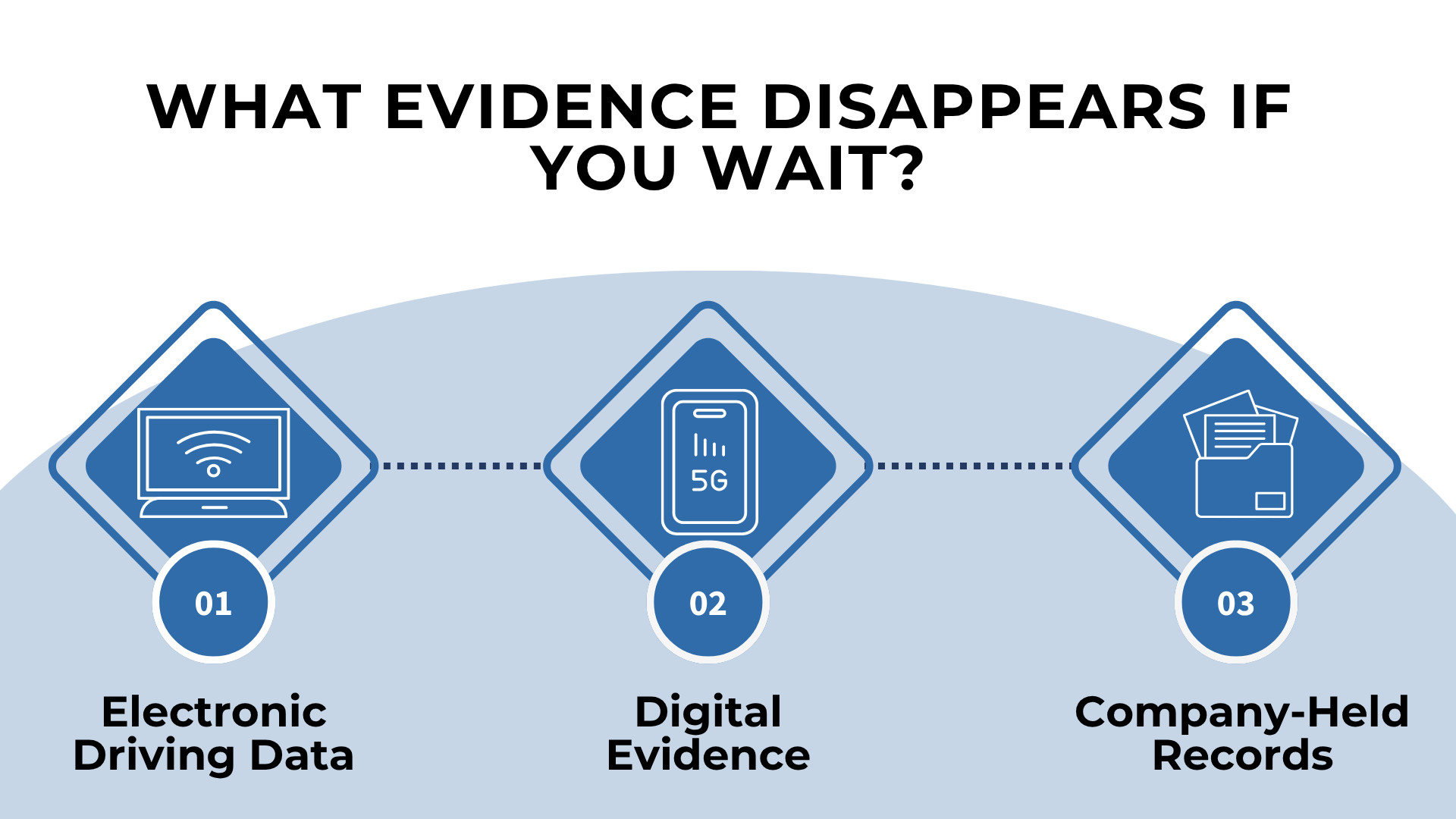
Federal law requires motor carriers to retain electronic logging device records for only six months from the date of receipt under 49 CFR § 395.8(k). Event data recorder (“black box”) information, dashcam footage, GPS tracking data, and dispatch communications may be overwritten even sooner depending on the carrier’s systems. Driver qualification files, pre-trip inspection logs, and brake maintenance records are all in the trucking company’s possession — not yours.
Connecticut law takes evidence preservation seriously. The state imposes a common-law duty to preserve evidence when litigation is pending or reasonably anticipated. The jury may draw a permissive adverse inference from intentional destruction of evidence — meaning the jury can be told to assume the destroyed evidence would have helped your case. The Connecticut Supreme Court established this standard in Beers v. Bayliner Marine Corp., 236 Conn. 769 (1996).
Connecticut goes further than most states. In Rizzuto v. Davidson Ladders, Inc., 280 Conn. 225 (2006), the Supreme Court recognized an independent tort of intentional spoliation. That means a party that deliberately destroys evidence to disrupt your case can be held separately liable for the damages caused by that destruction. Federal regulations also specifically prohibit the alteration or erasure of original ELD data under 49 CFR § 395.30(f).
Here is the practical takeaway. One of the first things a trucking accident attorney does after taking your case is send a spoliation preservation letter to the carrier, the driver, and any maintenance companies. That letter demands that all electronic data, inspection records, and communications be preserved immediately. Every week that passes without that letter increases the risk that something critical gets overwritten or discarded.
How long do you have to file a claim in Connecticut?
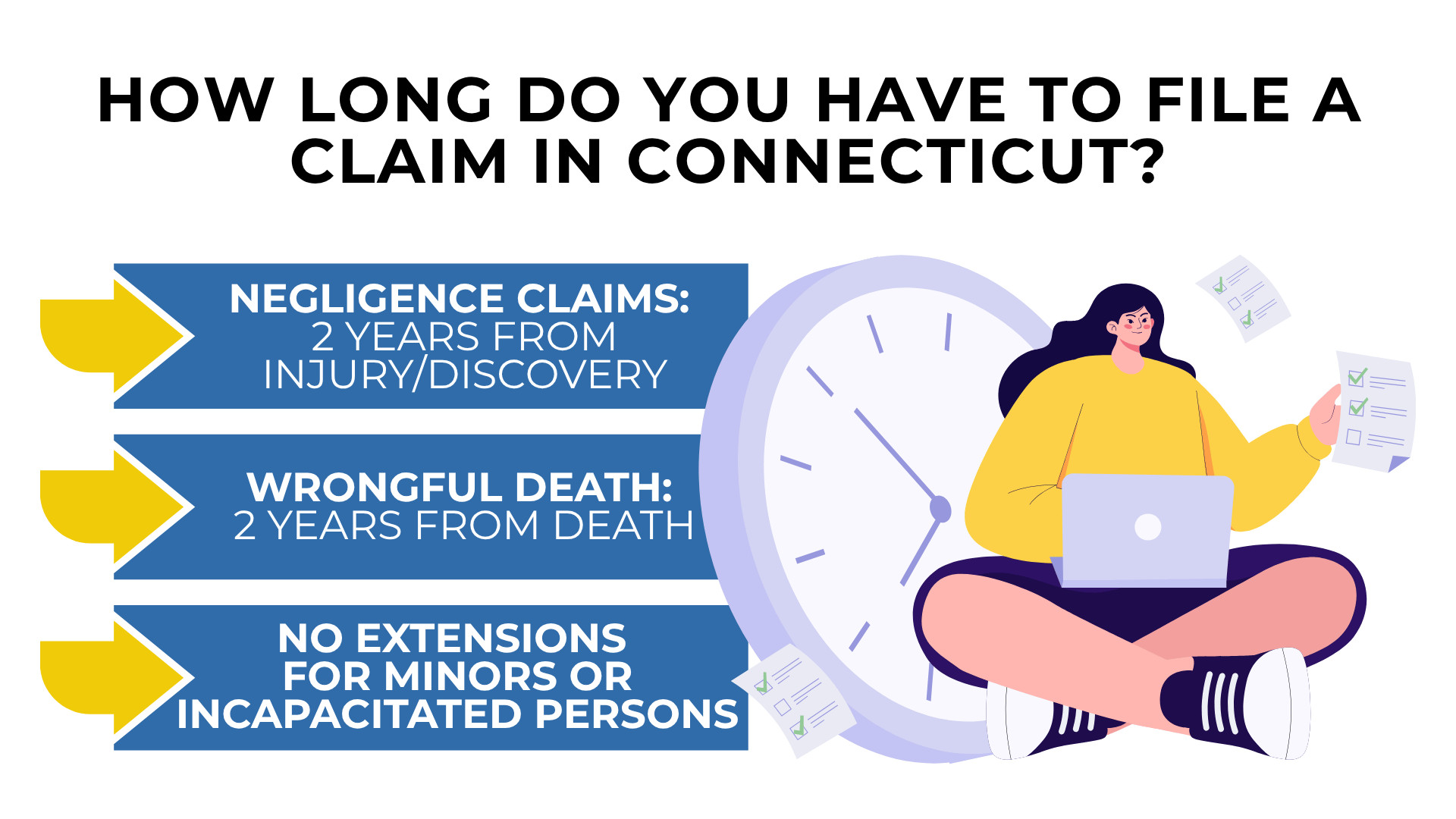
Connecticut imposes a two-year statute of limitations for negligence claims under Conn. Gen. Stat. § 52-584, running from the date the injury is first sustained or discovered. There is also an absolute three-year statute of repose from the date of the act or omission. This is a hard deadline that cannot be extended even if the injury was not yet discoverable. The Connecticut Supreme Court confirmed the absolute nature of this repose period in McDonald v. Haynes Medical Laboratory, Inc., 192 Conn. 327 (1984).
For wrongful death, the timeline is governed by Conn. Gen. Stat. § 52-555: the action must be brought within two years from the date of death and no more than five years from the date of the act or omission.
Connecticut is the only state that does not toll the negligence statute of limitations for minors. If a child was injured, parents or guardians must act within the standard two-year window — no extension applies.
What can you recover after a jackknife truck accident?
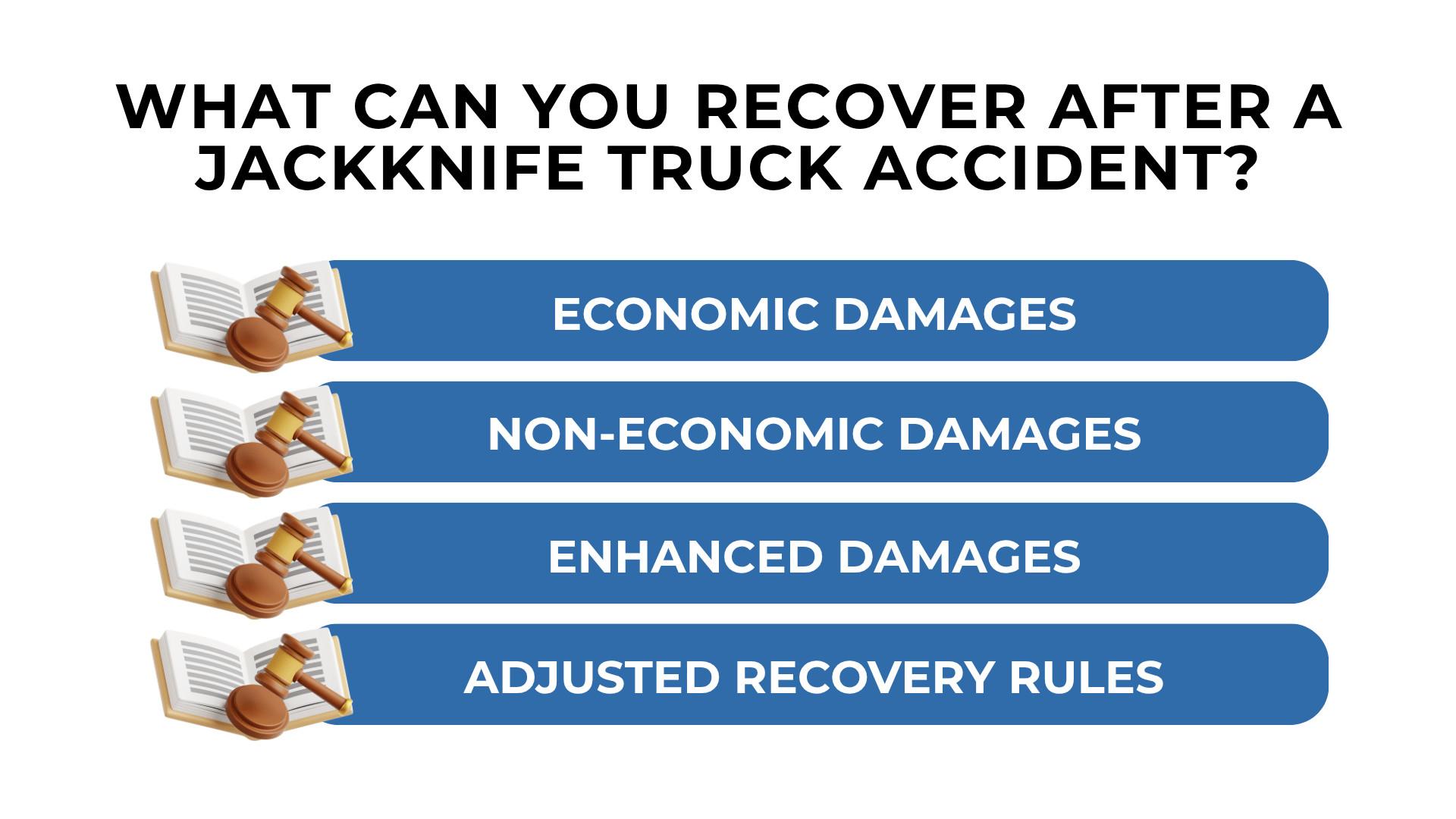
Connecticut allows you to recover both economic damages — medical expenses, lost wages, future care costs, and lost earning capacity — and non-economic damages, including physical pain and suffering and mental and emotional suffering. There is no statutory cap on either category.
Each defendant in a Connecticut negligence case is liable for their proportionate share of damages under Conn. Gen. Stat. § 52-572h. But when a truck driver’s conduct crosses from negligence into recklessness, the picture changes significantly. Conn. Gen. Stat. § 14-295 authorizes double or treble damages when a party deliberately or with reckless disregard violated specified traffic statutes and that violation was a substantial factor in causing injury, death, or property damage. This must be specifically pleaded, but it can dramatically increase recovery in cases involving extreme conduct like falsified logs or extreme speeding.
It is also worth understanding that Connecticut’s common-law punitive damages are limited to the plaintiff’s litigation costs — attorney’s fees and nontaxable expenses — as the Supreme Court held in Bodner v. United Services Auto. Ass’n, 222 Conn. 480 (1992). The statutory treble damages under § 14-295 are the main path to punitive recovery in motor vehicle cases.
One important rule to know: Connecticut follows a modified comparative negligence system. Under Conn. Gen. Stat. § 52-572h, if you are found to be 50 percent or more at fault, your recovery is completely barred. If you are less than 50 percent at fault, your damages are reduced by your percentage of responsibility. Trucking companies and their insurers routinely attempt to shift blame to you — arguing you were following too closely, changing lanes, or not paying attention. Having an attorney who understands these rules and knows how to counter those arguments is essential to protecting your recovery.
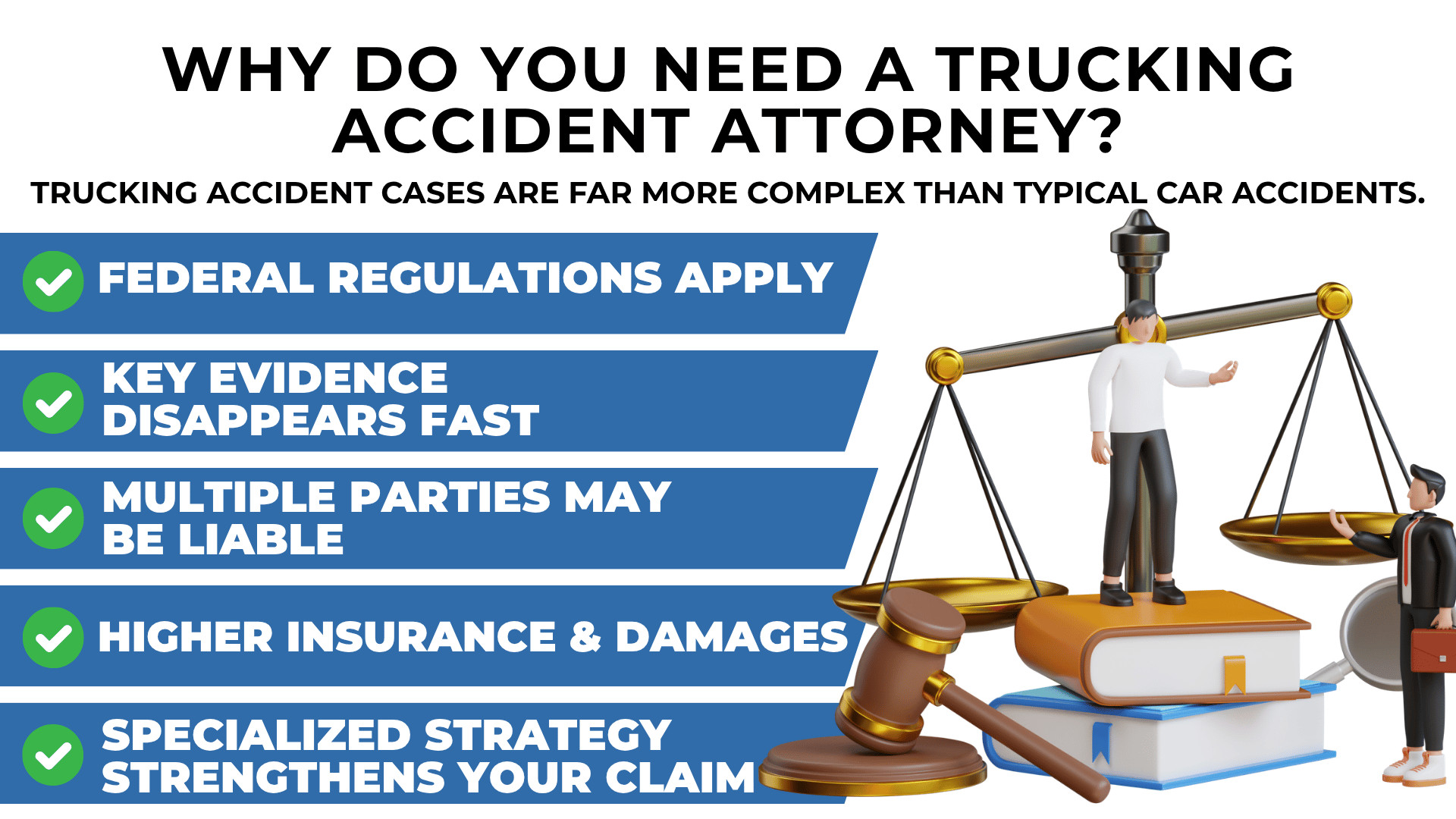
Why do you need a trucking accident attorney?
A jackknife truck accident is not a standard car accident case. The regulatory framework is federal. The evidence is electronic and short-lived. The liable parties may include the driver, the carrier, and maintenance providers spread across multiple states. The insurance minimums start at $750,000 and the damages often run into the millions.
What a trucking accident attorney does that a general personal injury lawyer may not:
- Send immediate spoliation preservation demands before ELD and black box data are overwritten.
- Obtain the carrier’s federal safety records and compliance history.
- Identify every federal regulation that was violated and frame those violations as negligence per se under Connecticut law.
- Pursue all liable parties — not just the driver who was behind the wheel.
At Etemi Law in Waterbury, Connecticut, our attorneys handle commercial trucking accident cases with the depth these claims require. Ron Etemi has tried over 100 cases to verdict and has received the Top Verdict Award. Peter Brown has 175 jury verdicts and spent his first 15 years in practice as one of Connecticut’s most respected civil defense trial lawyers — meaning he knows how the other side thinks. Lou Etemi and Semir Dervisi bring aggressive negotiation and detail-oriented case strategy to every stage of the process, from the first preservation letter through trial.
If you or someone in your family was injured in a jackknife truck accident in Connecticut, the evidence window is narrow and the deadlines are real. Contact Etemi Law for a free consultation. We will review what happened, identify who is responsible, and tell you whether you have a case — before anything critical disappears.